Author: Mike Vizard

  • CA, IBM Partner to Drive DevOps on the Mainframe

    CA, IBM Partner to Drive DevOps on the Mainframe

    CA Technologies and IBM announced today at the Built to Change Summit they are combining their tools and platforms to bring DevOps process to mainframe environments.

    The two companies are extending their existing relationship to include a partnership to jointly develop and sell new services for IBM’s Cloud Managed Services on z Systems (zCloud). Included in that effort is CA Brightside, a platform for bringing DevOps processes to mainframes using existing open source tools and frameworks such as Jenkins, Gradle and IntelliJ via a command line interface and CA Mainframe Resource Intelligence, a software-as-a-service (SaaS) application for monitoring consumption of mainframe resources.

    Other managed services will be based on CA Service Virtualization software for rapidly testing and modifying applications in place; CA Mainframe Operational Intelligence to monitor applications; and CA Data Content Discovery to find, classify and protect data.

    The services are available today to all IBM Managed Cloud Services for z Systems clients in North America and will then be rolled out globally throughout the rest of 2018.

    Greg Lotko, general manager for mainframe at CA Technologies, said that although CA Technologies competes with IBM when it comes mainframe software, it has a vested interest in making sure mainframes stay relevant at a time when organizations are looking to replace less agile forms of application development that use waterfall and ITIL processes with DevOps methodologies that speed application development. From a practical perspective, end customers are demanding that CA Technologies and IBM work more closely together, he said.

    Barry Becker, vice president of hybrid cloud services for IBM, added that as the line between mainframes and distributed applications continues to blur, it’s clear organizations want to be able to treat mainframes as back-end platforms that make a wide variety of enterprise data available to those applications. That need is driving many those organizations to extend DevOps processes to mainframes.

    Historically, competition for control over application workloads within internal IT organizations between mainframe advocates and proponents of distributed computing  has tended to be fierce. But Becker said that as digital business transformation gains traction, there’s now a greater appreciation for the need to leverage transaction processing and big data applications that are widely deployed on mainframes. Not only is it not practical to rewrite all those applications, he noted, applications running on mainframes are more secure. The creates the need to extend out to the mainframe the DevOps processes that are being used to build distributed applications, he said.

    Zealotry that tends to focus on the merits of one platform above all others is usually counterproductive. The rise of DevOps presents organizations with an opportunity to bridge a divide within their organizations that, in some cases, is decades old. Of course, mainframe proponents are not likely to abandon waterfall and IT methodologies overnight. But DevOps processes can mainframe environments a lot more agile at a time when senior business and IT leaders are now judging the merits of one platform versus another increasingly on how flexible it allows the business to become.


    — Mike Vizard

  • Microsoft Is Acquiring GitHub for $7.5B, Becomes Steward of Leading Open Source Repository

    Microsoft Is Acquiring GitHub for $7.5B, Becomes Steward of Leading Open Source Repository

    As part of its effort to get even closer to the developer community, Microsoft is acquiring GitHub for $7.5 billion. GitHub controls the open source repository that is at the center of millions of DevOps processes and is home to up to 28 million developers worldwide.

    Microsoft CEO Satya Nadella said GitHub will remain an open platform that developers will be able to employ for any programming language to deploy software anywhere. As part of that commitment, GitHub will continue to operate as a Microsoft business unit led by Microsoft Corporate Vice President Nat Friedman, founder of Xamarin who will assume the role of GitHub CEO. Current GitHub CEO, Chris Wanstrath, will become a Microsoft technical fellow, reporting to Executive Vice President Scott Guthrie. Wanstrath previously announced his intention to step down as the CEO of GitHub. The deal is expected to close before the end of this calendar year.

    Nadella said Microsoft is committed to acting as a steward for GitHub rather than making the open source repository an element of the application development business unit.

    Microsoft recognizes that GitHub is the platform through which millions of developers now collaborate, said Nadella. Acquiring GitHub presents the company with an opportunity to get closer to the developer community by providing both the platform they collaborate on as well as the tools many of them rely on to build applications. That’s critical now because as more organizations transform into software companies, those organizations are pouring more resources into application development and workflows than ever, Nadella said.

    Friedman said GitHub will focus on making it easier for cloud service providers to plug their platforms into GitHub, adding Microsoft is also committing to making all its application development tools available on the GitHub marketplace. The company also will make GitHub services available via its direct sales and reseller channel.

    It’s unclear yet how the open source community that relies on GitHub will react to the stewardship of Microsoft. There are plenty of smaller repository options that might benefit from developers deciding to shift their allegiance. Microsoft clearly is aware of the potential downside, which helps account for why Friedman is stressing that any effort to make it simple to integrate GitHub with cloud services would apply to all services, not just Azure. At the same time, however, given its long history of delivering application development tools, there’s probably a deeper appreciation for how GitHub plays to a Microsoft customer base that counts developers as its largest segment.

    On the plus side, Microsoft will become a much bigger advocate for application development based on open source code. The company steadily has been making large swaths of its application development tools available as open source code. Less clear is to what degree it will be willing to embrace open source across its entire portfolio. With more than 2 million commits made to GitHub a year, Microsoft claims to be the largest contributor to GitHub.

    The challenge from a DevOps perspective, however, is not the repository employed to house code, but rather how well that repository fits into a larger continuous integration/continuous deployment (CI/CD) environment.

    — Mike Vizard

  • HPE Extends IT Management Reach with OneSphere

    HPE Extends IT Management Reach with OneSphere

    Hewlett-Packard Enterprise (HPE) today extended OneSphere, the software-as-a-service (SaaS) platform for IT management, to include support for Microsoft Azure public clouds and the Kernel-based virtual machine (KVM) that serve as the foundation for OpenStack.

    At the same time, HPE announced an update to HPE OneView, a platform for managing IT that can be deployed on-premises or in a public cloud, which makes it easier to manage farms of virtual machines. In addition, version 4.1 of HPE OneView adds support for Microsoft Azure Log Analytics and VMware vRealize Orchestrator, as well as reference configurations for Chef automation software and architecture for Red Hat OpenShift Container Platform deployed on top of HPE Synergy, a software-defined infrastructure (SDI) platform.

    HPE today also revealed it has sold its one-millionth license for HPE OneView, which it launched four years ago. HPE OneSphere was launched as a suite of SaaS applications earlier this year.

    Paul Miller, vice president of marketing for the Software-Defined Cloud Group at HPE, said the bulk for the HPE OneView licenses HPE sold occurred in the last 12 months as organizations realize they need to modernize how IT is managed as they build, deploy and manage their own private clouds. A big reason for increased adoption of HPE OneView is preference for an open platform that is extensible using application programming interfaces (APIs), he said.

    Miller said HPE is a bifurcated approach to IT management to give IT organizations the ability to modernize IT in keeping with best DevOps practices, either by continuing to deploy an IT management platform themselves or shift to a cloud service.

    In general, Miller said increased diversity in IT environments requires a different approach to managing enterprise IT, which now spans multiple public clouds and on-premises IT environments consisting of both virtual machines and physical servers. There’s a lot more focus on creating a consistent approach to managing IT in way that is seamless across people and processes, said Miller.

    Making things even more challenging is the rise of containers, which today run primarily run on virtual machines but increasingly will show up on physical servers as well, once IT organizations master the skillsets needed to manage containers wherever they wind up being deployed, Miller said.

    Miller also noted that organizations are finding that complying with a wide variety of regulations, such as the General Data Protection Rule (GDPR), are also forcing organizations to revisit how IT is managed.

    Many IT organizations are at a crossroads when it comes to IT management. Taking advantage of SaaS applications is often an attractive option because the whole process of updating IT management frameworks is eliminated, along with the need to provision the hardware an IT management application requires. But many organizations still prefer to be able to customize their IT management frameworks in addition to contending with compliance rules that require them to deploy management software in a way they control directly.

    HPE clearly wants to remain relevant to IT organizations regardless of the IT management path chosen. The challenge facing those organizations now is making a decision that is likely to dictate how enterprise IT will be managed well into the next decade.

    — Mike Vizard

  • Eggplant Extends Scope of AI Applied to Application Testing

    Eggplant Extends Scope of AI Applied to Application Testing

    Reliance on machine learning algorithms and other forms of artificial intelligence (AI) to not just run application tests at scale  but actually construct them may be about to increase.

    The latest release of a Digital Automation Intelligence (DAI) Suite from Eggplant enhances the AI capabilities baked into the testing tool to include the capture and analysis of runtime performance data in a way that enables a testing process to “learn” where potential bottlenecks are hidden. Eggplant CTO Antony Edwards said DAI Suite will then suggest a series of tests designed to make it easier for developers to identify the root cause of the problem.

    The goal is to reduce reliance on humans to construct formulaic tests, which Edwards said often limits the rate at which applications can be deployed and updated.

    Eggplant’s DAI Suite

    Other new capabilities being added to DAI Suite include enhancements to Eggplant Functional, which now takes advantage of AI to discover the elements of a graphical user interface (GUI) to automatically populate the automation logic in an Eggplant AI application model. Eggplant Performance, a load and performance testing product, has been integrated with JMeter, an open source performance testing framework, to enable developers and testers to reuse JMeter assets as well as creating load test scripts. Additionally, new real-time key performance indicators (KPIs) can be employed to shorten the feedback loop between testing and analysis.

    Both Eggplant Manager and Eggplant Automation Cloud are now 10 times faster and provide higher levels of testing scalability, according to the company.

    Edwards noted that, in general, application testing is too formulaic. The end goal should be on identifying the best way to delight an end user rather than merely trying to check a compliance box. That requires being able to test more application use cases at scale without slowing down the overall application development life cycle. In fact, he said the biggest hindrance to DevOps today is a reliance on manual testing processes that are driving a $32 billion testing services sector.

    It’s now only a matter of time before AI is applied more broadly to application testing. As the number of applications being developed increases, the more challenging testing becomes. The longer it takes to conduct those tests the more tempted developers are to short-shrift the testing process altogether, believing whatever issues that might arise can be addressed quickly using agile development methodologies. However, not only are there more dependencies than ever between applications, but also end users are less forgiving. Many of them will not, for example, ever give a mobile application that initially disappoints them a second look. Compounding that pressure is increased reliance on digital business processes, where the quality of the underlying application experience directly correlates to the perception of the value of the corporate brand.

    Developers may not always have the highest regard for application testing. But as IT continues to evolve, chances are high there soon will be many more developers perfectly happy to take advantage of all the AI help they can get.

    — Mike Vizard

  • Chef Embraces Microservices to Advance IT Automation

    Chef Embraces Microservices to Advance IT Automation

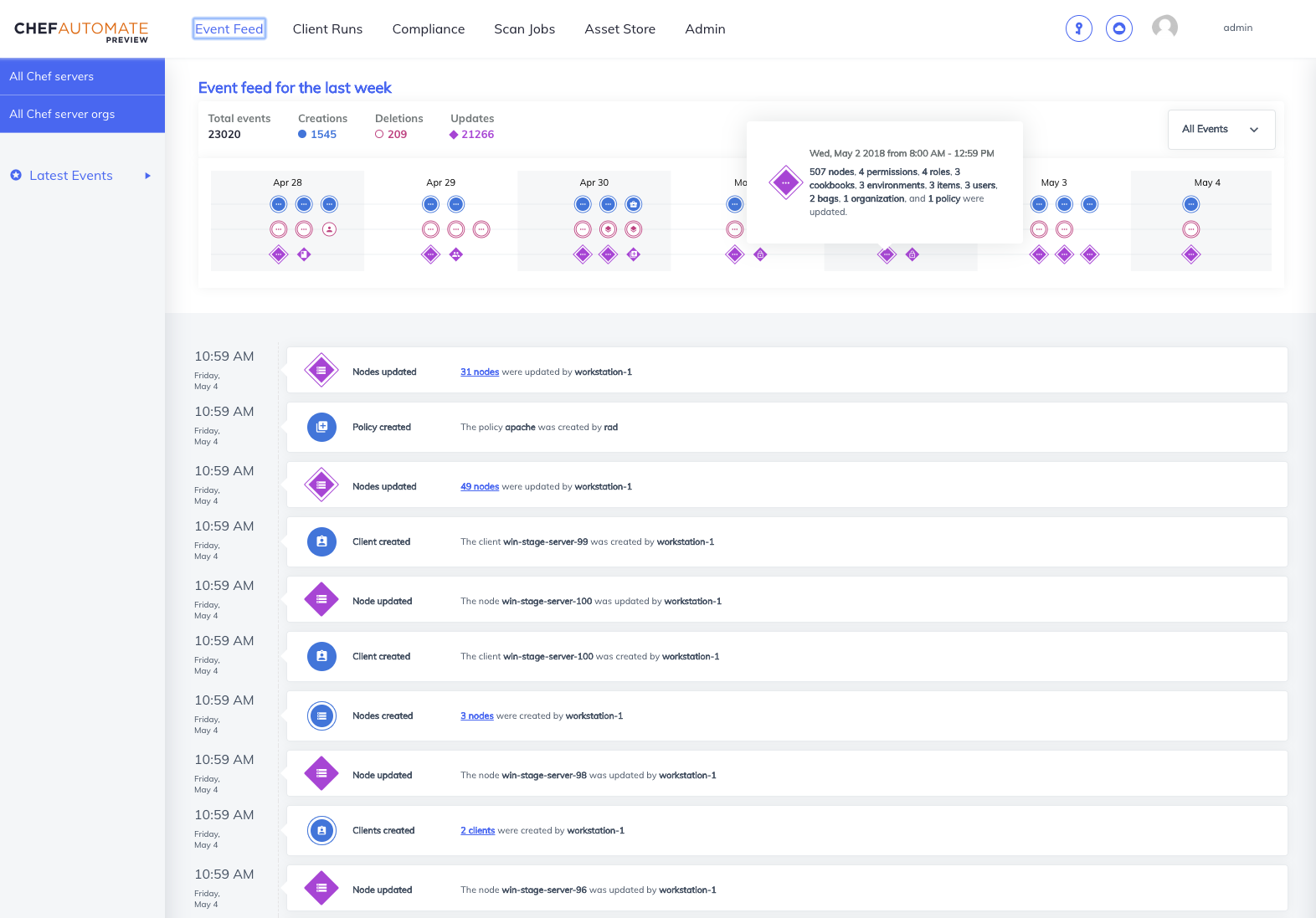
    Chef at the ChefConf 2018 conference today unveiled a series of DevOps offerings, including a revamped version of Chef Automate that has been rewritten using the Go programing language to improve performance and scalability. Now based on a microservices architecture, Chef Automate 2.0 a new user interface based on a REST application programming interface (API) that also serves to enhance integration. There also are a variety of visibility and debugging tools built into the platform, including a streaming event feed, trend graphs and a query language.

    Chef Automate

    At the same time, Chef unveiled Chef Workstation, which enables members of a DevOps team to take advantage of IT automation capabilities on a local PC without having to load any agents.

    Chef also updated its Habitat application release management software to include support for Kubernetes Operator for Habitat and the Open Service Broker originally developed by the Cloud Foundry Foundation, the ability to export to Azure Container Service (AKS), a Helm chart exporter for Kubernetes clusters and integration with operational analytics software from Splunk. Habitat also is now available in an on-premises edition as well as as a software-as-service (SaaS) application.

    Finally, Chef updated InSpec, the company’s compliance automation tool. The latest version can now verify Amazon Web Services (AWS) and Microsoft Azure policies, while support for the Google Cloud Platform support is in beta. InSpec also now has built-in support for more than 30 new resources, including Cisco IOS network devices as agentless targets.

    Chef is touting InSpec performance gains of 90 percent on Windows and 30 percent on Linux systems.

    Julian Dunn, director of product marketing for Chef, said as more companies transition to emerging technologies such as containers and Kubernetes, the need to rely on IT automation frameworks increases. In fact, while container use is widespread, more than half (51 percent) of 347 application and operations professionals surveyed by Dimensional Research on behalf of Chef said they have fewer than 10 percent of their production applications deployed using containers. Dunn said that survey also finds that adoption of DevOps practices in general are still limited—just over half the respondents (53 percent) said they are using both infrastructure and app automation for DevOps.

    However, 46 percent survey respondents said by 2020 they will have more than a quarter of their applications containerized, while 45 percent said at least a quarter of their application deployments will be based on microservices. That accelerated rate of transition will require IT organizations to rely more on IT automation frameworks to implement DevOps processes, Dunn noted.

    Further complication matters, Dunn said organizations are trying to lift and shift existing applications into multiple public clouds while continuing to develop new applications faster than ever to drive various digital business transformation initiatives.

    There’s no doubt that IT organizations are relying more on IT automation frameworks more than ever. The question is, Which one will they use? There are now more IT automation framework choices than ever. Chef is betting that a comprehensive approach based on a modern microservices architecture spanning both IT management and compliance ultimately will win the day.

    — Mike Vizard

  • AppDynamics Taps into SAP Applications

    AppDynamics Taps into SAP Applications

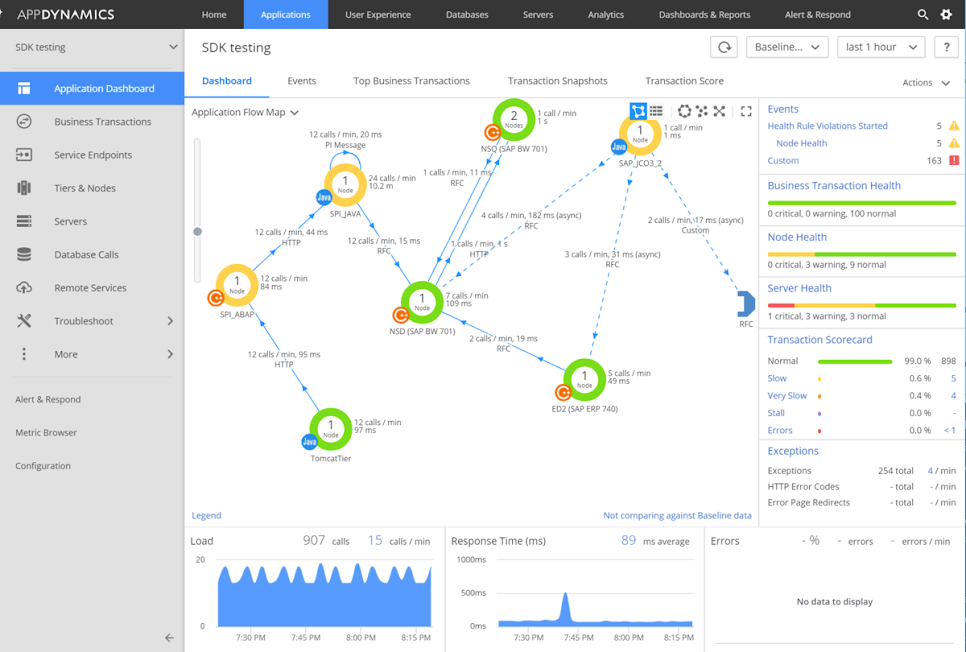
    Application performance management (APM) is starting to be  employed more widely as more organizations embrace digital business transformation. As the number of digital business processes spanning multiple applications increases, so does the need to understand what’s occurring inside both greenfield and legacy applications. In fact, at the heart of many of those digital business processes are enterprise resource planning (ERP) and customer relationship management (CRM) applications from SAP. To make it possible to gain insights into those applications AppDynamics, a unit of Cisco Systems, announced today it is making available AppDynamics for SAP.

    Jonah Kowall, vice president of market development and insights at AppDynamics, said his company is now able to support ABAP, the proprietary language SAP developed to build its applications. That language also has been employed extensively by IT organizations to customize those applications.

    SAP currently is trying to transition its customers to building custom applications on a cloud framework based on the Cloud Foundry platform-as-a-service (PaaS) environment. Most of those applications are be written in Java or the new Jakarta platform that replaces Java. SAP has also provided a software development kit and application programming interfaces (APIs) for tapping into S/4 HANA ERP applications.

    But there is a massive installed based of ABAP applications running in enterprise IT environments. Much of that code is now being integrated with other applications as part of a larger digital business transformation initiative.

    Kowall said those extensions are now driving organizations to apply an agent for the AppDynamics APM to custom applications written in ABAP. Historically, enterprise IT organizations only applied APM to their most critical applications. But as organizations move to digitize business processes, they now need to able to track transactions spanning multiple applications. Given the reliance many organizations have on SAP applications, it’s inevitable those transactions will involve SAP applications that were customized using ABAP.

    In addition, Kowall noted that being able to discover precisely where those custom applications are involved in any transaction is pivotal when it comes to upgrading to the SAP S/4 HANA applications, which are based on the SAP in-memory database, or lifting and shifting a legacy SAP application into the cloud.

    Kowall said organizations that have used ABAP to customize SAP applications now will have visibility down to the code level, including queries being made to the underlying database. From a DevOps perspective, that capability will go a long way to breaking down yet another silo in the enterprise. AppDynamics expects the first order of business for many organizations will be simply to create a performance baseline for their ABAP applications, which in many cases are likely to be an eye-opening experience, he said.

    The focus on digital business transformation is likely to spur adoption of DevOps processes over a much broader swath of the enterprise. Rather than simply apply DevOps processes to new applications, many organizations soon will extend DevOps into the realm of legacy application environments as well. That may take some time to play out, given the scope of the cultural changes involved. But at this point, those changes are now all but inevitable.

    — Mike Vizard

  • More App Dev Models Increase DevOps Pressure

    More App Dev Models Increase DevOps Pressure

    A bifurcation in types of developers will become more pronounced in the years ahead as more application code moves to the network edge. As that transition continues occurring, the pressure on IT operations to be able to be able to flexibly manage different classes of applications by embracing DevOps processes will correspondingly increase.

    Mike Piech, vice president and general manager of middleware for Red Hat, said applications running on internet of things (IoT) devices and smartphones present developers with a finite amount of compute resources that require them to have advanced skills. Conversely, back-end applications can now take advantage of multiple layers of abstraction, including (soon) serverless computing frameworks based on event-driven architectures that make potentially unlimited compute resources available. The availability of all those compute resources, however, encourages developers of back-end services and applications to be less disciplined when writing applications.

    The good news is that it’s getting easier to right-size applications using trial and error methods versus having to commit to a specific computing architecture up front, said Piech. If something doesn’t work as well as it should, modular approaches to microservices make it possible to more easily move application code to where it should best optimally reside. Rather than focusing on the rigor of the underlying architecture, developers are free to experiment with different tools and languages more now than any time in the history of IT, he said.

    In fact, Piech speculated that many graphical user interfaces will continue to run locally while accessing a wide variety of back-end services via application programming interfaces (APIs). That approach essentially creates a new form of hybrid computing wherein developers no longer need to think much about the runtime environment, he noted.

    However, all that freedom tends to put a lot more pressure on the IT operations team. As the types and classes of applications continues to evolve, Piech said it’s only a matter of time before more organizations move further down the DevOps path. Adoption of DevOps processes across organizations has been somewhat uneven. But as developers experiment with different computing models, the expectation is that operating teams will be flexible enough to dynamically make the appropriate adjustments, he said.

    Longer term, middleware and databases will eventually be deconstructed into sets of microservices that developers can call when needed. Today, IT operations teams make available monolithic application servers and databases. Many of those databases and application servers are starting to be encapsulated in Docker containers as part of a first step toward lifting and shifting applications into the cloud before transitioning to more agile microservices-based frameworks, Piech said.

    In some cases, those services will be accessed directly via a platform-as-a-service (PaaS) environment or a serverless computing framework. Piech said Red Hat expects serverless computing frameworks based on event-driven architectures will be used mainly to provide bursting capabilities as a complement to long-running stateful applications that typically consume a fixed amount of IT infrastructure resources. It’s probable stateless applications that run intermittently also will find their way on to serverless computing frameworks. Red Hat has thrown its support behind the open source OpenWhisk serverless computing framework.

    There clearly will be many more types of distributed applications running across the enterprise. IT operations teams may not have much control over what types of applications run where and when. But they will be expected to be able to deploy and manage them all, regardless.

    — Mike Vizard

  • Red Hat Positions PaaS as Cure to Heal DevOps Divide

    Red Hat Positions PaaS as Cure to Heal DevOps Divide

    Red Hat is making a strategic bet that IT organizations increasingly will rely on platform-as-a-service (PaaS) environments to make a broad range of distributed services available to developers, which would eliminate friction without enabling IT operations teams to maintain control.

    Paul Cormier, president of products and technologies for Red Hat, said IT organizations are realizing PaaS environments such as OpenShift have evolved into a platform through which a broad range of curated distributed services can be exposed to developers by IT operations teams. That capability is critical because, otherwise, developers simply go around the IT operations team to download libraries. IT operations teams before too long are asked to support applications of uncertain provenance that in many cases wind up duplicating functions.

    As appreciation of the role PaaS environments play in enterprise IT, Cormier said Red Hat is increasingly having conversations with CIOs and other senior IT leaders who are trying to bridge the historic divide between developers and IT operations teams by exposing a broad range of curated distributed services via well-defined application programming interfaces (APIs).

    Red Hat is expanding the types of applications that can run on OpenShift alongside traditional 12-factor applications. In fact, by embracing Kubernetes container orchestration software, Red Hat is effectively obliterating the line between a PaaS and container-as-a-service (CaaS) environment, Cormier said, adding OpenShift makes it possible to build and deploy those applications on-premises or in the cloud as IT organizations deem best, based on cost, data gravity and regulatory requirements. Serverless computing frameworks will make it possible to bridge those environments by invoking an event-driven framework to take advantage of, for example, cloud bursting in a heterogeneous hybrid cloud, he said.

    In fact, Cormier noted more IT organizations will mix and match internal and external services, as each platform tends to run different classes of application workloads better. For example, IT organizations may want to be able to invoke one type of artificial intelligence (AI) service on one cloud over another based on their performance attributes.

    Traditional enterprise IT organizations are not looking to eliminate the need for IT operations teams, he said. Rather than have developers take over IT operations, most organizations would prefer to maximize the amount of time developers spend building and testing applications. The need to build more applications faster than ever will force IT leaders to separate those concerns to eliminate much of the internal friction that results when developers throw application code over the proverbial IT operations wall, Cormier said.

    Most IT organizations have yet to embrace a PaaS environment broadly. There tend to be pockets of adoption. But most applications today are still built and deployed without employing a PaaS environment, mostly because PaaS environments are viewed by many as being too prescriptive in terms of dictating application development workflow. Red Hat is betting that with the rise of microservices-based applications based on containers, many IT organizations will finally decide to trade a little less control in exchange or for much less IT infrastructure complexity.

    — Mike Vizard

  • Red Hat Aims to Push IT Management to the Cloud

    Red Hat Aims to Push IT Management to the Cloud

    Red Hat at the Red Hat Summit 2018 conference this week showed a technology preview of an instance of Red Hat Insights, a predictive analytics IT management application capable of identifying operations issues before they become a problem, running as a software-as-a-service (SaaS) application.

    The instance of Red Hat Insights will be extended to apply analytics to any infrastructure platform. Red Hat plans to eventually make the rest of its IT management portfolio available as a cloud service.

    Joe Fitzgerald, vice president and general manager for management at Red Hat, said the goal is to enable management of virtual machines, container, infrastructure-as-a-service and physical servers all from a single pane of glass.

    Cost analytics also will be embedded in those services, adds Fitzgerald. Cost is now a much bigger issue because cloud service providers bill customers based on actual consumption. Previously, a virtual machine left running on an on-premises server might result in someone being yelled at, but no additional cost, notes Fitzgerald. Now, however, if an IT organization doesn’t turn off those virtual machines, it will end up paying more.

    Fitzgerald noted that management of IT operations is becoming increasingly automated. Red Hat is now adding integrations with the agentless Ansible framework it acquired in 2015 at rate of 50 a week. There already  are 1,600 integrations with Ansible. He said the fact that Ansible presents IT operations teams with a declarative approach to automating IT using YAML files makes IT automation much more accessible. Other frameworks require IT operations teams to learn how to program, which becomes a significant barrier to adoption, but YAML files allow IT operations teams to make use of familiar shell scripts.

    Many organizations now are moving up the IT management curve as applications become more distributed, Fitzgerald said. Every platform they have comes with its own management tools. But the need for a control plane through which multiple platforms can be centrally managed is now becoming more evident, he said, especially as IT organizations realize they will be running many different types of platforms for many years to come.

    Other benefits to shifting IT management into the cloud is that the move eliminates the need to deploy a local server just to run IT management software and all updates to the IT management platform are provided by the applications provider.

    Obviously, Red Hat is not the only IT vendor building a centralized, cloud-based approach to managing distributed computing environments. But as Ansible becomes more widely adopted, the opportunity arises for Red Hat to engage in a broader IT management conversation with IT organizations.

    Most enterprise IT organizations are rapidly approaching something of an IT management crisis. Each platform adopted creates yet another silo that makes adopting integrated DevOps processes even more challenging. While most organizations are not likely to abandon the management tools from the vendors that built those platforms, IT organizations are demanding thet underlying infrastructure exposes an application programming interface (API). In fact, it’s the proliferation of all that software-defined infrastructure that now makes it feasible to centralize the management of IT in the cloud.

    — Mike Vizard

  • Microservices Momentum Accelerates

    Microservices Momentum Accelerates

    A global survey of 353 application development professionals conducted by Dimensional Research on behalf of LightStep, a provider of application performance management (APM) tools, finds a full 86 percent of respondents expect microservices to be the default architecture within five years.

    A total of 60 percent of respondents said they already have microservices in production or deployed as part of a pilot, and 92 percent said they expect to grow their use in the coming year.

    Top reasons cited for employing microservices are agility (82 percent) and scalability (78 percent).

    The downside of increased reliance of microservices is the need to manage them all. The survey finds 99 percent report challenges in using them. More than half (56 percent) reported that each additional microservice increases operational challenges, and 87 percent of those that have deployed microservices in a production environment reported they are generating more application data.

    To make matters more challenging, a full 98 percent of respondents said they have trouble identifying the root cause of performance issues associated with microservices. More than three-quarters (76 percent) said it also takes longer to resolve issues. In fact, 73 percent said it is more difficult to troubleshoot application performance problems compared to a traditional monolithic application.

    Not surprisingly, just less than three-quarters (74 percent) said they plan to increase investments in microservice performance management tools in the next year.

    LightStep CEO Ben Sigelman said that while microservices come in many forms, advances in how software is developed is clearly coming at a cost. Not only is software becoming more challenging to manage, APM tools are now a prerequisite. Historically, IT organizations only monitored their most mission-critical applications. But the level of dependency each microservice has on others requires a more holistic approach to APM, Sigelman said, noting that IT teams now need to be able to see well beyond the border of any one microservice.

    Challenges associated with managing microservices are not likely to deter organizations from eventually adopting them. The level of agility and resilience inherently built into in a microservices-based application are too high to ignore. But the rate at which they are employed might be impacted. There’s usually a direct relationship between the availability of tooling and expertise and the rate at which any emerging technology gets deployed in a production environment. The good news is advances in machine learning algorithms and other forms of artificial intelligence (AI) should make it easier to manage microservices in the years ahead.

    In the meantime, IT organizations can take some comfort in the fact that developers are being held more accountable for the microservices they build. That level of accountability tends to vary widely by organization. But the end result is generally higher levels of software quality because developers increasingly realize they can’t throw code over the proverbial IT operations wall without it coming back to them. The challenge now is to bridge the historic divide between developers and IT operations teams in a way that works best for everyone concerned.

    — Mike Vizard