Author: Mike Vizard

  • Splunk Updates SignalFx APM Platform

    Splunk Updates SignalFx APM Platform

    Splunk today unfurled its first major update to the SignalFx application performance management (APM) platform since acquiring it last October.

    Karthik Rau, general manager for application performance management (APM) at Splunk, said SignalFx Microservices APM combines for the first time the SignalFx platform with Omnition, a software-as-a-service (SaaS) platform for implementing distributed tracing as an alternative to application sampling that Splunk also acquired last year.

    In addition, the latest iteration of SignalFx adds a Kubernetes Navigator tool to a SignalFx Infrastructure Monitoring module to make it easier to manage Kubernetes clusters alongside the microservices-based applications running on that platform. The module surfaces recommendations to expedite triaging and troubleshooting based on machine learning algorithms that are embedded in the platform. Splunk has also enabled workflow integration across Kubernetes Navigator and Splunk Enterprise and Splunk Cloud to provide IT teams with additional insights and context, noted Rau.

    With the acquisition of SignalFx, Rau said Splunk is at aiming to advance two major DevOps trends. The first is the rise of open source agent software that makes it increasingly feasible to instrument the entire IT environment. Omnition, prior to its acquisition by Splunk, was a founding member of and contributor to the OpenTelemetry project now being managed under the auspices of the Cloud Native Computing Foundation (CNCF).

    The second is the need to eliminate relying on sampling in favor of employing distributed tracing to be able to analyze every event that has occurred within an IT environment.

    At a time when IT environments are getting more complex, Rau said being able to resolve IT issues is critical. Modern applications based on microservices can be especially problematic given all the dependencies involved, he noted. In contrast to legacy APM platforms built to monitor monolithic application environments, SignalFx is built from the ground up to address application environments based on microservices, he said Rau, noting core to that effort is the ability to ingest massive amounts of distributed tracing data.

    Historically, APM platforms were used sparingly to help manage the most mission-critical applications in the enterprise largely because of concerns about cost. Given the complexity of modern applications, however, it’s become apparent that observability is now a core tenet of any approach to implementing best DevOps practices. The issue many DevOps teams will need to address is determining to what degree the existing tools they have for observing their IT environments sufficiently meet the requirements of new classes of applications. In many cases, that decision may be predicated on the rate at which those organizations are embracing microservices-based applications.

    Of course, Splunk is not the only vendor making a case for an APM platform optimized for microservices. Competition between emerging and legacy providers of APM platforms that have added support for containers and Kubernetes clusters is already fierce. The real issue going forward, however, is determining which of the platforms will enable DevOps teams to discover the most relevant issues soonest. After all, when short-handed DevOps teams encounter an issue, every second it takes to remediate that problem counts.

    — Mike Vizard

  • Eclipse Foundation Delivers on Theia Promise

    Eclipse Foundation Delivers on Theia Promise

    The Eclipse Foundation has made available Theia 1.0, an open source alternative to Microsoft’s Visual Studio (VS) Code tool for editing code.

    Mike Milinkovich, executive director of the Eclipse Foundation, said Theia will provide IT teams with a no-cost option to editing code that can be deployed on-premises or on the cloud alongside the Eclipse integrated development environment. In contrast, VS Code today only runs on a desktop, he said.

    Theia

    While many developers still prefer to write code on their desktops, Milinkovich noted that more code is now being written in collaboration with other developers in the cloud. The pace at which that transition has been occurring is only likely to accelerate with more developers working from home as part of the effort to mitigate the impact of the COVID-19 pandemic, he added.

    To provide access to a code editor in the cloud Theia runs in two separate frontend and backend processes that communicate via JSON-RPC messages over WebSockets or REST APIs over HTTP connections. Both processes expose a dependency injection (DI) container to which extensions can be made. Those extensions will also be available via the Eclipse Foundation marketplace, noted Milinkovich.

    In fact, he said, the Eclipse Foundation expects more developers will be exposed to Theia first via third-party application development platforms. Early adopters and contributors to the Theia project include ARM, Arduino, Ericsson, Gitpod, Google Cloud, IBM, Red Hat, SAP and TypeFox. Microsoft, however, has thus far not expressed any interest in participating in the Theia project. In many cases, those vendors will be making Theia an extension of the DevOps environments that these vendors already provide as a cloud service, noted Millinkovich.

    The future of writing code is clearly becoming more hybrid. Application developers will always want to be able to write code locally whenever inspiration strikes. What’s changing is the level of collaboration that is now possible thanks to the rise of the cloud. It’s become a lot easier for small teams of developers to edit code together, which in theory should lead to less debugging because better code is being created at the front end of the process. The degree to which that theory pans out naturally will vary based on the individual skills of any development team.

    In the meantime, Millinkovich said the Eclipse Foundation remains committed to expanding the range of open source tools that can now be accessed via the cloud, including  Che, an integrated development environment (IDE); CodeWind, a project that adds support for containers to IDEs based on Eclipse; Eclipse Dirigible, a cloud-based development platform developed by SAP; Eclipse Sprotty, a diagramming framework; and Eclipse Orion, a browser-based integration platform.

    It may take a while for all these projects to reach the level of maturity required to drive mainstream adoption. However, as work on these projects continues, the number of open source application development tools heading into the cloud is only going to accelerate in the months ahead.

    — Mike Vizard

  • Humio Adds Unlimited Ingest Plan to Log Management Service

    Humio Adds Unlimited Ingest Plan to Log Management Service

    Fresh off raising an additional $20 million in funding, Humio, a provider of a platform for analyzing log data, has added an unlimited ingest plan to a cloud-based service to make it easier for organizations to retain massive amounts of log data.

    The unlimited ingest plan for the company’s cloud service extends a similar option Humio already makes available to customers that deploy its log management platform in an on-premises environment.

    Morten Gram, executive vice president for Humio, said one of the significant limitations of rival log management platforms is they charge customers based on the amount of data ingested. That approach only serves to dissuade organizations from ingesting data to limit their costs. The trouble is that organizations won’t be able to discover outlier issues in data they never see in the first place, he said, noting issue becomes even more problematic as organizations embrace best DevOps practices to deploy more applications both in the cloud and in on-premises IT environments. The Humio Bucket Storage can retain more than a petabyte of log data.

    Given the scale and scope of modern applications, Morten said organizations are now using log data to drive a wide variety of analytics tools to automate processes in real-time. Log data is also playing a critical role when it comes to applying artificial intelligence (AI) to IT management. The more log data made available, the more accurate the AI models being employed become, he noted.

    In addition, Gram said that because Humio doesn’t rely on an index engine to organize data for a search engine, IT teams can launch any type of query they like. In contrast, rival platforms are optimized for specific types of queries, he said, which also substantially reduces the amount of compute and storage required to analyze log data. That capability is why Humio can offer unlimited ingest of data and still remain profitable, as long as there are enough customers to enable Humio to operate at scale, he noted.

    Given the current need for many IT employees to work from home to help combat the COVID-19 pandemic, it’s clear more organizations will be relying on tools hosted in the cloud to manage IT environments. Many of those organizations will also be a lot more sensitive to costs given the impact the COVID-19 pandemic is having on the economy. Of course, it’s probable many organizations will postpone new application development projects until sometime after the COVID-19 pandemic subsides. However, as more organizations start to appreciate the extent to which people may adopt social distancing, many of them will soon be re-engineering business processes to adjust to a new reality. As such, it may now only be a matter of time before there are even more digital business transformation projects being launched than ever before.

    — Mike Vizard

  • Startup Aims to Manufacture Ventilators Using 3D Printers

    Startup Aims to Manufacture Ventilators Using 3D Printers

    A startup company is in the early stages of building a proof-of-concept that would allow local hospitals to employ 3D printers to manufacture ventilators and other medical equipment to help combat the COVID-19 pandemic.

    Veritx president James Regenor said company executives have already been involved in use cases in which the military has used 3D printers to create replacement parts on aircraft carriers at sea. That same concept could be applied to medical equipment using any number of 3D printing services that now operate in most municipalities. In fact, some hospitals attached to universities already probably have access to 3D printers.

    Veritx is in the process of looking for funding to help create a proof-of-concept (PoC) around an electronic file that would contain the schematics for printing out the parts that make up a ventilator. Those parts could then be assembled near a medical facility to provide a steady source of ventilators as needed, said Regenor.

    Those printers could also be employed to create splitters that would enable multiple patients to share the same ventilator or, if need be, convert other devices for pumping oxygen, such as scuba equipment, into a makeshift ventilator, he said.

    Regenor estimates a local 3D printing service could manufacture more than 1,000 ventilators a day. Alternatively, medical facilities could use 3D desktop printers to fill an immediate need.

    The issue that 3D printing could solve is that ventilator manufacturing is currently dominated by a handful of companies. As demand for ventilators escalates, many of these companies are having issues scaling up their manufacturing. That shortage of ventilators has resulted in a wide range of companies, including Ford and General Motors, offering to use their manufacturing lines to build ventilators. However, it may be months before any ventilators that might be manufactured by those companies become available because of the need to retool manufacturing lines. Ventilators created using 3D printers could, in theory, be available within hours or days of being ordered, at a much lower cost.

    The ventilator shortage is already a chronic issue in areas such as Italy and New York, where the COVID-19 pandemic is now raging. It’s likely to become an even bigger problem as the virus spreads to more rural areas where hospitals don’t tend to keep many ventilators on hand. State governments naturally will do their best to acquire as many ventilators as possible; however, competition is now fierce, with individual states and governments around the world outbidding each other for ventilators. The chances that smaller states will have the financial resources necessary to compete for ventilators are slim.

    It’s too early to say to what degree the current pandemic may be one of those seminal events that winds up boosting an emerging technology such as 3D printing. The one thing that is certain is manufacturers of 3D printers have a role to play in the current crisis that could transform the medical equipment industry in a most unexpected way.

    — Mike Vizard

  • Akamai Extends Scope of DevOps Integrations

    Akamai Extends Scope of DevOps Integrations

    Akamai today extended its DevOps strategy to provide tighter integrations with continuous integration/continuous (CI/CD) platforms and IT automation tools such as Terraform from HashiCorp.

    In addition, Akamai is adding support for serverless computing functions to Akamai EdgeWorkers, a JavaScript-based framework through which application logic can be executed on the edge of the Akamai content delivery network (CDN) now as a microservice.

    Greg Griffiths, product marketing manager for DevOps solutions at Akamai, said the latest additions will make it easier for DevOps teams to view the Akamai CDN as a natural extension for deploying applications. Akamai launched its first DevOps initiative last year. The goal is to make possible for DevOps teams to spin up new properties and make configuration changes from within the context of their CI/CD workflows, he said.

    Terraform support, meanwhile, will make it possible for DevOps teams to programmatically provision and manage properties and DNS zones as code, added Griffiths.

    As part of that effort, the Akamai Pipeline can now synchronize with the Akamai Control Center to capture any manual configuration changes in a way that then allows them to be incorporated into a CI/CD workflow, he noted.

    Akamai has been making a case for deploying applications as close to the network edge as possible using its CDN to reduce network latency. As part of that effort, EdgeWorkers allows developers to spin up microservices as needed. Those microservices can now access data embedded in the function, including all the data from the HTTP request such as cookies, headers, URL and query parameters.

    DevOps teams can now also more easily conduct A/B testing and feature experiments using cached content in addition to delivering different application experiences by modifying the path to cached images and other content based on variables such as customer location or time of day.

    Other new capabilities being added by Akamai include the ability to modify both the path and query arguments for a request and determine to which origin any request should be routed.

    Griffiths said now that more organizations are leveraging the Akamai CDN as a vehicle for delivering applications at the network edge, the next big initiative will be to make it easier to leverage the company’s managed security services to embrace DevSecOps.

    It’s not clear to what degree DevOps teams have embraced CDNs as a vehicle delivering applications. Organizations have, however, been leveraging CDNs to deliver web applications for years now. By providing tighter integration with CI/CD platforms Akamai is essentially making the CDN just another target for deploying applications at the end of a DevOps workflow. That capability may prove critical as organizations move to deploy more application code on edge computing platforms involving use cases that require data to be processed and analyzed in near real-time.

    Of course, Akamai is not the only CDN providers with similar ambitions. It is, however, already the largest, so from a DevOps perspective most organizations will soon encounter an Akamai point of presence somewhere soon, if they have not already.

    — Mike Vizard

  • COVID-19 Reaction: Massive Spike in IT Incidents

    COVID-19 Reaction: Massive Spike in IT Incidents

    A report published this week by PagerDuty, a provider of an incident management platform, finds organizations that rely on the platform to manage IT issues are managing on average double the number of incidents since the start of the COVID-19 pandemic.

    In some industry segments, such as online learning services, travel and entertainment services, the number of incidents has increased 11-fold, the report noted.

    Rachel Obstler, vice president of product for PagerDuty, said with more people at home, online services that are seeing a spike in use while at the same time deploying new code to drive additional services are clearly stressed. Enterprise IT organizations, meanwhile, are now dealing with large numbers of employees trying to remotely access a wide range of applications simultaneously. Incidents now range from relatively simple authentication issues to accelerating the rollout of a digital business initiative to help maintain business continuity, she noted.

    Many of those organizations were already short of staff before the COVID-19 pandemic so longstanding challenges in many cases are now being further exacerbated, added Obstler. In addition, organizations that are rushing to deploy applications to enable their organizations to maintain business continuity are likely to not have tested those applications as thoroughly as they once might have. Inevitably, that decision will result in more IT incidents as issues are discovered after those applications are deployed in a production environment.

    Naturally, there may be a temptation to suspend rollouts of new applications. However, with millions of individuals now required to work from home for an indefinite amount of time, digital business applications may be the only way to engage those individuals. In fact, Obstler noted that as working remotely becomes the new normal, many people are about to become a lot more proficient at both working and shopping from home. As such, digital business applications may soon become the primary medium through which organizations engage their end customers.

    On the plus side, Obstler said it’s now relatively simple to deliver IT services from anywhere in the world, so there is an opportunity to bulk up existing IT support staff. Of course, the pool of IT professionals who are available to hire should also increase as vertical industries such as the travel and hospitality sectors essentially shut down.

    It’s too early to say precisely how the COVID-19 pandemic will impact the IT sector. While there will certainly be layoffs, many organizations will be loath to let go of IT staff who will be difficult to replace once the immediate economic recession ends. Countries around the world are also making funds available to companies on the condition they keep layoffs to a minimum.

    Regardless of how many IT people are retained, however, the remaining IT staff will continue to be stressed. Many organizations are going to have to re-engineer IT processes by, for example, embracing best DevOps practices on the fly to adjust to a new reality. Many of the IT issues about to be encountered might not always be within the control of IT teams to address. However, business leaders will expect that one way or another those IT staff will come up with the innovative workarounds needed to enable the business to continue to survive and thrive.

    — Mike Vizard

  • Quick Base Makes Free Low-Code Platform Available for First Responders

    Quick Base Makes Free Low-Code Platform Available for First Responders

    Quick Base, a provider of a platform for building low-code applications, announced this week that it is making its platform available for free through Sept. 30 to first responder organizations that need to build applications quickly to address the COVID-19 pandemic.

    Jay Jamison, chief product and technology officer for Quick Base, said it’s apparent first responders soon will need applications to track things ranging from assets such as ventilators to heat maps that show the number of patients in a geographic area relative to the number of intensive care units (ICUs) available.

    Quick Base is also making available templates that can be employed to build the most common types of emergency response applications, such as ones already being employed by the City of New Orleans.

    Examples of other applications that will be needed include the ability to track businesses in real-time that may be flouting COVID-19 restrictions or landlords that are evicting tenants despite emergency decrees, noted Jamison.

    Most of these applications will need to be developed in days versus weeks or months. To that end, Quick Base is also making available to first responder organizations the expertise of its internal customer success staff as well as third-party consultants, he said.

    In addition, Quick Base plans to certify many of these applications for distribution via its online store, which will make it easier for a first responder organization in one locality to leverage an application that has already been developed by another first responder organization.

    In general, Jamison said first responder organizations will need to apply DevOps principles across their entire organization to adjust to highly fluid situations. Applications undoubtedly will need to be modified as processes evolve and new emergency decrees are declared, he noted.

    The biggest challenge from an IT perspective is many first responder organizations lack the process expertise needed to build an application on the fly. Volunteers with IT expertise will be needed to work alongside medical experts, who will need applications that most likely will be deployed in the cloud but made accessible via a range of mobile computing devices. The chances all those applications will work perfectly when first deployed is almost nil, so timely updates to applications will be critical.

    Of course, applications and IT processes are not always the first things that come to mind to combat a pandemic. However, the faster first responders can respond to changing conditions on the ground, the more lives that might potentially be saved. In some large cities, it’s probable first responders already have access to a range of applications that to vary degrees might scale to meet the current challenge. However, in smaller localities, the availability of such applications is nominal at best.

    Quick Base is not the only provider of low-code and no-code tools for building applications, so there are plenty of options for building applications quickly. Whichever the platform employed, time is going to be of the essence. Outbreaks in Italy, Spain and China have already shown how quickly events can spiral out of control. If any new application is going to be relevant in any other emerging CIVID-19 hot zone, the work to build that application needs to start immediately.

    — Mike Vizard

  • New Relic Gives COVID-19 Relief Agencies Free 90-day Access

    New Relic Gives COVID-19 Relief Agencies Free 90-day Access

    New Relic will provide free access to the entire New Relic One observability platform for 90 days to any organization engaged in COVID-19 pandemic relief efforts that have a specific benefit to the public.

    Erin Dieterich, director of corporate social responsibility at New Relic, said it’s apparent that the IT platforms of both nonprofits and private companies that are lending their services and expertise to mitigate the impact of the COVID-19 pandemic will be taxed in unexpected ways.

    To help IT teams rise to that challenge, New Relic will make it possible to identify both software and infrastructure issues that are having an adverse impact on applications, noted Dieterich. Those issues undoubtedly will be experienced by both non-profit organizations as well as private companies trying to leverage their existing IT environment to make additional digital services available. Examples of organizations beyond those providing humanitarian aid that are being invited to register to use New Relic One via NewRelic.org include public and private schools and other providers of education services.

    New Relic also has a crisis management team in place to make sure the New Relic One service is not disrupted as the company’s own employees work from home across multiple geographies.

    Many of the providers of COVID-19 relief services are likely to find their efforts stymied at some point by IT issues. As IT environments have become more intertwined in the age of the cloud, it’s become difficult to ascertain the root cause of any application performance issue. Platforms such as New Relic One provide access to a cloud service through which IT teams can more easily pinpoint where a specific issue is potentially creating a wave of downstream application issues that would not be obvious to the average IT administrator.

    Beyond the teams of employees New Relic already allocates to New Relic.org on a full-time basis, Dieterich said the company is tapping volunteers from its own base of employees. Many of those employees themselves are now working from home, much like most of the rest of the global workforce.

    It’s too early to say to when the COVID-19 pandemic might subside, so New Relic plans to re-evaluate this initiative three months from now. In the meantime, the company has also pledged to make available $100,000 to match employee contributions to COVID-19 relief efforts.

    In the days and months ahead relief agencies of all sizes are going to be put to the ultimate test. While most of the focus is now on health care, it’s clear the COVID-19 pandemic also represents a major economic disruption. IT expertise will be needed to augment relief efforts spanning everything from tracking coronavirus cases to making sure people who are out of work receive food assistance. IT expertise that enables relief agencies to access public and private funding as quickly as possible is likely to be among some of the most important tasks ahead, regardless of whether anyone realizes today or much less even appreciates it tomorrow.

    — Mike Vizard

  • Storj Labs Unfurls Decentralized Storage Service

    Storj Labs Unfurls Decentralized Storage Service

    Storj Labs has made generally available a distributed storage platform based on the excess capacity available on devices ranging from servers to individual desktops.

    Company CEO Ben Golub said the goal is to provide IT organizations with an alternative to storing data inexpensively using storage resources that have been vetted by Storj Labs.

    At the core of the Tardigrade Decentralized Cloud Storage Service provided by Storj Labs is an open source object storage system that is compatible with the S3 application programming interface (API) defined by Amazon Web Services (AWS). That object storage system distributes 80 slices of a file across a subset of thousands of nodes that each contain only a slice of the data required to reconstruct that file when needed. Only 29 of those slices are needed to reconstruct a file, so Golub said it’s relatively simple to ensure data is secure without having to manage encryption keys.

    Following an extensive beta test of the Tardigrade, the company claims to have achieved 99.95% availability, with a service level agreement of 99.9999999% achieved in terms of durability. Golub said Tardigrade makes use of erasure coding to make sure data is distributed in a highly resilient fashion.

    Storj Labs compensates owners and data centers along with individuals with access to a lot of excess storage capacity for making capacity available, Golub said. Most storage drives are not anywhere near full capacity, which Golub noted has made it relatively easy for Storj Labs to amass 19PB of storage for its Tardigrade service. Each provider of storage capacity is required to pass a series of data stewardship tests for a period of time before being allowed to become a member of the Tardigrade service.

    Storj Labs has also set up an open source partner program through which any open source project with a Tardigrade connector will receive a portion of the storage revenue generated by users of that software. That approach allows participants in projects to be partially compensated for their efforts as alternatives to cloud service providers, which routinely commercialize open source software without helping to fund its development, said Golub. Based on his previous experience as CEO of Docker Inc., he noted many open source projects die on the vine simply because the team that created it simply can’t afford to sustain it.

    Interest in Tardigrade Decentralized Cloud Storage Service for certain use cases as an alternative to pubic clouds could be high, he said, given the fact that there has been no meaningful decline in cloud storage service pricing in the last three years. Use cases that should prove to be especially appealing include data protection and image retention. Storj Labs is also making available a library of bindings for Go, Android, C, .NET/Xamarin, Node.js, Swift and Python to make it easier for developers to invoke Tardigrade storage services as code.

    It may be a while before IT organizations are completely comfortable with decentralized storage services as an alternative to public clouds. However, as the amount of data that needs to be stored continues to grow, every option available to store data may be needed soon.

    — Mike Vizard

  • OverOps Allies With SonarQube To Improve Application Quality

    OverOps Allies With SonarQube To Improve Application Quality

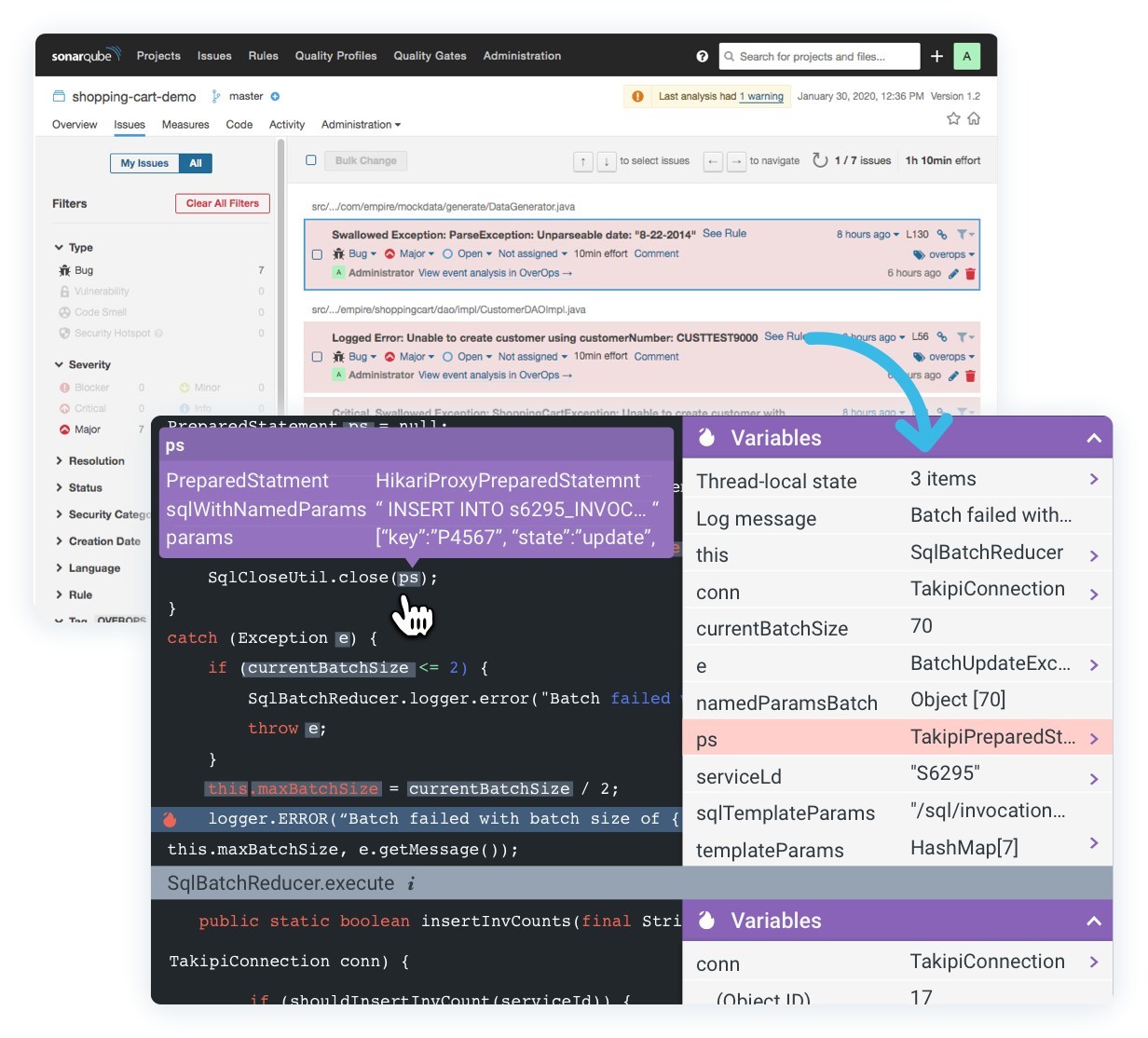
    OverOps, a provider of tools for dynamically analyzing code at runtime, has partnered with SonarQube, a provider of static analysis tools for source code, to enhance application quality by unifying code analytics.

    Chen Harel, vice president of product for OverOps, said the two companies have collaborated to create a plugin through which DevOps teams can now more easily analyze source code before it gets deployed in a production environment.

    The goal is to equip DevOps teams with the tools required to assure application quality as more responsibility for maintaining applications continues to shift left on to the shoulders of developers, said Harel. In the absence of tools to analyze code, he noted, developers are not going to be able to identify, for example, potential vulnerabilities in source code and errors at run-time.

    The plugin also allows issues identified by OverOps at runtime to be fed back into the SonarQube tools for analyzing source code to identify issues that previously would not have been discovered, he added.

    Specifically, when the OverOps plugin is installed, it automatically creates an event rule for Java code based on new, critical, resurfaced and unique runtime errors. When a quality gate fails a release based on these criteria, users can view the issues directly within their SonarQube dashboard. OverOps then provides a direct link to the event analysis containing the full context behind the error, including the stack trace, variable state and system state.

    As a result, Harel said DevOps teams are going to be able to reproduce an issue much faster, which should result in much shorter times to remediation. Without such tools, DevOps teams can spend weeks reproducing an error that only takes a few minutes to actually fix.

    Harel said with both the OverOps and SonarQube tools included as part of the gates set up within a continuous integration/continuous delivery (CI/CD) platform, it becomes possible to substantially improve the overall quality of the applications being developed. That’s critical because developing applications faster often results in more errors having to be addressed, said Harel.

    There’s a lot of debate these days concerning the degree to which the adoption of DevOps might be increasing the total cost of IT. It’s a lot more expensive to fix an application after it’s deployed in a production environment than it is to address issues as they arise in the application development process. As such, there’s a lot more focus on code analytics to help ensure that DevOps processes are churning out not just more code faster but also higher quality applications.

    Of course, the level of DevOps sophistication tends to vary widely by organization. However, as more gates that address application quality assurance are erected on CI/CD platforms, the better the DevOps outcome will become. The challenge is making sure the DevOps culture being fostered prizes application quality as much as it does how much code is being written and deployed how fast.

    — Mike Vizard