Author: Mike Vizard

  • LinearB Aligns with Clubhouse to Advance Project Management

    LinearB Aligns with Clubhouse to Advance Project Management

    LinearB, a provider of an analytics application for software delivery projects, announced today it has allied with Clubhouse, a provider of a project management application that includes built in collaboration tools.

    LinearB’s analytics application uses code, Git logs and releases to automatically construct and visualize detailed timelines without requiring any manual input. That data can now also be automatically fed into the Clubhouse project management application.

    Dan Lines, COO, LinearB, said the goal is to make it possible for any project participant to keep track of updates without spending hours manually compiling and entering data into a project management application.

    In addition, DevOps teams can use both applications to gain visibility into every feature, bug and chore via a live feed of activity generated by branches, pull requests and releases for Clubhouse stories. Along with tools for tracking individual activity and collecting metrics, blockers, delays, high-risk code and branches merged without review for Clubhouse stories are also highlighted. There is also a shadow work detector that detects activity in a Git repository that is not attached to a Clubhouse story.

    Lines said one of the project management challenges organizations face today is the tools they employ only allow them to see segments of a DevOps pipeline. The LinearB analytics application unifies the data and metrics required to make an informed decision, without having to first collect and then normalize data residing in different tools. Instead, all the metrics required to make an informed decision about how best to allocate limited software development resources is automatically collected from the tools the DevOps team employs, Lines said.

    There is no need, then, for project managers to pester members of a DevOps team to enter data in a separate analytics or project management application, Lines added. Given the rate at which application development projects are now updated, much of the data manually entered into a project management application is usually outdated, anyway.

    LinearB employs the application programming interfaces (APIs) exposed by DevOps tools to gather the existing metadata about the status of any given project. LinearB then employs machine learning algorithms to construct and correlate that data to give DevOps leaders more accurate insights into the status of a project, instead of requiring that data to be entered manually.

    In fact, Lines said meetings should be shorter, too, because rather than the need to provide a status update, it will become apparent to everyone what the real status of a project is before a meeting even starts. That means more time can be allocated to determining how best to optimize limited application development resources, Lines said.

    In the wake of the COVID-19 pandemic, organizations have more application development initiatives underway than ever. Many of these projects are core to digital business transformation initiatives which a core group of developers are working on simultaneously. Being able to dynamically reallocate resources to a faster-moving project from one that is stalled is increasingly critical. The challenge has been that the more projects there are, the harder it becomes to collect data that accurately reflects their true status at any given time. The goal should be to eliminate the need to reenter data that, in one form or another, already exists in another tool.

  • ZeroNorth Adds Analytics App to Advance DevSecOps

    ZeroNorth Adds Analytics App to Advance DevSecOps

    ZeroNorth today added an Advanced AppSec Risk Analytics module to its platform for orchestrating DevSecOps processes.

    John Worrall, ZeroNorth CEO, said the analytics tool pulls vulnerability data generated by a variety of security tools to provide both DevOps and cybersecurity professionals with a single source of truth for assessing security within an application environment.

    The ZeroNorth platform is designed to enable IT organizations to orchestrate multiple vulnerability scanning tools within the context of a larger DevSecOps workflow, and can apply analytics to a large pool of security data. That data can be viewed in the context of specific groups, such as a business unit or specific application development and deployment team, or within the context of whichever application generates the most revenue for the business, Worral said.

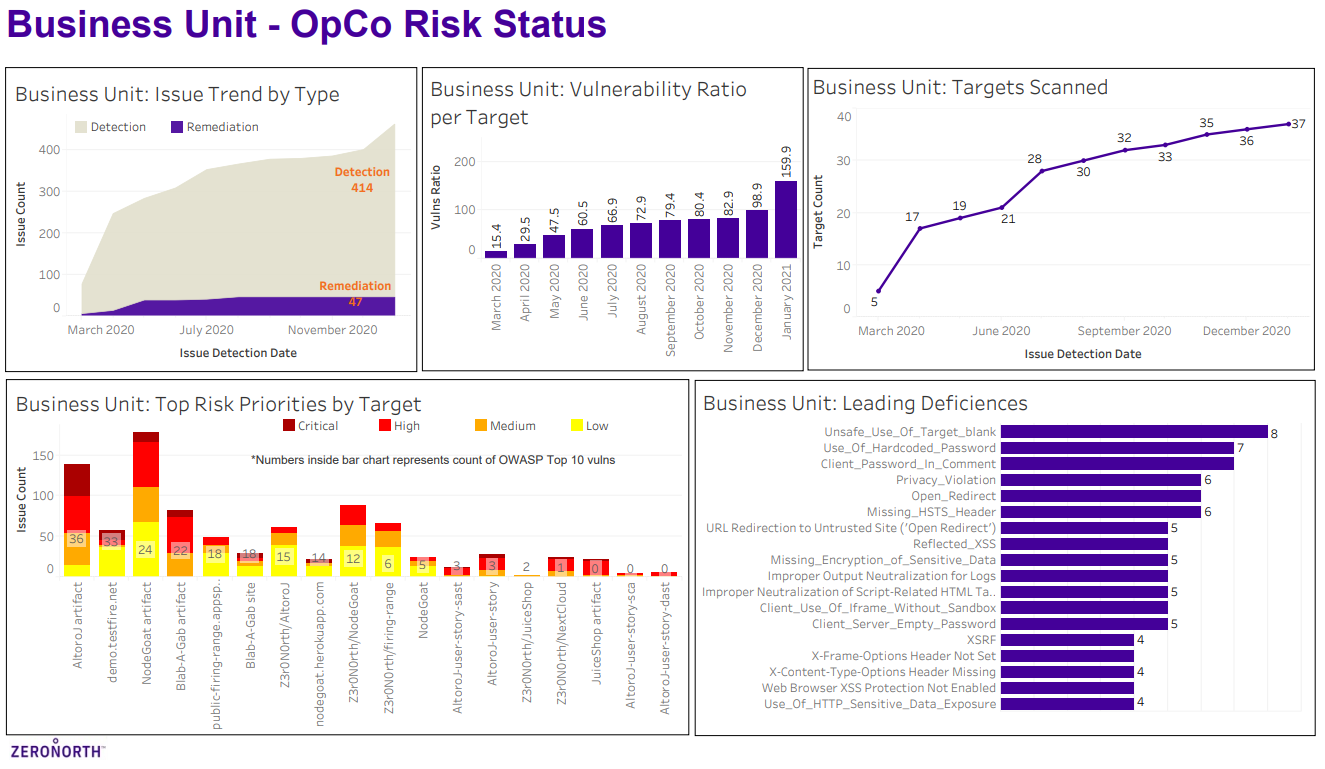
    Additionally, the Advanced AppSec Risk Analytics module will surface types of vulnerabilities detected and the vulnerabilities most encountered, ranked by criticality, along with other trends in types and number of vulnerabilities detected/remediated, such as the number and criticality of vulnerability findings per specific scanner. It also tracks the applications and entities scanned, number of vulnerabilities detected per application/entity and the applications/entities that have the highest risk.

    ZeroNorth

    Armed with that analytics data, Worral said it becomes easier for IT teams to prioritize and focus their efforts, in addition to identifying areas of the business that may need additional cybersecurity resources and training. IT leaders can also get a snapshot view of the top application security risks to better assess the organization’s overall security posture, Worral noted.

    The Advanced AppSec Risk Analytics module will also surface vulnerability remediation bottlenecks spanning multiple applications within the context of a software development life cycle (SDLC), Worral added. Longer term, Worral said the data collected by the ZeroNorth analytics application will also create an opportunity for the company to apply machine learning algorithms to DevSecOps.

    In general, Worral said the only viable path toward achieving DevSecOps is to foster more collaboration between developers and cybersecurity teams. Getting those teams on the same page in terms of the security data that needs to be analyzed is a crucial first step, Worral said.

    It’s still early on in the adoption of DevSecOps best practices within organizations, however, it’s apparent a lack of cohesion between software developers and cybersecurity teams about which vulnerabilities to prioritize is a major source of dysfunction. Cybersecurity teams tend to create long lists of vulnerabilities discovered within applications without providing much context. Developers are then left to weigh, on their own, when to address a vulnerability versus focusing on writing additional code needed to make an application delivery deadline. Developers take potential vulnerabilities seriously, but there are only so many hours in a day to write code.

    Unfairly or not, developers are being held more accountable for application security. The challenge – and the opportunity – is to find a way to make the entire DevSecOps workflow a whole lot less contentious by helping DevOps and DevSecOps teams more aware of which tasks should be prioritized when.

  • Open Source Advocates Want Share of Wealth

    Open Source Advocates Want Share of Wealth

    The egalitarian spirit of the open source community might be starting to fray as individual developers begin to question who is really benefiting most from their efforts.

    A survey of 4,440 developers who actively participated in open source projects in 2020 finds more than half (54%) of respondents said they feel that individuals should be paid for their contributions to open source projects. The report, conducted by DigitalOcean, a cloud service provider, finds only 14% of respondents are currently paid for their contributions.

    Developer opinions vary, depending on age group, about whether individuals should be paid for their contributions to open source, with those between the ages of 18-25 being more likely to be in favor (60%), while only 34% of those aged 55 or above agreed.

    “A lot more people want to be compensated,” said Raman Sharma, vice president of product marketing for DigitalOcean. “That may mean there will be a need for more sponsorships by vendors.”

    The DigitalOcean report arrives just after Elastic announced it is changing the licensing terms under which it makes Elasticsearch available. Elastic is shifting away from an Apache license to a dual license strategy that includes a server-side public license, or SSPL, along with a proprietary Elastic license. That shift was made to help ensure more of the revenue generated by Elasticsearch winds up in the hands of Elastic rather than cloud service providers, such as Amazon Web Services (AWS), that routinely launch paid services based on open source code. AWS responded to the Elastic move by announcing plans to fork Elasticsearch code that it will now curate.

    Nearly half of respondents (47%) to the DigitalOcean survey said they think technology companies should fund the payment of open source contributions, while a quarter (25%) believe project owners or individuals should pay.

    Discontent among startup vendors has been building for months. Startups typically are backed by venture capitalists, and make their software available as open source code in an effort to build a customer base on the strength of their support services. Cloud service providers have discovered they can take the code these vendors create to launch their own service. Those cloud service providers may contribute code to the project, but the startup vendor doesn’t typically enjoy any of the economic benefits.

    In most cases, the open source code used by the cloud service provider comes from a small cadre of developers that work for the startup company. Most of those startup companies are hoping to build a community around their code that includes individual contributors, external to the company, to help defray those costs. In fact, that business model has contributed to open source projects’ role as one of the primary drivers of IT innovation in recent years. If more independent developers demand to be paid for those efforts, the innovation rate of open source projects is likely to slow. The labor required to support those projects simply won’t be as freely available.

    In contrast, massive open source projects, such as Linux, have already reached a level of sustainability that other projects can only dream of. The Linux community is still ruled by Linus Torvalds, who some say is something of a benevolent dictator. Many of the contributors to Linux, however, are full-time employees working for vendors like IBM and SAP, which have a vested interest in the underlying open source platform.

    In contrast to the Linux community’s approach, the Eclipse Foundation, The Open Infrastructure Foundation (formerly the OpenStack Foundation), the Apache Software Foundation and the various arms of the Linux Foundation have stepped in to provide some level of independent governance for a wide range of open source initiatives, with mixed success. The Cloud Native Computing Foundation (CNCF), for example, as an arm of the Linux Foundation, has played a major role in spurring Kubernetes adoption. However, Google recently spurned the CNCF when it decided to create its own steering committee to oversee development of the Istio service mesh.

    Despite all the internecine rivalries and the potential for more forking of open source projects, overall, these projects are still viewed favorably. A survey of 3,400 developers, conducted by O’Reilly Media on behalf of IBM, finds 94% of respondents said they rate open source software (OSS) as equal to or better than proprietary software. Nearly two-thirds of respondents (65%) also agreed that contributions to open source projects impress potential employers and result in better professional opportunities.

    Of course, one of the primary reasons so many developers prefer open source is that there is no purchasing process for them to navigate.

    “Developers can move faster,” said Todd Moore, vice president for open source at IBM. “Programmers can move at the speed of light.”

    Regardless of motivation, it’s clear open source software isn’t going away. However, how it is built and exactly what is permissible under an open source license may soon vary much more widely from one project to the next.

  • Survey: DevOps Growing Pains in Salesforce Environments

    Survey: DevOps Growing Pains in Salesforce Environments

    IT organizations that have adopted software-as-a-service (SaaS) application platforms from Salesforce in part to jumpstart their digital business transformation initiatives are experiencing some DevOps growing pains.

    A survey published this week of 230 executives, managers, and members of Salesforce delivery teams conducted by Beagle Research on behalf of Copado, a DevOps platform for IT teams building custom applications, shows that while 82% have increased or maintained the size of their Salesforce development teams, the change fail rate jumped from 23% last year to 33% in 2020 when compared to a similar survey conducted a year ago. The survey also notes time to recover increased from 110 hours in 2019 to nearly 196 hours in 2020.

    Andrew Leigh, chief marketing officer for Copado, said those results generally reflect the nature of the more complex application initiatives being launched on top of Salesforce applications. The survey also noted 55% of respondents don’t consistently automate their Salesforce deployments, with less than a quarter of respondents (23%) having a way of automatically deploy a configuration from development through testing to production.

    In fact, in teams with fewer than 10 members, only 28% of survey respondents automated Salesforce deployments compared to 56% of teams with more than 100 developers that have automated their deployments, the survey found.

    The survey also noted that more than a third (34%) of respondents said features that development teams create may not be adopted. That issue suggests there is more work to done in terms of better aligning development teams with the goals of the business, Leigh said.

    Organizations building applications on top of Salesforce don’t typically embrace DevOps best practices until development teams have 25 or more members, Leigh noted. Salesforce environments generally require their own DevOps platform, because applications are constructed using a set of objects and tables unique to the platform. Those objects and tables are most often invoked using a set of low-code application development tools. Nearly three-quarters of respondents (73%) employed at least one commercial Salesforce development tool.

    Overall, the survey finds 82% of organizations have increased their budgets for or effort toward digital transformation, with 53% reporting they have exceeded their performance goals for the year. The survey also identifies a set of elite DevOps performers that are reporting 30x shorter lead times; 46x more frequent deployments; 5x lower change fail rate; and 37x shorter time to restore. Elite performing teams are 65% more likely to have adopted continuous integration than low performing teams, the survey notes.

    More than half of respondents (53%) said that they found it easy to find people who have DevOps experience in a Salesforce environment, with salaries typically in the $90,000-$140,000 range.

    The survey also finds the majority of organizations (82%) expect the systems integrators they contract to build applications to help define their DevOps processes.

    As organizations continue to adjust to new business realities in the age of COVID-19, there’s no doubt more custom applications will be built and deployed on top of SaaS application platforms such as Salesforce. The challenge is finding the best way to accelerate the development of those applications in a way that consistently produces the desired result.

  • Rewind Acquires BackHub to Protect GitHub Repositories

    Rewind Acquires BackHub to Protect GitHub Repositories

    Rewind, a provider of a software-as-a-service (SaaS) platform for backing up cloud services, today announced it has acquired BackHub to gain control of a platform for backing up GitHub repositories.

    Based in Germany, BackHub adds a data protection platform to a Rewind portfolio that includes offerings for backing up everything from QuickBooks to Shopify. Fresh from raising an additional $15 million in funding, Rewind CEO Mike Potter said BackHub addresses a critical issue involving the protection of some of the most valuable intellectual property any organization has in a cloud service. GitHub, a subsidiary of Microsoft, is the largest host of source code in the world, with over 40 million users and 190 million repositories. BackHub claims it protects data in those repositories for more than 1,000 organizations.

    Rewind GitHub backup

    While GitHub itself is a reliable cloud service, the code residing in GitHub is subject to the same potential threats as it would be in any other cloud service. It’s not uncommon for a malicious actor to gain access to credentials that they exploit, for one reason or another, to delete or alter data – or, in the case of GitHub, code. BackHub makes it possible to back up code stored in GitHub to another cloud service where it can be easily recovered.

    Potter said the ultimate goal for Rewind is to make it possible to back up the entire cloud. Achieving that goal will require both additional acquisitions and internal product development, said Potter.

    In the meantime, the company is focused on providing data protection for specialized cloud services usually overlooked by other backup and recovery tool providers. For now, it leaves the backup and recovery of data stored on widely used cloud services, such as Microsoft 365, to other vendors. Rewind claims more than 80,000 organizations are using its platform to protect data, stored in a wide range of cloud services, that address a specific niche use case.

    Given the prominent role GitHub plays in software supply chains, it is not surprising that the code stored in Git repositories becomes a target for cybercriminals. Much of the intellectual property stored in those repositories is a high-value target for organizations looking to reduce the amount of time required to re-engineer a rival company’s functionality.

    Nation-states around the world have cyber-espionage programs aimed at gathering any type of digital asset that might benefit their military or economy. Naturally, copying code isn’t always enough when, in one fell swoop, add code that might derail that project long enough for them to catch up.

    Unfortunately, there have been some high-profile breaches involving software supply chains. The best way to determine if a project has been compromised is to compare code bases. Repositories, by definition, provide application development teams with version control capabilities. However, backing up a GitHub repository provides one extra layer of security that can make it easier to recover from a breach.

  • EraDB Launches Log Management Alternative

    EraDB Launches Log Management Alternative

    EraDB today launched EraSearch to provide IT teams with an alternative to open source ElasticSearch software for managing logs at scale.

    Todd Persen, EraDB’s CEO, said EraSearch is based on a modern database that decouples storage and compute. In this way, EraSearch can scale more efficiently than ElasticSearch, while providing IT teams with the same familiar construct for managing logs.

    Persen said EraDB also uses true zero-schema data representation, and an indexing engine based on machine learning algorithms, to enable EraSearch to scale better. This approach also cuts cloud and operational costs by as much as 30% and 70%, respectively, by relying, in part, on object-based storage systems to store log data.

    As IT environments become more complex and continue to scale, organizations that standardized on ElasticSearch are discovering that a platform based on decades-old search engine technology is not keeping pace with their needs.

    EraSearch provides an alternative, based on a commercial time-series database platform that EraDB created, to address such use cases as an alternative to database platforms such as InfluxDB.

    The question is whether IT organizations, that have relied on ElasticSearch for years, are ready to abandon an open source platform in favor of a proprietary platform, even if it provides a similar user experience. EraDB, however, is betting there are enough IT organizations willing to make that shift to justify its investment in EraSearch.

    Persen said one issue with ElasticSearch is that, as log volumes increase beyond a few terabytes, the platform becomes inefficient and difficult to efficiently scale. That leads to higher costs in terms of both raw storage, as well as all the manual effort on the part of software engineers, required to maintain the platform.

    EraDB, of course, is making a classic case for a proprietary platform over an open source platform: that open source, while free, often proves more expensive to support. Persen said EraDB decided to eschew the open source model altogether, because it is too difficult to prevent nullification of the benefits open source could bring to a small company by open source project forks.

    The ElasticSearch community, meanwhile, is roiled by Elastic’s decision to change the licensing terms under which it makes ElasticSearch available. Elastic is shifting away from an Apache license to a dual-license strategy that includes a Server-Side Public License, or SSPL, along with an Elastic License. That shift was made to help ensure more of the revenue generated by Elastic search winds up in the hands of Elastic, rather than cloud service providers, such as Amazon Web Services (AWS), that routinely launch paid services based on open source code. AWS responded to the Elastic move by announcing plans to fork ElasticSearch code that it will now curate.

    Regardless of how that battle ends, however, EraDB is making it clear it views its platforms as too critical to its customers’ IT operations to get caught up in a similar maelstrom over business models and associated licensing terms.

  • Dynatrace Extends Reach of Observability Platform

    Dynatrace Extends Reach of Observability Platform

    Dynatrace this week updated its observability and software intelligence platform as part of an effort to expand its reach across modern enterprise IT environments.

    Announced at the online Dynatrace Perform 2021 conference, the company’s namesake platform can now capture logs from Kubernetes and Red Hat OpenShift as well as Amazon Web Services, Google Cloud Platform and Microsoft Azure cloud platforms.

    In addition, Dynatrace is adding support for open source log data frameworks such as Fluentd and Logstash. Those logs can now be centrally viewed via a Dynatrace Log Viewer that enables IT teams to search, analyze and segment both real-time and historical log data.

    Dynatrace also added a Cloud Automation Module based on Keptn, an open source tool for automating configuration of observability tools, orchestrating code tests and quality checks. Keptn was created by Dynatrace and is being advanced under the auspices of the Cloud Native Computing Foundation (CNCF).

    The company also launched a Software Intelligence Hub to make it easier to access more than 500 pre-configured integrations, as well as access tools for creating integrations without having to write code.

    Dynatrace also announced it has extended a previously launched Application Security Module to now include support for Node.js applications. In addition, the module includes the ability to enforce security policies against applications instrumented with its agent software, and offers extended capabilities to enable the detection of Kubernetes cluster vulnerabilities, as well.

    Finally, Dynatrace has added a Session Replay capability to its Digital Experience Module to enable IT teams to capture a mobile application experience.

    Steve Tack, senior vice president of product management at Dynatrace, said the company is moving quickly to add support for platforms and technologies widely employed within cloud-native applications to provide IT teams with a single platform through which they can manage monolithic and microservices-based applications.

    With the rise of microservices, IT environments are becoming too complex to manage without some type of observability platform. Historically, cost concerns limited IT teams to employing application performance management (APM) platforms, such as Dynatrace, only for their most mission-critical, monolithic applications. It’s now become apparent that observability platforms capable of correlating log and telemetry data captured from applications and infrastructure are required to effectively manage a modern IT environment.

    As part of that effort, Dynatrace is now collecting data from additional sources alongside the agent software it provides. That data is then fed into an observability platform, that Dynatrace has augmented with a Davis AI engine, to identify anomalies and other potential issues by employing machine learning algorithms.

    It’s not clear to what degree IT teams completely trust the recommendations surfaced by any AI engine. However, as platforms such as Dynatrace collect more data from an IT environment, the more accurate AI models tend to become. In fact,  IT teams that don’t have access to AI capabilities might soon be at a distinct disadvantage, compared to other IT teams that do.

    In the meantime, the battle for observability supremacy continues to intensify, as incumbent providers of APM platforms such as Dynatrace look to forestall a host of startup rivals, all promising greater visibility into IT environments at a lower cost. The challenge now is determining what level of visibility is achieved, and at what total cost.

  • New Relic Adds Visualization Tool to Observability Platform

    New Relic Adds Visualization Tool to Observability Platform

    New Relic announced today it has added a visualization tool, dubbed New Relic Explorer, to make it simpler for IT professionals to discover the root cause of issues that adversely affect application performance.

    Buddy Brewer, global vice president and field CTO for the Americas, New Relic, said the goal is to make it simpler for IT professionals to navigate and, ultimately, act on, all the metrics collected by the New Relic One observability platform.

    New Relic Explorer includes a New Relic Lookout capability that enables IT teams to drill down into telemetry data gathered from New Relic One, as well as other third-party sources, and a New Relic Navigator capability for determining the health of relationships between services, said Brewer. These capabilities make it possible to more easily identify correlations, abnormal history and traces that would be, for example, indicative of blind spots or unknown relationships between IT services, Brewer said.

    Just as importantly, IT professionals can more easily discover recent changes to an IT environment, which are most likely the cause of any new issue that is adversely affecting the IT environment, Brewer added.

    New Relic Explorer requires no configuration, and will be included as part of the existing New Relic Full-Stack Observability offering to give IT teams a single unified view of their IT environments, said Brewer.

    As IT environments become more complex, the amount of time spent looking for the root cause of an issue that might only take a few minutes to fix has substantially increased. As a result, organizations are allocating a significant amount of time to convene “war rooms” to identify the source of problems; those problems can now be more readily identified using New Relic Explorer.

    In general, Brewer said, New Relic remains committed to opening up the platform to external telemetry sources, including data collected using open source tools, such as Prometheus and OpenTelemetry agent software, both advanced under the auspices of the Cloud Native Computing Foundation (CNCF).

    New Relic, like providers of similar tools, has recently begun repositioning itself as a provider of an observability platform, rather than of application performance management (APM) tools, that provides insights into both applications and the infrastructure on which they depend. That approach promises to provide IT teams with more context any time an issue arises. As part of that shift, New Relic is making it clear that while it views its agent source as a richer source of telemetry data, its platform can consume relevant data wherever it can be found. New Relic will also remind customers that its agent software, and the other data collection tools it provides, are simpler to install and update.

    The tradeoff, of course, is cost. While open source software itself is free, the total cost of implementing and managing that open source software can be substantial. Regardless of approach, however, the days when IT teams only applied application monitoring tools to their most mission-critical applications because of cost concerns are coming to an end. It has become impossible to manage a modern IT environment made up of both monolithic and microservices-based applications without such capabilities.

  • Survey Shows DevSecOps Progress in Larger Organizations

    Survey Shows DevSecOps Progress in Larger Organizations

    A survey of 250 U.S. and UK large enterprises with more $1 billion in revenue conducted by Security Compass, a provider of a platform for automating security tasks as application are developed, finds three-quarters (75%) have implemented DevSecOps processes on current application development projects.

    Rohit Sethi, CEO, Security Compass, said the State of DevSecOps Report published today makes it clear more organizations are starting to embrace security by design as they develop their applications. Nearly three-quarters of respondents (73%) said their organizations follow a “by design” approach that enables them to proactively address cybersecurity and regulatory compliance.

    The primary reasons respondents cited for embracing DevSecOps best practices were to improve security, quality and/or resilience (54%), followed by the ability to bring applications to market faster (30%). One of the misconceptions about DevSecOps is that it slows down application development and deployment. However, Sethi said, in practice, DevSecOps enables organizations to address security and compliance issues that would otherwise result in an application not being promoted into a production environment. Almost three-quarters of respondents (73%) noted that manual security and compliance processes slow down code releases. A full 96% said their organization would benefit from the automation of security and compliance processes.

    The biggest DevSecOps obstacles cited by survey respondents included technical challenges (60%), followed by cost (40%), insufficient time (39%), lack of education (38%), lack of skills (36%) and organizational inertia (35%).

    In terms of deploying applications, the biggest reasons cited by the 51 C-suite executives that participated in the survey were insufficient automation and lack of tooling, at 51% each. Organizational barriers came in a close third (50%).

    In the longer term, Sethi said it’s clear most organizations are shifting toward zero-trust architectures to make their application environments more secure. However, achieving that goal across a broad application portfolio will require more investment in both automation and, eventually, various forms of artificial intelligence (AI), said Sethi.

    It’s not clear to what degree smaller organizations will have the tools and resources required to fund adoption of the automation platforms needed to advance DevSecOps more broadly. There’s more awareness of DevSecOps than ever. The challenge is the tools and processes required to achieve it are not uniformly being pushed into the hands of the individual developer. In some cases, organizational leaders are encouraging developers to embrace DevSecOps without any practical guidance.

    Eventually, of course, every organization will embrace DevSecOps best practices, but the real question is, at what rate? The number of applications organizations are rolling out continues to accelerate, but reliance on DevSecOps best practices to ensure security and compliance remains uneven, at best. Larger organizations that have the resources required to fund these initiatives tend to be further along in their adoption journey. However, there is no correlation between organizational size and the ability to build and deploy secure applications. After all, a smaller organization may make up for what they lack in resources with a greater commitment to DevSecOps best practices.

  • BluBracket Community Edition of Secrets Discovery Tool now Available

    BluBracket Community Edition of Secrets Discovery Tool now Available

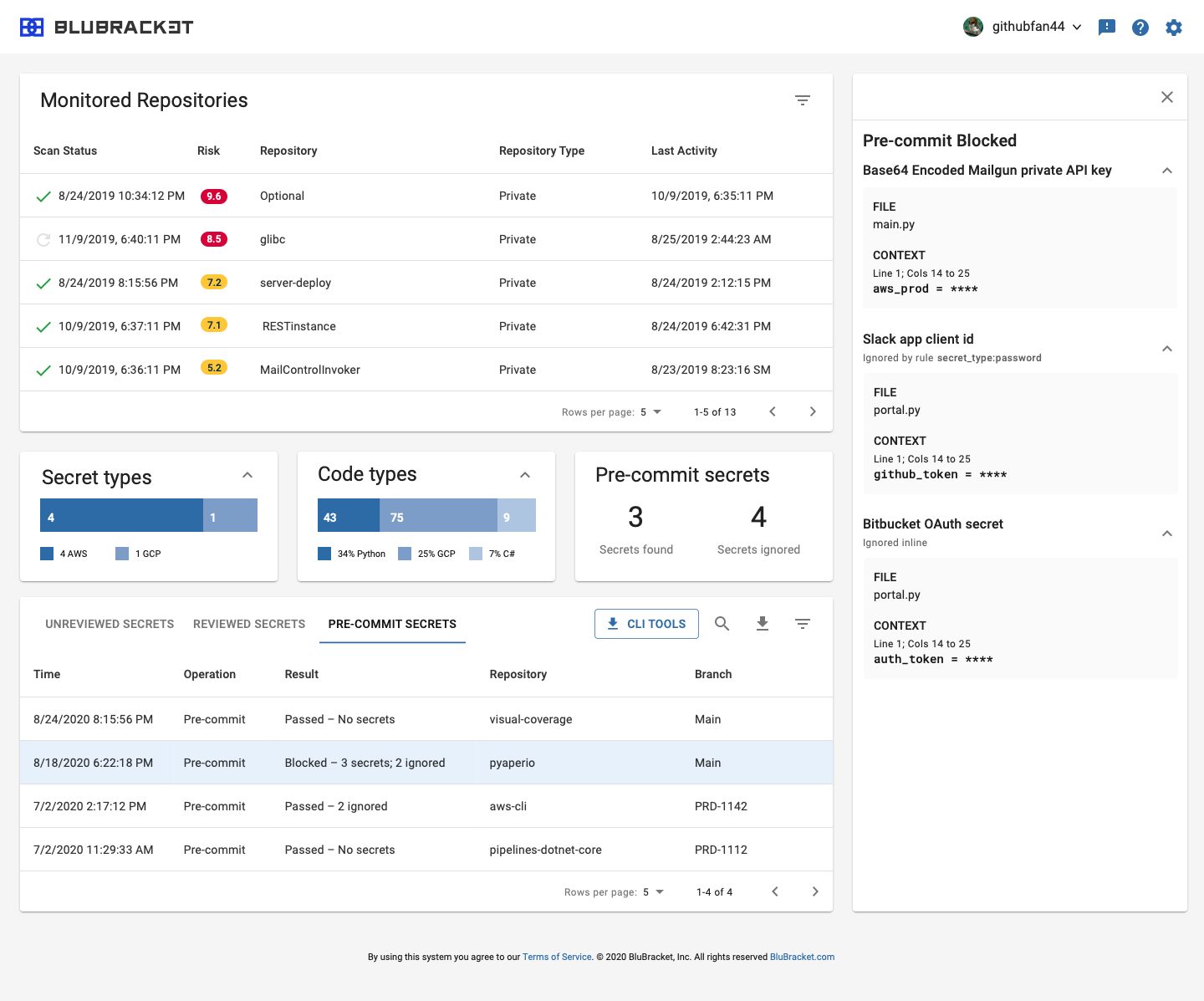
    BluBracket today announced general availability of a community edition of a tool that employs machine learning algorithms to discover passwords, tokens and other security vulnerabilities in code.

    Prakash Linga, BluBracket’s CEO, said application secrets stored in code enable cybercriminals to compromise applications in ways that can impact an entire software supply chain. The community edition of the company’s namesake tool scans commits to determine if any new risks were introduced, and will then block the staged files from being committed. It works with any continuous integration/continuous delivery (CI/CD) platform or integrated development environment (IDE) that supports pre-commit hooks, including VSCode, Jetbrains IntelliJ and PyCharm.

    Developers are then presented with a risk score based on the number of secrets discovered in their code. For example, an active token for Amazon Web Services (AWS) would receive a high score, while a a password in a test environment would be rated low.

    The Community Edition of BluBracket can be accessed via GitHub. The free version of BluBracket can be employed to scan up to 10 repositories and sharing reports in real-time, covering more than 50 types of secrets that might be employed using any programming language.

    Linga said BluBracket also cuts down on false positives by combining machine learning algorithms with a built-in rules engine. In contrast to open source tools, BlueBracket generates far fewer false positives, said Linga.

    Linga said the Community Edition is intended to help foster adoption of DevSecOps best practices among individual developers, in hopes that when those developers are hired, their organizations eventually license the full instance of BluBracket. The company views its tools as being complementary to both tools that surface vulnerabilities in code as well as secrets management platforms, which are often not employed as widely within an organization, Linga said.

    In the wake of recent high-profile breaches that embedded malware in widely-distributed applications, there’s increased focus on securing software supply chains. In some of those instances, Linga said, it’s probable cybercriminals discovered passwords and other secrets that were inadvertently exposed in code.

    However those breaches were enabled, it is apparent cybercriminals are becoming more adept at exploiting a weakness in one application to inflict maximum damage across an entire environment. It’s hard to say exactly what role secrets discovery is playing, but cybercriminals tend to prefer the path of least resistance when it comes to exploiting application vulnerabilities.

    Of course, the hope is that adoption of DevSecOps best processes will reduce the number of breaches by shifting responsibility for cybersecurity further left toward developers. However, that’s difficult to achieve without finding the simplest way possible of getting the security tools required into the hands of the developers that need them most.