Author: Mirco Hering

  • How to Fail at Test Automation

    How to Fail at Test Automation

    Let me start by admitting that I am not a test automation expert. I have done some work with test automation and have supervised teams who practiced it, but when it comes to the intricacies of it, I have to call a friend. It is from such friends that I have learned why so many test automation efforts fail. Talking to people about test automation validates my impression that this is the DevOps-related practice that people most often fail at.

    Let me share the four reasons why test automation fails, in the hope that it will help you avoid these mistakes in your test automation efforts.

    Before I go into the four reasons, allow me one more thought: Test automation is actually a bad choice of word. You are not automating testing, you automate quality assessments. What do I mean by that? It is a mistake to think of test automation as automating what you otherwise would do manually. You are finding ways to assess the quality of your product in automated ways and you will execute it way more often than you would do manual testing. This conceptual difference explains to a large degree the four reasons for test automation failure below.

    Reason 1: Underestimating the Impact on Infrastructure and the Ecosystem

    There is a physical limit of how much pressure a number of manual testers can put on your systems. Automation will put very different stress on your system. What you otherwise do once a week manually you might now do 100 times a day with automation. And into the mix an integrated environment, which means external systems need to respond that frequently, too. So you really have to consider two different aspects: Can your infrastructure in your environments support 100 times the volume it currently supports, and are your external systems set up to support this volume? Of course, you can always choose to reduce the stress on external systems by limiting the real-time interactions and stub out a certain percentage of transactions or use virtual services.

    Reason 2: Underestimate the Data Hunger

    Very often test automation is used in the same system where manual testing takes place. Test automation is data-hungry, as it needs data for each run of test execution and, remember, this is much more frequent than manual testing. This means you cannot easily refresh all test data whenever you want to run test automation and have to wait until manual testing reaches a logical refresh point. This obviously is not good enough; instead, you need to be able to run your test automation at any time. There are a few different strategies you can use (and you will likely use a combination):

    • Finish the test in the same state of data that you started with;
    • Create the data as part of the test execution;
    • Identify a partial set of data across all involved applications that you can safely replace each time; or
    • Leverage a large base of data sets to feed into your automation to last until the next logical refresh point.

    Reason 3: Not Thinking About the System

    Test automation often is an orchestration exercise as the overall business process in test flows across many different applications. If you require manual steps in multiple systems, then your automation will depend on orchestrating all those. By just building automation for one system you might get stuck if your test automation solution is not able to be orchestrated across different solutions. Also, some walled-garden test automation tools might not play well together, so think about your overall system of applications and the business processes first before heavily investing in one specific solution for one application.

    Reason 4: Not Integrating it into the Software Development Life Cycle

    Test automation is not a separate task; to be successful it needs to be part of your development efforts. From the people I have spoken to there is general agreement that a separate test automation team usually doesn’t work for several reasons:

    • They are “too far away” from the application teams to influence “ability to automate testing,” which you want to build into your architecture to be able to test the services below the user interface;
    • Tests often are not integrated in the continuous delivery pipeline, which means key performance constraints are not considered (tests should be really fast to run with each deployment);
    • Tests often are not executed often enough, which means they become more brittle and less reliable. Tests need to be treated at the same level as code and should be treated with the same severity. This is much easier when the team has to run them to claim success for any new feature and is much harder to do when it is a separate team who does the automation. It also will take much longer to understand where the problem lies.

    Of course, absence of failure does not mean success. But at least I was able to share the common mistakes I have seen and, as they say, “Learning from others’ mistakes is cheaper.” Perhaps these thoughts can help you avoid some mistakes in your test automation journey. I do have some positive guidance on test automation, too, but will leave this for another post.

    And in the case you found your own ways of failing, please share it in the comments to help others avoid those in the future. Failures are part of life and even more so part of DevOps life (trust me, I have some scars to show). We should learn to share those and not just the rosy “conference-ready” side of our stories.

    Test automation is for me the practice that requires more attention and more focus. Between some open-source solutions and very expensive proprietary solutions, I am not convinced we in the IT industry have mastered it.

    One bonus thought: If you cannot automate testing, automate the recording of your testing.

    If you cannot automate testing, find a way to record the screen with each test by default. Once you identify a defect you can use the recording to provide much richer context and make it a lot easier to find the problem and solve it. Verbal descriptions of error are very often lacking and don’t provide all the context of what was done. I keep being surprised how long triage takes because of the lack of context and detail in the defect description. There is really no excuse for not doing this. Record first, discard if successful, attach it to the defect record if you find a problem.

  • Why we are still fighting with the same problems in DevOps as 15 years ago

    Why we are still fighting with the same problems in DevOps as 15 years ago

    One thing that continues to fascinate me is how after so many years I can still walk into IT organisations and see basic practices not being followed (e.g. Software Configuration Management or Continuous Integration or …). Shouldn’t we all know better?!? I recently came across some slides from the late 90s and early 2000s that pretty much read like something that comes from a DevOps conference today. So I wonder what is it that has prevented us from being better today and I think I found a feasible answer to my question.

    For illustrative purposes I have used the Accenture DevOps maturity model, but feel free to use any other model here as the tendency would be similar. I believe that as an industry we used to be better than we are today (of course all generalisations are dangerous, including this one). While it is hard to find hard evidence for this, let me try to justify my perspective.
    DevOps Journey

    More than 10 years ago we had much more custom development to solve the big problems and most work was done onshore in collocated teams. The only way to be more productive and reduce cost was to have better engineering practices and leverage more automation, hence companies invested in this. We used to be on the mature end of consistent in many places. Then two trends caused us to regress as far as engineering practices are concerned:

    • Offshoring – With the introduction and mastering of offshore delivery, the industry had an alternative to automation and good engineering practices as labour arbitrage was providing a quick fix to cost reduction. It was potentially cheaper to do something manually offshore than maintaining or introducing automation onshore. Of course this couldn’t last as the labour cost offshore increased steadily. Some organisations stayed the course of engineering practices and automation others lost maturity along the way. This trend is similar to the same trend in manufacturing where manual labor became so cheap that automation wasn’t a critical element to cost reduction anymore. Those companies who went offshore did not sufficiently focus on automation and good practices as it was harder to oversea this with across locations and cost reductions were easy to achieve.
    • Packaged and proprietary Software – As we leveraged more and more packaged and proprietary software we relied on those vendors to provide the solution to our productivity challenges. This led over time to island solutions, which supported specific packages, but are not open enough to integrate into the IT ecosystem. How do you baseline an enterprise wide software package when configuration management is hidden in a package or worse still configuration is only possible through a graphical user interface with no access to the underlying source code/text files? The pre-packaged software was a quick fix to get functionality, but again the good engineering practices were lost out of sight. And many organisations make so many customisations that they should really treat the original “COTS” just like any other application with the same rigor. The other problem that packaged software introduced is that the people customising them are often considered or consider themselves not to be programmers (which means they don’t have to worry about those practices that the custom application developers use), a dangerous mistake in my view.

    “Speed is the new currency of IT and businesses”

    This was all well and good when cost as expressed by the cost of a day of labor was the main driver for optimisation in organisations. This paradigm has shifted and nowadays speed to market is driving incentives and behaviour. Organisations across the globe are trying to find ways to speed up their delivery processes without risking quality. But how do you now revert the trend that many organisations followed – your IT organisations is mainly outsourced and/or offshored, you have an application architecture that is a mix of packaged software, proprietary solutions and custom elements and you lack the engineering experience and skills to fix it.

    This is where we need to acknowledge that DevOps is a journey that is different for every organisation. Of course there are the engineering driven organisations like Etsy, Amazon and Facebook that have engineers/IT people in their C-suite of executives who intuitively understand the importance of application architecture and good engineering. I believe they won’t ask you for a business case for what is ultimate an optimisation for speed and flexibility – they understand how important good IT is – at least I believe that to be the case. They will also consider which applications to introduce into their ecosystem and making sure that those are open products for which good engineering practices can be employed. In other organisations the adoption of DevOps practices needs to be supported by business cases that are often difficult to create (especially in the middle maturity levels where the pain is not at mission-critical levels and the full benefit of highest maturity is not yet in arms reach). Organisations that are on this journey with the majority of us in the industry need to acknowledge the sometimes intangible nature of improvements. Speed to market and other cycle time measures should be the guides for your journey.

    “Everyone is on the DevOps journey, whether you know it or not”

    The question whether “you are doing DevOps or not” is not valid in my view. We are all on the DevOps journey, it’s the journey of improving delivery of IT solutions. DevOps is a broad field and provides us with an ever growing toolkit of practices and tools. All of us IT Executives are on the search to improve our organisations and our delivery capabilities. What label we use for that doesn’t matter as long as we keep moving forward and keep experimenting. Is there a goal to this journey? No, I don’t think there is concrete goal, a state when we declare we are done. I think the best of us will keep pushing forward no matter how good we are getting at it and from what I have seen during my travels there is still plenty of road in front of me that I can see and I don’t need to worry about getting “there” anytime soon in any case. Join me on the journey and may our paths cross to share stories of our adventures on the road.

  • DevOps for Systems of Record – A new hope (Preview of DOES talk)

    DevOps for Systems of Record – A new hope (Preview of DOES talk)

    I am speaking at the DevOps Enterprise Summit later in the month and thought I give people a teaser of what I am going to talk about, so that they know what to expect. I am looking forward to share my story – a story of adversity but also of hope – with many of you. (See me on Wed, 21st October at 11:15 at the Bayview B)

    So we have all heard about the DevOps and Continuous Delivery stories from our favorite Web companies (Google, NetFlix,…). It is much harder to come across successful case studies with Enterprise-grade Systems of Record. While I cannot provide the 50 times a day deployments for SAP (yet ;-)), I wanted to share my story so far and what I have learned in the journey (both in regards to solved and unsolved issues).

    Hopefully this contribution to the discussion helps some of those out there who are looking for a first step. But why should we even deal with COTS and other systems of record? Ultimately for me this comes back to the two gear analogy that I keep using (Two Gear Blog Post) . If you can just ditch your “legacy” applications completely, then congratulations you don’t have to deal with this and can probably stop reading this blog post. For all of you out there that cannot do that, you will be confronted with the reality that even though your digital and custom applications can deliver at amazing speed you are still somehow constraint by your “legacy” applications. Hence speeding up those will help you achieve the ultimate terminal velocity of your delivery organisation. So how do I approach Systems of Record and the DevOps adoption of it?

    DOES1

    3 Key steps:

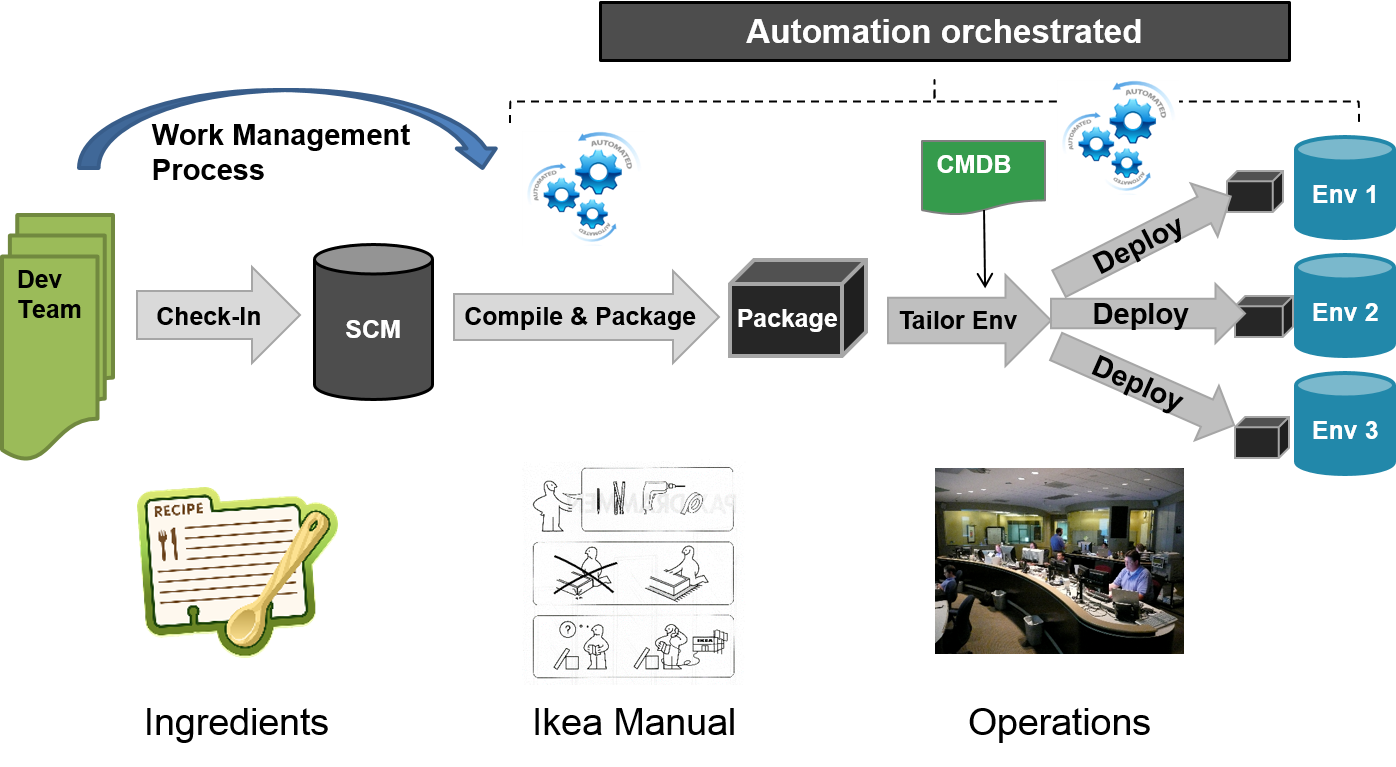
    1. Look under the hood to find the ingredients
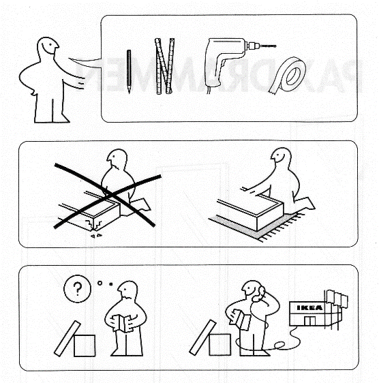
    2. Recreate the IKEA manual
    3. Understand the path to production/operations

    Step 1.  Let’s open the Hood

    DOES2Ultimately the two things that I am always looking for are the moving parts of the application and the processes to build and deploy the application. Sounds easy, right? Well it often isn’t as easy as you think, especially COTS application try to abstract those processes away. Look at SAP where you make configuration changes in one environment that then somehow get transported to other environments, but you have little visibility into the underlying process (Ok – my SAP experience is 10 years old, so it might have changed, but you get the gist).

    Why do we look for moving parts? Well we want to use the common software engineering practices as much as we can and don’t necessarily want to trust the inbuild features for version control for example. So we look for ways to find the source code files or ways to extract the relevant information in text format (well SQL, XML, etc count as text in my world view), this is sometimes relatively easy (Siebel .sif files are just a type of XML for example) and sometimes it is pretty difficult or impossible. These underlying files is what we will store in source control to make sure we understand at each point in time the configuration of the application.

    Once you have found the source code, you will have 3 things to do with it:
    a) Get it out of the proprietary solution
    b) Integrate it with your IDE
    c) Solve for Merges
    (I will explore this further in another blog post later)

    Step 2. Recreate the IKEA Manual
    DOES3Once you have all the moving parts, you need to understand how it all fits together. Custom applications usually require explicit instructions which makes it much easier to define and automate the instruction set. For systems of record packaging and deployment is often done through UIs and there is usually more than one way of doing it. Experienced operators have found their own short cuts and the reliability of the system depends on having the right guy in the operating centre (I have some stories to tell about not having the right guy on go-live weekend).

    Your goal needs to be an “Ikea Manual” that creates the system from the moving parts we identified earlier without requiring complex interactions or decisions from human operators. Ideally all instructions work from the commandline or some programming API, but when all else fails a UI driver like Selenium can solve the really tricky parts of creating and automating the manual user entries in the application. Every black-box step should be drilled open so that you understand what is happening within the system and so that you understand the variations that could cause you trouble down the path.

    Step 3. Understand the Path to Production
    does4Speaking of paths…Of course for systems of record the same rules apply as for any other system. You should practice the exact things that you will do to establish the system in production in all previous environments and minimise the difference between configurations. The challenge for systems of records is often the cost associated with production like environments So you might have to look for creative ways to minimise the difference and to parameterise configurations so that you can at least automate for the differences.


    So all is good in Mirco’s land of the Systems of Record?
    Unfortunately not, there are still many challenges that I am working on. The progress we have made so far allowed for a step change in velocity and reliability, but there are still areas that I want to find better solutions for:

    • Unit test automation
    • Unsupported activities or no API
    • Performance
    • Configuration Management skills – the curse of the configurators
    • Common Objects
    • Operations – the last mile…

    I will speak at much more detail about my experiences at the DevOps Enterprise Summit, if you are attending, come say Hi. I am always happy to show you the scars of working with Systems of Record and share war stories.

    And for two “legacy” technology stacks that I have done extensive work for (Siebel and Mainframe ) I promise to write more in-depth blog posts in the future.