Author: Manasi Vartak

  • Positioning ML Devs and Teams for Success

    Positioning ML Devs and Teams for Success

    Intelligent applications are (by their very nature) complex. While conventional software basically consists of one thing (code), intelligent software involves code, models and data. As previously discussed, three distinct fields—DevOps, MLOps and DataOps—have evolved to govern each of these interconnected disciplines. 

    Moving through the ML life cycle quickly and efficiently requires collaboration between teams in each of the above disciplines. Organizations should strive to make this collaboration as frictionless as possible to position their ML efforts for success. What follows are four places where we believe organizations should focus: 

    • Infrastructure
    • Team structure
    • Tools 
    • Project ownership and KPIs

    Build Dedicated Infrastructure for Each Pillar

    Infrastructure software is not one-size-fits-all across the three pillars of code, model and data. For example, DevOps teams have historically played the infrastructure role in software development, supporting application or product services. Think of regular software engineering teams who are supported by DevOps, producing different kinds of application services. App infrastructure is so baked-in to software development that most of us take it for granted.

    Just as regular software services require DevOps, data and model services require corresponding infrastructure. Data infrastructure is typically concerned with managing tools (such as Airflow installations, Spark clusters and feature stores), building data pipelines and ensuring that data services remain smooth and operational for data consumers. 

    On the other hand, model services are chiefly concerned with creating, running and organizing models in such a way that others can use them efficiently. Since the AI/ML life cycle is incredibly complex, a host of factors need to be considered (e.g., hardware, parallelization libraries, model packaging formats, etc.) to help data scientists and engineers do their jobs efficiently. Robust ML infrastructure along with a dedicated ML infrastructure team goes a long way in helping organizations scale their AI.

    Optimize Team Structure

    Best practices for ML and AI are continuously evolving, and organizations have tried a host of team structures over the years. We have noticed two popular structures for intelligent application development teams emerged in recent years:

    • Pods

    Pod structures involve smaller teams—usually a data scientist, a data engineer and an application software engineer—working together closely to deliver an intelligent feature or product. Due to their tight-knit nature, these teams are positioned to iterate extremely quickly, which often leads to better products and features. However, the closely-knit nature of pods also comes with a downside, as knowledge sharing between pods with different objectives can be difficult.


    • Center of Excellence

    In a center of excellence (or COE) structure, all data scientists or data engineers are “pooled” and then assigned to different products or features depending on project requirements and circumstances. In contrast to pods, COE structures tend to share knowledge very easily. However, this arrangement can lead to slower iteration cycles because team members are not dedicated to particular products or features. 

    In our opinion, both pod and COE arrangements can be effective depending on the realities of an organization. Choosing an optimal team structure depends on how the rest of the organization is structured and how reporting relationships are set up. 

    Select Appropriate Tools

    To select the best possible tools for your organization, choose those that foster collaboration and uphold safety across code, model and data teams. 

    The right tools help teams work quickly and efficiently. Teams should be able to discover pertinent information for themselves without having to pull others off of whatever they are working on. For example, a data science team should be able to discover what data access or learn what features exist. Similarly, application teams should be able to discover what models exist, what versions are the latest or how and when to use models. The more that you can make your code, model and data self-serve, the faster teams will be able to build products that are ready to be put into production. 

    Furthermore, proper tools make debugging faster and easier. If you’ve been around ML-enabled features or products for any length of time, you’ve probably been bitten by undeclared dependencies and apps breaking due to upstream changes. In an intelligent app, finding the root of a problem can be extremely difficult because the root cause can exist in any of the three pillars or any combination of the three. Robust tools provide logs and information to help discover what went wrong more easily.

    Finally, governance should play a key role in tool selection, as safety should be a chief concern for ML teams. For example, consider a model that predicts the demographics of a user based on their app usage. While these predictions might be considered acceptable in certain applications, if a model is being used to make financial recommendations or approve credit applications, use of certain demographics may violate various consumer protection laws. Since a software engineer using this model might not be aware of the nuances related to its use, baking in safety checks on model and data use becomes vitally important. 

    Establish Ownership and Determine Appropriate KPIs

    Whether we are working at a company or in an academic lab, our goal always remains the same: build the best product. 

    But “best product” can mean a lot of different things depending on the use case. For example, sometimes teams may be willing to trade a bit of accuracy if a model fails in predictable ways (e.g., in health care applications.) By contrast, an e-commerce recommendation system can optimize for overall model accuracy even if a model isn’t quite as stable. As a result, choosing the appropriate KPIs for model optimization requires careful attention.  

    Similarly, choosing appropriate metrics that make sense for the product and business usually requires a high-level view of a number of factors — user expectations, revenues, user complaints, etc. In our experience, product owners are usually in the best position to make these decisions. KPIs for each of the pillars supporting the intelligent app should be based on key metrics determined by product owners. While these can range, we’ve seen the following KPIs work well:

    • Code — Number of releases, number of bug fixes, number of features that have shipped, mean time to resolution
    • Model — number of model iterations shipped, model quality in production, model performance SLAs 
    • Data — frequency of data refreshes (e.g., every day or every month?), number of data quality issues, speed of access to data

    The key point here is to drive all of these based on the product KPIs and to focus on the agile principle, which is how quickly are you moving and how many deploys are happening. 

    Know what metrics your team is looking to optimize so that you can invest your resources in the right spot. 

  • What is MLOps? DataOps? And Why do They Matter?

    What is MLOps? DataOps? And Why do They Matter?

    Let’s look at three distinct disciplines—DevOps, MLOps and DataOps. In 2011, Marc Andreessen famously proclaimed that software was “eating the world.” A little more than a decade later, it’s all but impossible to argue with his premonition as software has embedded itself into virtually every industry. 

    But now another shift is underway and AI is gobbling up software as we know it. Our emails can finish our sentences for us, connected cars are helping us stay safer on the road and predictive technology is helping minimize supply chain disruptions caused by COVID-19. In the near future, almost every piece of software we interact with will have intelligence built-in, and as AI gains acceptance and new use cases are rolled out, applications will only continue to become more intelligent. The widespread move toward ML-enabled software has the potential to be as transformative and far-reaching as what Andreessen predicted. 

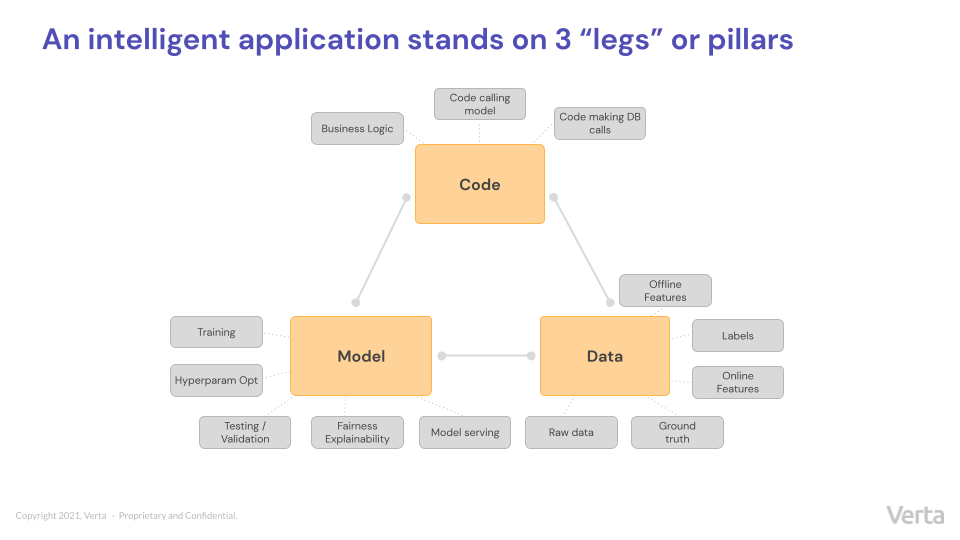
    But innovation is rarely easy or simple—and intelligent applications are no exception. While conventional software involves one thing—code—and not much else, intelligent software relies on a complex relationship between three interconnected variables or legs of a three-legged stool.

    A Three-Legged Stool: DevOps, MLOps and DataOps

    Model:  The one or more AI/ML models (e.g., linear regressions, rules, deep neural networks, etc.) trained to recognize patterns in data and make decisions are what makes an application “intelligent.” 

    Data: Most often, a model is trained on historical data and programmed to emulate it. As a result, an application’s behavior depends heavily on the data—the raw input data, labels and features, as well as the new data to which the model is applied and ground-truth for this data.

    Code: Code is the language an application uses to function. When used in the context of intelligent applications, the code pillar might refer to business logic, calls to models, receiving outputs, decision making and calls to other data systems. 

    A Real-World Example

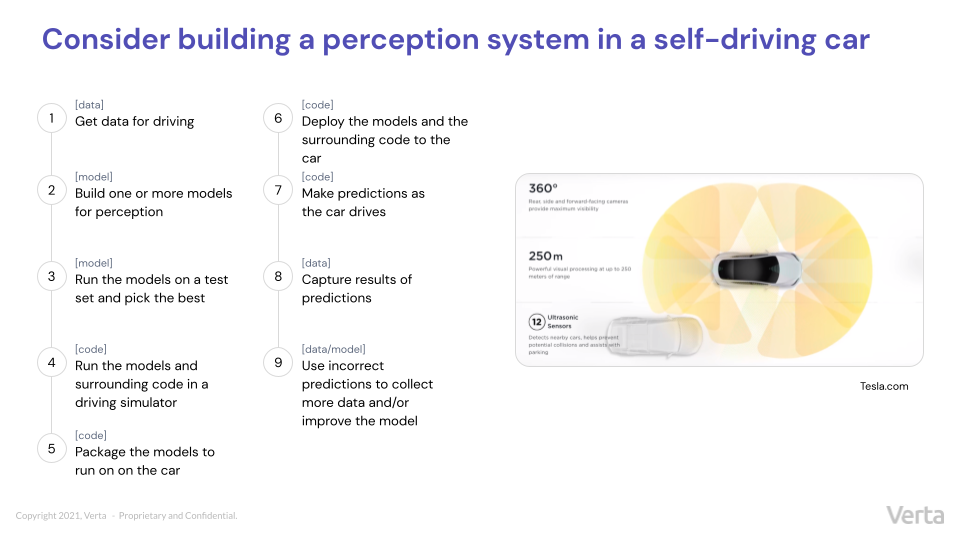
    To see how these pillars play out in real life, consider the example of a perception system for a self-driving car. Such systems use data (provided by offline sources and real-time cameras and sensors), models and code to determine myriad ever-changing variables (for example, if there are obstacles on the road, what lane markings look like, how fast a car can safely travel, etc.) While the following illustration is greatly simplified, it outlines the basic steps needed to build and deploy such a system and indicates which pillar each step belongs to. 

    Regardless of application type, the legs that intelligent applications stand on are always the same: Model, data and code. And if you try to remove any one of them, the application will topple over.

    With the three distinct pillars that make up intelligent applications, three distinct disciplines have emerged to keep each individual pillar functioning as efficiently as possible: DataOps, MLOps and DevOps. The rest of this post examines the details that make each discipline distinct and necessary to the model life cycle.

    DevOps

    Once upon a time, companies used waterfall processes to develop software. The process often moved so slowly that products didn’t realize their potential before they died or were replaced. In 2000, Agile was introduced, allowing developers to work quickly and iteratively in tight sprints where they were constantly delivering. By 2009, Flickr, for example, was the envy of the industry, routinely performing 10+ deploys per day. Companies seeking to increase their own productivity combined software development with established operations principles—and the term “DevOps” was coined. 

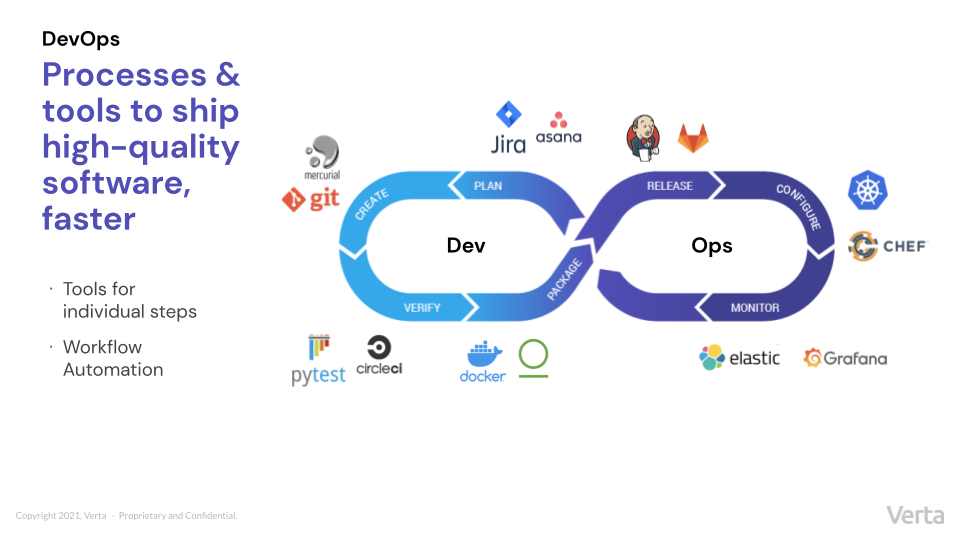
    As the familiar loop graphic below illustrates, the DevOps cycle goes from the planning stages to the creation, testing/verification, packaging, release, configuration, monitoring and then starts over again with planning. Over the past two decades, a host of unique tools have emerged to support individual steps in the DevOps life cycle—helping developers ensure quality by building in continuous integration and continuous testing from the start and helping speed up time-to-market with workflow automation. The DevOps ecosystem is robust, well-thought-out and always iteratively improving.

    MLOps

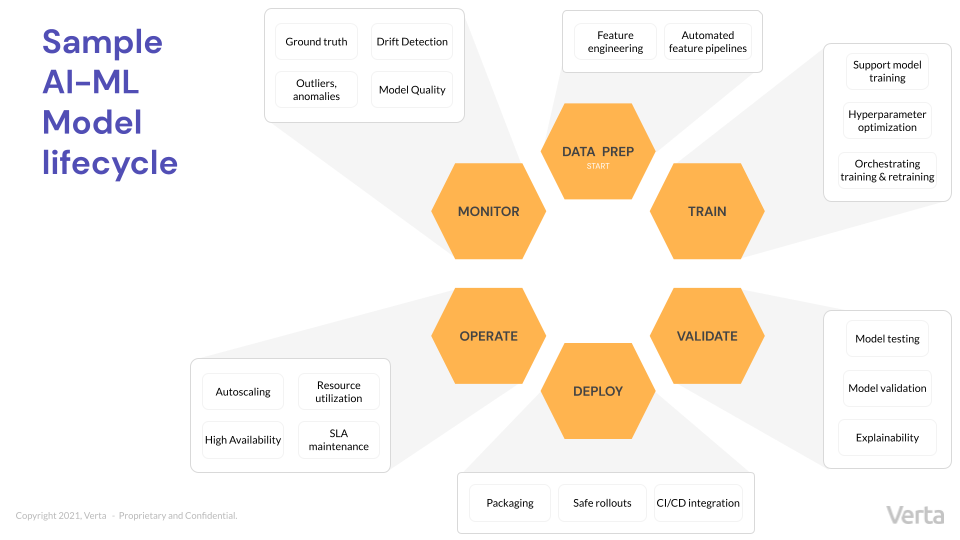
    MLOps helps teams move more quickly and efficiently through the model life cycle—a loop that involves six distinct steps, each of which contains unique considerations. 

    Since MLOps is related to DevOps, businesses sometimes try to adapt the processes used to write conventional software to execute the unfamiliar task of machine learning operationalization. But the approach doesn’t work, as the two disciplines are actually quite different.

    MLOps primarily deals with models, not code—and models are quite different from code. For example, model training and testing look very different from code building and testing. (What does “test case” even mean for a model?) And monitoring model performance is completely different than monitoring traditional software. (DevOps looks at things like CPU utilization, latency and throughput, while MLOps looks at model quality, drift and data quality.)

    Furthermore, the people that MLOps engineers are building for are quite different than their DevOps counterparts. As one might expect, the primary users of models are data scientists while DevOps generally serves software developers. Most often, MLOps engineers come from a background in ML and data science or software engineers who picked up ML. 

    As with DevOps, no single all-inclusive MLOps platform exists. Rather, different tools support different individual steps in the model life cycle and provide some amount of workflow automation to speed up processes. Different tools support specific pieces of the ML life cycle—but the ecosystem is still somewhat fragmented. Ideally, MLOps will evolve to offer more DevOps-like tools that work well together and offer more automation. For companies looking to build an MLOps platform, build a suite of supporting tools with speed, safety and automation in mind.

    DataOps

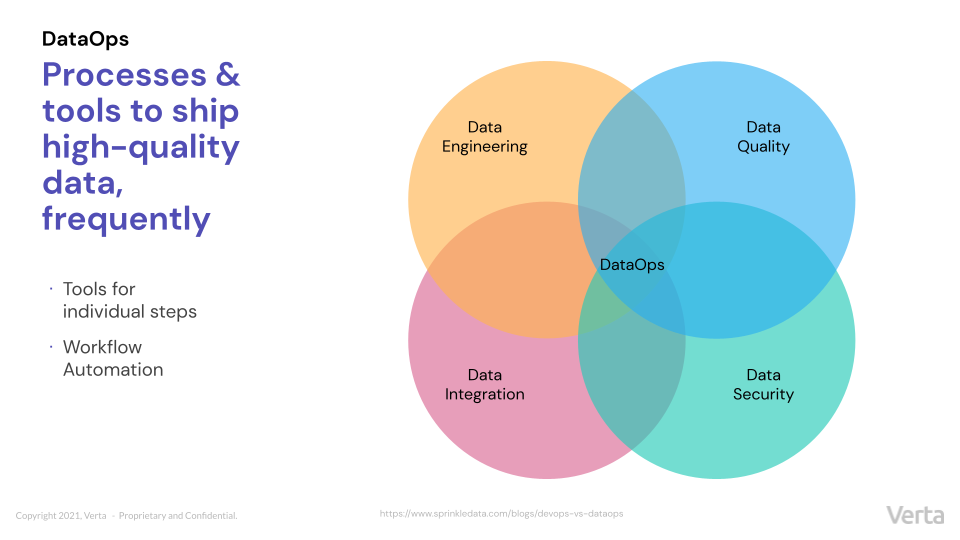
    We’ve seen very well-defined life cycles for the other two pillars discussed above; however, when it comes to DataOps, the life cycle is still being defined. But the overall objective of DataOps should sound familiar: DataOps involves processes and tools to ship high-quality data frequently—which requires a combination of data engineering, data quality, data security and data integration. 

    As with DevOps and MLOps, what the DataOps platform or DataOps engineer is doing is supporting the tools that help perform one of these activities and help build workflows. For example, a workflow may take data from a database, apply some transformation to it and then make it available for a business intelligence (BI) tool. That’s the kind of automation that is involved in DataOps. 

    As you might imagine, the skillset and the tools required for DataOps are quite different from the ones needed in MLOps and DevOps—so expecting a DevOps engineer to also be an expert in DataOps seems a bit unrealistic. While MLOps requires a much tighter integration with data than DevOps historically has required, MLOps is not the same thing as DataOps. More so than the other pillars that support intelligent applications, DataOps tends to be quite separate and distinct. 

    Conclusion

    From perception systems to enterprise-scale fintech software, every intelligent application depends on three distinct disciplines: DevOps, MLOps and DataOps. And therein lies the complexity of developing intelligent products. Each of these fields is distinct, dealing with a different set of questions and objectives within the ML life cycle and requiring different kinds of people and tools. However, they are all fundamentally united by a common goal: Optimizing quality and speed of iteration of the ML life cycle. The tools, practices and organizations that will rise to the top are the ones that will enable more seamless collaboration between different ML teams, helping them move through the ML life cycle quickly and efficiently.