Author: Kit Merker

  • Debunking Myths About Reliability

    Debunking Myths About Reliability

    “Our service should always be up.” Some myths just won’t die.

    Engineering for reliability is well understood by engineering leaders, less so by bosses demanding unreasonable uptime with minimal resources and immense feature pressure. Business leaders tend to waffle between ignoring reliability with a hand wave and freaking out after an outage. How can they understand the reality of reliability and forget the myths?

    Myth One: Our Service Should Always be Up

    Reality: Our Service is Engineered to Consistently Exceed Expectations

    Some might imagine reliability like a light switch—it is either on or off. But reliability is about consistent repetitions and managing the risk of minor, occasional, recoverable failures. Can we consistently exceed customer expectations?

    Understanding customer expectations is challenging because you can’t ask people what they expect from you (unless you have a peculiar customer). So instead, we want to define and quantify the impact of our service not working and how that could negatively impact customer experience based on observed behavior. For example, “People abandon their shopping cart when our checkout experience takes more than 10 seconds to load, which means we lose money.”

    We reflect business impact in our reliability goals and then engineer our system and processes to meet this goal. We might change how we do releases, ensure tests pass or avoid changes during times of peak usage. These engineering decisions use reliability as a business metric based on customer expectations.

    Myth Two: Innovation is More Valuable Than Reliability

    Reality: You Need to Balance Innovation and Reliability Engineering Work

    The constant drive for new features over reliability is the most frustrating myth. “We need to release new feature X, or we won’t have customers; we can worry about reliability later.” In reality, most customers care about reliability; they don’t mention it until it’s a problem.

    You can have the most fantastic whizbang feature in the world, but if it doesn’t work–and Murphy’s Law will make sure that it doesn’t work at the worst possible time–no one can use it, no one will be impressed and it will turn your technology into a laughingstock.

    Innovation excites customers, but trust comes from reliability, which you must earn through hard work and clever engineering. Depending on your business context, you may require reliability more than ever. If you are facing headwinds, you may need to scale back your ambitions regarding innovative features. Still, you can’t scrimp on reliability or customers will justifiably leave.

    Myth Three: Five Nines is Normal and Incremental From Four Nines

    Reality: Five Nines is Expensive—10X the Cost of Four Nines

    No one–not even massive cloud providers or telcos–can consistently deliver at 99.999% across all their services by accident. Reliability at that level–less than six minutes downtime per year!–is an engineering marvel. A bridge or a dam might look simple after completion, but the engineering required to create a reliable physical infrastructure is immense, as everyone knows. Why is it so hard to understand the complexity, design, engineering and redundancy required to deliver a highly available and performant digital system? Further, it’s easy to think that 99.999% is just a bit more than 99.99%. After all, it’s “just one more nine.” Remind your less-technical counterparts that each nine requires ten times more effort!

    Why is it so expensive to deliver? Because the failure tolerance (also known as an error budget) is 1/10th the size but the risk of missing the goal increases exponentially. You’ll need more redundancy, careful testing and certification of releases, increased on-call rotations, extra hardware or cloud capacity and extensively tested backup plans to achieve this goal.

    Worst of all, higher reliability will slow you down. You can’t innovate or deliver updates as fast when you need to ensure absolute uptime.

    But what if there was a limit to how much reliability we need?

    Myth Four: More Reliability is Always Good

    Reality: Reliability Engineering Has Diminishing Returns

    There is a point at which being “too reliable” is terrible for business. It’s expensive to build all that redundancy, testing, responding to tiny glitches and all the rest. And most of your users won’t notice. We must avoid the large blowups that put us in the headlines and manage expectations everywhere else. The significant outages that can impact thousands, if not millions of customers come from this reductionist view of reliability as a by-product of conscientious work rather than an engineering problem with well-defined tolerances and thresholds. You earn the trust of your customers by properly engineering reliability into your delivery process.

    Consider tardiness at meetings. If you wanted to be 99% on time, you’d need to join a one-hour call within 36 seconds and at 99.9%, you would need to enter a Zoom within 3.6 seconds of its start time, a timescale so small you don’t even notice it. You would have to do this for every meeting you attended, no excuses–bio breaks, last meeting ran long, someone at the door, etc. None of these things matter when defining and measuring reliability. This metaphor also provides a common sense way to think about risk and error budgets. Your other meeting attendees can’t possibly notice (or care) if you’re 3.6 seconds late, no matter how prestigious or impatient the other party is.

    You could apply this same reasoning to catching a flight, picking up your kids from school, completing an exam, building a woodworking project or any human endeavor. The concept is so intuitive to daily life that even pointing it out seems absurd. But this is the fundamental concept from which reliability engineering stems. To build a reliable system, we must define acceptable failure boundaries. Otherwise, we will spend precious time and resources to eliminate the 3.6 seconds of delay that no one cares about and miss the more significant issues–like being present and engaged in the discussion.

    Busting Reliability Myths

    Understanding reliability is vital for engineers and business people alike. It all comes down to intentionally designing a customer experience, keeping up with expectations and, in some cases, even promises. Right-sizing reliability lets you find the perfect balance between delivering excellent service and efficiently running your organization.

    Image Source: Indira Tjokorda via Unsplash 

  • SREs: Stop Asking Your Product Managers for SLOs

    SREs: Stop Asking Your Product Managers for SLOs

    One of the fundamental premises of software reliability engineering is that you should base your reliability goals—i.e., your service level objectives (SLOs)—on the level of service that keeps your customers happy. The problem is, defining what makes your customers happy requires communication between software reliability engineers (SREs) and product managers (PMs) (aka business stakeholders), and that can be a challenge. Let’s just say that SREs and PMs have different goals and speak slightly different languages.

    It’s not that PMs fail to appreciate the value that SREs bring to the table. Today, in the era of software as a service, features such as security, reliability and data privacy (which used to be considered “non-functional requirements”) are respected as critical features of the service-product a SaaS company delivers. Modern application users and customers of software services care a lot about data privacy, cybersecurity and uptime; therefore, PMs care, too. In fact, it’s not uncommon to see these features touted prominently on a company’s website (I saw one today claiming “99.99% uptime for every customer!”) because the folks in marketing know that customers are making purchasing decisions based on whether the company can deliver reliability, speed, security and performance quality. So, yes, PMs do care.

    The difficulty lies in the negotiation between the PM and the SRE about the value of providing that level of service and the cost associated with it:

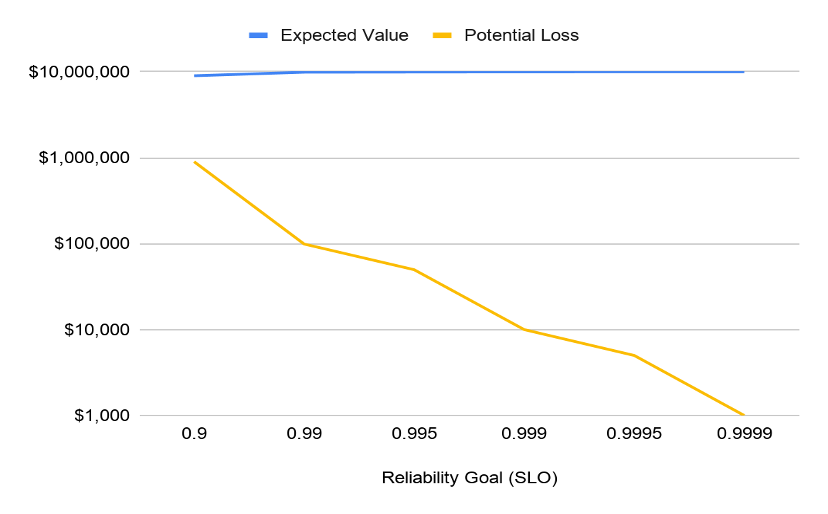
    The people and infrastructure costs associated with providing the next level of reliability increase geometrically for a host of reasons, but the expected value to a $10 million business of losing out on that one in 1,000 transactions versus one in 10,000 is only $1,000.

    But translating “customer happiness” into actual objectives derived from observable metrics is easier said than done, particularly for companies that are just getting started with SLOs. Let’s face it, all the talk about “nines” can be difficult to conceptualize. Fortunately, there’s an easy way for PMs and SREs to get on the same wavelength.

    Engineers, stop asking your PMs for SLOs!  Instead, convert user stories into reliability goals.

    User stories are a great way for PMs to express a customer’s experience and expectations to the engineering team. SREs can then translate the user stories into SLOs in a few simple steps.

    What is a User Story?

    User stories are narratives that describe how a particular type of user engages with the service. The first-person plotline might go like this: I am this type of person, and this is what I need and expect to be happy, and if I’m not happy, this is what it’s going to cost you.

    Note: In this user story, we’ve taken the liberty of including empathy for the reliability expectations of the user.

    Retail example: I’m a shopper on your online store on Black Friday, and I want to take advantage of your Black Friday sale. I want to log on, peruse your Black Friday deals, pick the products and features I prefer, and make my purchase in just a moment or two. If it takes too long to log on, or if I get hung up in the system, I’ll easily get frustrated and move on to other retailers. I don’t want to miss the deals!

    An SRE can take that user story, ask the PM a few questions to gather just a few more critical bits of information, then do some simple math to derive the SLO for your Black Friday.

    Ask Your PM These Questions

    To determine the reliability goals for a user story, you need to add three pieces of context:

    Step 1 – Identify the Top Critical User Transactions

    First, determine the relative priority or criticality of the transaction being successful. Not all transactions are created equally, so we need to understand what kind of transaction we’re talking about here. For example, browsing a catalog page (which could be refreshed if unsuccessful) is different from the shopper’s checkout experience.

    Retail example: We have several transactions in a retail business, including:

    1. Inventory catalog search.
    2. Order fulfillment.
    3. Payments processing.
    4. Price and discount.
    5. Checkout experience/shopping cart abandonment.

    For our example, let’s develop the SLO for payments processing, which is a throughput metric—the total number of transactions a retailer can handle in a given period of time.

    Step 2 – Estimate the Volume of Transactions at Various Times

    Now that we know the transaction we’re talking about (payment processing throughput), we can estimate the rough volume of transactions or user interactions that will occur in each of those categories, rounded to the closest order of magnitude (see Fermi Estimation). How much of your business happens during this time? Do you have a critical time of day? Do you have a critical season? Do you have a critical day(s) of the year?

    The same transaction at a different time may be more or less valuable. Think about an ad playing during the Superbowl or stock prices while the market is open. Or when your CEO is giving a critical customer presentation. Timing matters.

    Retail example: Our hypothetical retailer has critical periods in the holiday shopping season and a critical day called Black Friday. Typically, 4% of annual business happens during Black Friday weekend, and 16% of annual business happens during the remaining holiday season.

    Adobe Analytics estimates that sales for the full weekend (Thanksgiving through Cyber Monday) is 20% of total revenue for the full holiday season. According to the National Retail Federation, 2019 holiday sales were $730.2 billion, accounting for 20% of annual sales.

    Step 3 – Estimate the Business Value of Transactions in Each Circumstance

    Finally, we can now understand how the reliability of this transaction affects business outcomes. This could be the risk of lost revenue or perhaps a brand reputation metric such as reduced CSAT. Now you have a pretty clear picture of the business impact of unreliability.

    Retail example: If our imaginary retailer has revenue of $10 million, it would make $400,000 of that during Black Friday weekend, and $1.6 million during the rest of the holiday season. On Black Friday shopping carts are worth $100, $80 during the holiday season and $50 the rest of the time. There are 800 transactions per day on Black Friday, 625 per holiday season day and 488 any other day.

    Now that you have this input, you can start to calculate appropriate SLOs based on the value at risk and the cost to meet that reliability goal.

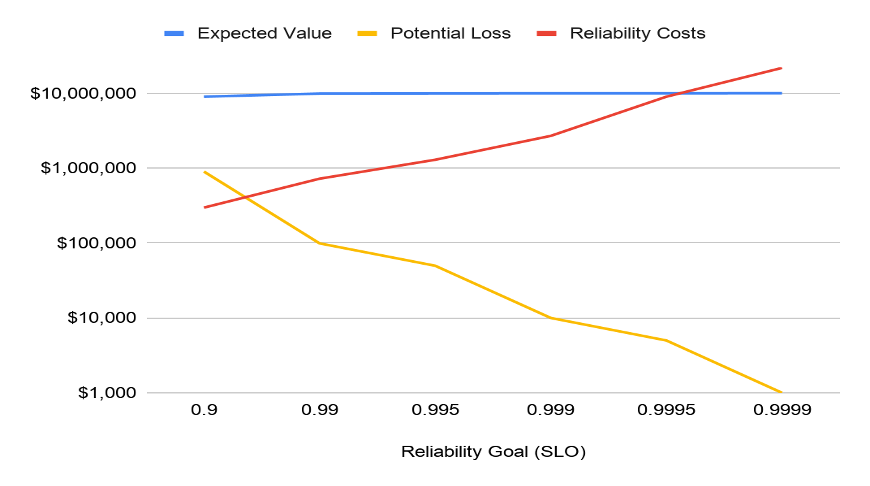
    If possible, you can estimate the cost to deliver each level of reliability. Consider not only the cloud computing and direct operational costs, but also the reliability investments in testing, performance, security, chaos engineering, release management, rollback, monitoring, on-call, automation, etc., that would be required to achieve the reliability level at each point. By plotting this cost (at least to the order of magnitude) you can find a break-even point where the value at risk and cost of reliability crossover. This is the business-justifiable SLO for these transactions.

    Plot the value-at-risk as a function of value x volume x SLO. The value-at-risk will decline sharply as the reliability is increased; however, the cost to achieve this reliability also increases exponentially. It’s simply not worth investing more than that at-risk amount for any given user story, so the SLO determination is clear. Note that the SLO may not be achievable for the team currently, but you have a precise idea of what matters to the business and the break-even point of your reliability investments.

    Instead of asking PMs to “speak SRE,” span the communication gap by using the common language of user stories to build business-cogent SLOs.