Author: Jayne Groll

  • Human Transformation Breeds DevOps Skills and Success

    Human Transformation Breeds DevOps Skills and Success

    As part of its mission to advance the human elements of DevOps, DevOps Institute has released its 2020 Upskilling: Enterprise DevOps Skills Report. The year-over-year data builds on the inaugural 2019 project but it’s more insightful and more regional than last year. DevOps Institute is grateful to the 1,300 respondents this past year who took the time to share their insights that allowed us to present this important research to the community.

    One thing that is abundantly clear is that human transformation is the single most critical success factor to enable DevOps practices and patterns for enterprise IT organizations. Traditional upskilling and talent development approaches won’t soon be enough for large enterprises to remain competitive. This is because the increasing demand for IT professionals with core human skills is escalating to a point that business leaders have not yet seen in their lifetime. If there is but one call to action from the report this year is that we must update our humans through new skill sets as often—and with the same focus—as our technology.

    Thoughts on Skills

    What we continue to see is a well-recognized gap between the skills needed for digital transformation and the skills available in new and existing talent. According to 58% of the Upskilling report respondents, finding skilled DevOps individuals is a huge challenge, whereas 48% of respondents say the retention of skilled DevOps individuals is a challenge.  

    Unfortunately, the term “skill” is so broadly generic, which fuels the belief that there is a single stack of competencies that will guarantee enterprise success. That’s simply not true. The modern IT professional has to possess a set of skills across at least four categories: process, function, automation and core/human skills. Within each category, individuals must know which skills are considered must-have, nice-to-have or not as important—which leads to the question: How do you know? Seeking the answer to that question is the genesis of DevOps Institute’s Upskilling: Enterprise DevOps Skills Report project.

    Additional Takeaways from the 2020 Upskilling: Enterprise DevOps Skills Report

    • The DevOps journey is difficult for at least 50% of respondents since it changes the traditional structure of IT.
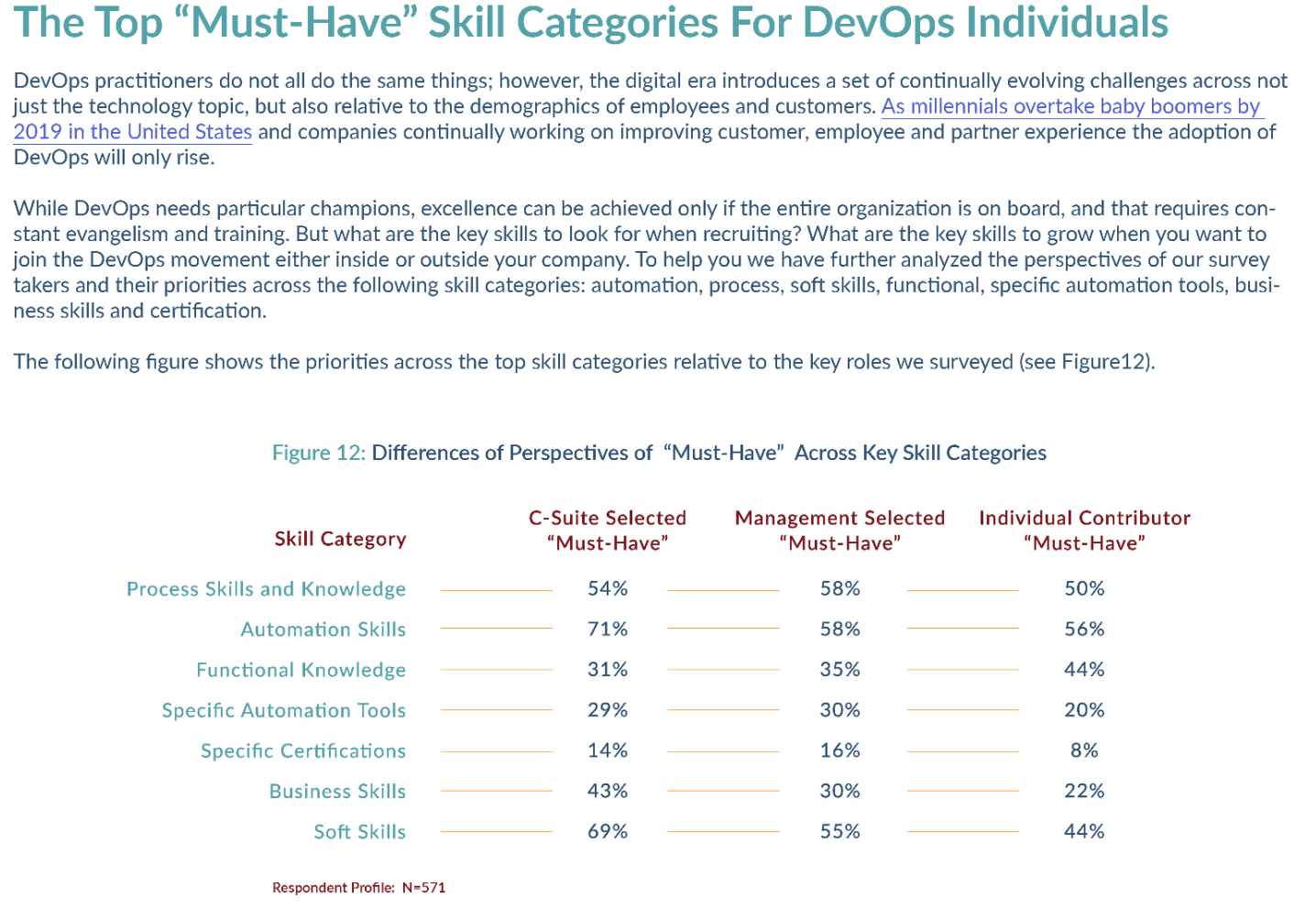
    • The DevOps human must have a hybrid set of skills since process skills and knowledge (69%), automation skills (67%) and human skills (61%) are the top three must-have skill categories in 2020.
    • Upskilling needs attention now since only 31% of respondents had a formal upskilling program while 38% do not,  21% said they were working on standing up a program.
    • Agile, DevOps and ITIL are getting strong competition from Site Reliability Engineering (SRE) which grew by 5% from 2019.  Value Stream Management and Systems Thinking are also gaining traction.

    To learn more, download the Upskilling 2020: Enterprise Skills Report.  The data is very granular and can serve as a waypoint for individuals and enterprises trying to plan their upskilling initiatives.

    — Jayne Groll

  • SRE Is the Most Innovative Approach to ITSM Since ITIL

    SRE Is the Most Innovative Approach to ITSM Since ITIL

    For over a decade, ITIL has been the leading ITSM framework adopted by enterprises across the globe. So, what is driving a rapidly increasing interest in Site Reliability Engineering (SRE) as a service management alternative?

    In its own words, Google refers to SRE as its approach to service management: “The SRE team is responsible for the availability, latency, performance, efficiency, change management, monitoring, emergency response and capacity planning.”

    In traditional ITSM terms, the role of the SRE is responsible for service level, change, availability, event, incident, problem, capacity, performance, infrastructure and platform management. While the operational practice areas may be similar, there are significant differences in how the practices are approached.

    ITIL4 Framework Compared to SRE

    Released in 2019, the newest update to ITIL4 remains a complex governance model with four dimensions, seven guiding principles, a Service Value System and 34 processes (now renamed as practices). While ITIL4 pays homage to Agile and DevOps, there is little depth in the publications released to date—to be fair, several other publications in the series are in queue  for gradual release. The framework spans just about every aspect of software delivery and operations and seemingly is trying to be the single source of truth in both principle and practice for IT management.

    SRE Is More Closely Aligned to Agile and DevOps

    By comparison, SRE focuses specifically on the reliability and resilience of complex production system operations. As an engineering discipline, SRE more closely aligns with the Agile and DevOps patterns that are being adopted by product development teams including continuous integration, testing, delivery and deployment. SREs bring the wisdom of production into the teams thereby breaking down many of the silo walls that have impeded IT for so long.

    As a service management alternative, SRE also updates traditional ITSM activities with innovative and self-organizing concepts such as management to service level objectives, error budgets, toil reduction, release engineering, monitoring/observability and embracing risk as neutral approaches to service management. The core SRE book provides practical and actionable guidance for Site Reliability Engineers on managing incidents, learning from failure, testing for reliability, load balancing, handling different types of emergencies, software engineering and capacity planning. Related publications such as the Site Reliability Engineering Workbook and Seeking SRE provide additional insight.

    Most importantly, a Site Reliability Engineer is an actual hireable job with a defined role, set of responsibilities and skills. SREs and SRE teams are encouraged to be creative, accountable and must spend 50% of their time reducing toil by engineering automation in order to make tomorrow better than today. Like Agile and DevOps, SRE supports self-regulation with policies and consequences. In fact, some consider SRE to be the third piece of the Develop (Agile), Deploy (DevOps), Operate (SRE) feedback loop.

    What This Means for the “Humans of DevOps” in Operations and ITSM

    SRE is breathing new life and opening new career paths for operations and ITSM professionals who a few years ago were battling against the mantra of “NoOps.” According to Linkedin’s 2020 Emerging Jobs Report, SRE is the fifth fastest-growing job role with 34% growth.

    Services will always need to be managed. However, competing in a digital age requires new ways of working and thinking with speed and quality as key metrics. Agility must be instilled across the value stream spectrum in order to increase flow and deliver an exemplary customer experience. Your organization may not be as complex as Google’s, but the principles and practices of SRE are applicable to all environments.

    You can read the Site Reliability Engineering and Site Reliability Engineering Workbook publications for free from Google. For those wanting to learn more about the practices and patterns associated with SRE, DevOps Institute recently released its Site Reliability Foundation certification with accredited training being offered globally by its Global Registered Education Partner network. Either way, if you are an operations or ITSM professional, I would highly recommend learning more about SRE. It is the future of ITSM as we cross the digital divide.

    — Jayne Groll

  • Take the 2020 DevOps Institute Upskilling: Enterprise DevOps Skills Survey

    Take the 2020 DevOps Institute Upskilling: Enterprise DevOps Skills Survey

    Everyone is talking about upskilling but how do you know which skills are considered a must-have, nice to have and not as important these days? What are the hiring trends within the industry including the most sought after roles and plans? With the vast array of tools, technologies, process frameworks and human/soft skills, it is daunting to try to establish a meaningful enterprise upskilling program or personal upskilling strategy.

    DevOps Institute published the first-ever “Upskilling: Enterprise DevOps Skills Report” in 2019 based on a detailed global community survey completed by over 1600 respondents. The results were very deep and insightful. The 2019 Upskilling report provided the DevOps community with a solid benchmark on the state of DevOps skills across those categories. But once is not enough in a rapidly changing skills landscape. It’s time to do it again in order to analyze and validate the data year over year.

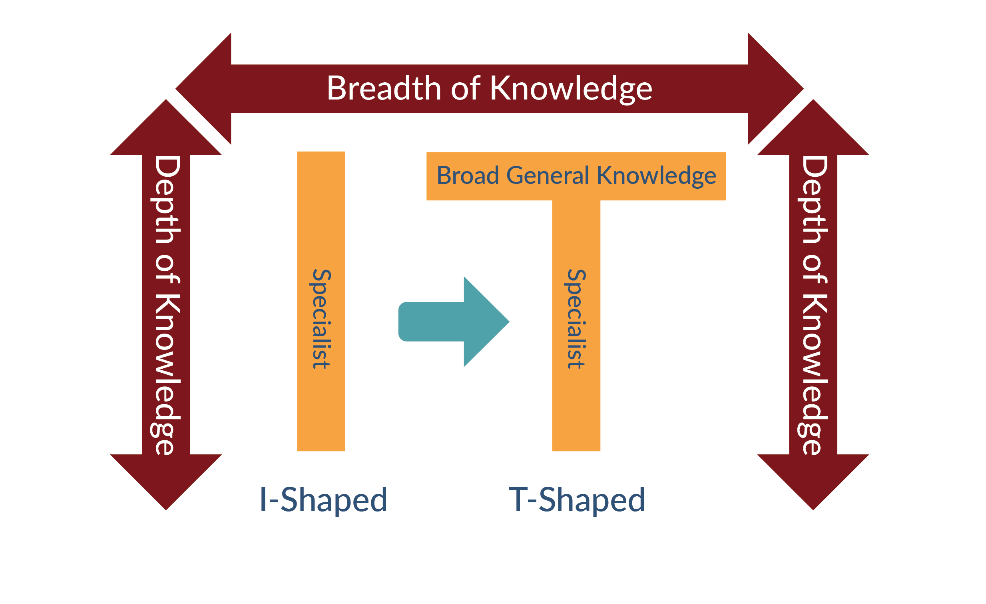
    The 2020 Upskilling: Enterprise DevOps Skills Report survey is active through December 20, 2019 and the second annual report will be published in early 2020. The new survey builds upon the 2019 report to help IT professionals understand the skills they need to become more T-shaped, by supplementing their depth of specific knowledge with a range of general knowledge. Further, it helps IT professionals understand the specific disciplines that will best fill the top of their “T.”

    We are once again honored to have organizations such as CloudBees, Continuous Delivery Foundation, Urban Code and others sponsoring and supporting this important project. The second annual Upskilling report will publish in February 2020. You can read the full press release here.

    Let’s never forget upskilling is a purely human endeavor. We need the help and support of enterprises, individuals, vendors, consultants and influencers. Please help DevOps Institute fulfill its mission to advance the human elements of DevOps by completing the survey and sharing the link with your friends, colleagues and community.

    Your effort will also go to a much need charitable cause. We’d like to do our part to help the under-served pockets of youth around the world and to that end, we’ve identified a global charity that aligns with our vision, Teach for All. We will contribute $1 for each completed survey and we are aiming for 5,000 participants.

    Teach for All tackles complex challenges facing children in disadvantaged communities as millions of children lack the education, support and opportunity they need to thrive. Teach for All is developing collective leadership to improve education and expand opportunities for all children, so they can shape a better future for themselves and the world around them.

    Every donation, no matter how small, can make a huge difference and we are happy to contribute on your behalf to thank you for your participation with the 2020 Upskilling Survey.

    Your participation is valued, and it helps support a great cause. Take the survey and share the link with your colleagues today!

    — Jayne Groll

  • The DevOps Institute Has Been Brandjacked

    The DevOps Institute Has Been Brandjacked

    Sadly, another organization has decided to brandjack the DevOps Institute name. Quickstart, an e-learning organization based in Austin, Texas, recently approached DevOps Institute about becoming a channel e-learning partner. Instead of joining our partner community, Quickstart chose to stand up another “DevOps Institute.” Since they were in communication with the actual DevOps Institute as late as March 9, I can only assume that this was an intentional act to confuse the market into believing that they are somehow associated with (or are) the actual DevOps Institute.

    They are not.

    Since 2015, the DevOps Institute has spent countless hours, attended numerous conferences and invested significant resources in advancing the human elements of DevOps. We were the first stand up formal association to focus on DevOps learning and certification as DevOps was emerging in the enterprise space. We are known and respected by many of the key DevOps thought leaders and vendors. We recently fielded the “Upskilling: Enterprise DevOps Skills Report” with the support of Electric Cloud, CloudBees and Lenovo. We not only talk the talk, but we also have demonstrated time and again that we are committed to walking the walk and are heavily invested in the goals of the DevOps community.

    To be clear, we have no issue with fair competition, particularly in a space that is growing as quickly as DevOps. That’s the nature and risk of running a business. Competing on products or offerings—that’s expected, and it ultimately helps the people within the industry succeed. Hiding behind another organization’s brand, though? That’s not only unethical, it defies every value that is at the heart of DevOps and established business practices.

    I thought long and hard about whether to give Quickstart and www.devopsinstitute.io visibility by exposing their actions. The easy way would be to stay quiet and let the lawyers sort this out (which they certainly will). However,  the real DevOps Institute stands by our moral obligation to the DevOps community and we, therefore, cannot let an imposter bully us into silence. The dictionary definition of an imposter is “someone who pretends to be someone else in order to deceive others.” Quickstart is an e-learning company masquerading as a well-respected DevOps association, presumably for commercial gain. What do you think?

    Please do not be deceived by imposters that falsely attach their services to DevOps Institute in the hope of benefiting from the goodwill we have established with our brand in the DevOps community.  There is only one DEVOPS INSTITUTE (www.devopsinstitute.com) and we are wholly committed to advancing the human elements of DevOps through our SKIL (Skills, Knowledge, Ideas and Learning) framework.

    Buyer Beware!

    — Jayne Groll

  • Got DevOps Skills? A Look at the Upskilling: Enterprise DevOps Skills Report

    Got DevOps Skills? A Look at the Upskilling: Enterprise DevOps Skills Report

    IT recruiting is at an all-time high and organizations want T-shaped professionals with cross-functional skill sets to join their teams. While “T” represents an individual’s core competency, and the top of the T represents a broad range of related knowledge, there has been little clarity on which skills are the most important across a wide spectrum of possibilities—until now.

    DevOps Institute launched the Upskilling: Enterprise DevOps Skills survey in 2018 to focus on the human element of skilling. The feedback from more than 1,600 individual responses echoed the notion that regardless of vertical, organizational size, geography or role, DevOps practitioners need data-backed skilling statistics. As the focus within the enterprise, DevOps community shifts from “What is DevOps?” to “How do we do DevOps,” this demand is more crucial than ever. After all, “how to” requires “know-how” and “know how” requires a new set of skills. But which skills?

    According to DevOps Institute’s Upskilling: Enterprise DevOps Skills Report:

    • Soft skills and technical skills are equally important
    • IT operations knowledge received the most “must-have” votes as a functional skill in DevOps
    • Cloud and analytical knowledge are the top technical skills
    • DevOps Engineer emerged as the most popular job title (see below for figure N=812)
    N=812

    The report was developed in partnership with veteran research analyst Eveline Oehrlich, formerly of Forrester Research. This comprehensive data provides indications of which functional, process, technical and automation skills are “must-have,” “nice to have” and “not important.”

    This is particularly significant for IT professionals who are confused about where to focus their personal skills transformations in their journey toward the “T.”

    Should developers work on upskilling their testing, automation, process and/or security skills? Should operations professionals learn to code, test or explore more about machine learning and AI? What about project management and systems administration? The Upskilling: Enterprise DevOps Skills Report can be used as a snapshot of critical enterprise skills that are important to successful digital transformation.

    The Upskilling: Enterprise DevOps Skills Report was released March 4 and is now available for download. On behalf of Platinum Sponsor Electric Cloud, Gold Sponsor CloudBees and Silver Sponsor Lenovo, industry influencers and international DevOps community, we hope this data will help shrink the skills gap and support the transformational goals of both individuals and organizations. We’re already looking forward to the launch of DevOps Institute’s Upskilling: Enterprise DevOps Skills Survey 2020 to continue meeting the demand for ever-evolving skilling trends in the DevOps community—stay tuned!

    — Jayne Groll

  • Upskilling: The Enterprise DevOps Skills Survey and Report

    Upskilling: The Enterprise DevOps Skills Survey and Report

    There has been a lot of recent reference to “T-shaped” IT professionals—individuals whose core competence (the stem) is supplemented by a broad range of other knowledge including soft skills (top of the T). T-shaped talent is in such high demand with a limited supply that recruitment efforts have become very competitive for those with upskilled and cross-skilled transformational know-how.

    Unfortunately, the migration from a deeply skilled specialist to a T-shaped practitioner is leaving many confused about what skills they should be acquiring and hiring and when. That’s why DevOps Institute (DOI) recently launched the 2019 “Upskilling: Enterprise DevOps Skills Report” community survey to help individuals and enterprises better understand the current and future state of DevOps skilling across the global IT community. Using data science coupled with hiring manager interviews, DOI’s goal in fielding the report is to provide tangible insight into why and where IT practitioners, managers, leaders and business stakeholders should focus their efforts in growing personal and organizational skills portfolios.

    Eveline Oehrlich, a former vice president and research analyst at Forrester, is bringing her data science expertise as the lead analyst for the report. Founding Platinum sponsor Electric Cloud and founding Gold sponsor Cloudbees are also sponsoring this important project. The “Upskilling: Enterprise DevOps Skills Report” will be a year over year project, and the results will be published in Q1 2019.

    The global survey will remain open until Dec. 7 and can be accessed through the following link: https://www.research.net/r/K9WD2XC

    We encourage everyone in the DevOps community to complete the survey so that the data samples truly reflect the global state of DevOps skills.  Any organization that has at least 20 people complete the survey will get a personal snapshot of the data results. All respondents who complete the survey will be entered into a drawing for four $100 Amazon gift cards.

    — Jayne Groll

  • Is Site Reliability Engineering the True ‘Ops’ in DevOps?

    Is Site Reliability Engineering the True ‘Ops’ in DevOps?

    I recently had the privilege of attending the SRECon conference in San Francisco. It’s in its third year and 650 attendees gathered to learn and share their experiences, insights and site reliability engineering (SRE) practices.

    Most SRECon attendees either identified as SREs or were there to learn more about this new role and approach. While there was strong representation from the “unicorn” community (Google, Shopify, Twitter, Netflix and Linkedin), enterprises such as Capital One and Comcast were among the many exhibitors actively seeking to recruit SRE talent. The conference spirit was infused with enthusiasm, a willingness to share, innovative thinking and grassroots advice. It reminded me very much of my first DevOps Days in 2012. There is no doubt that interest in SRE is rapidly growing and worthy of attention by enterprise IT.

    The practice of site reliability engineering was born out of the book by the same name from Google. Interestingly, the SRE movement emerged separately from the DevOps movement—although there is little doubt that they are part of the same IT spectrum with similar customer value-driven goals. DevOps focuses on engineering continuous delivery to the point of  deployment; SRE focuses on engineering continuous operations at the point of customer consumption. Both domains rely on sharing, culture, metrics and automation. Both require human and automated resources to ensure a seamless value stream and exceptional customer experience.

    The role of the SRE is rapidly gaining momentum. Part systems administrator, part second tier support and part developer, SREs are encouraged to be inquisitive, to acquire new skills, to ask questions, to solve problems and to embrace automation. I asked several of the exhibitors what types of skills they were looking for in new SREs. The answers almost unilaterally included the ability to code as well as an unwavering thirst for knowledge and improvement—to find answers, solve problems and ensure the highest levels of reliability and availability.

    I also can see a clear bridge between SRE with IT service management (ITSM). Many of the presenters spoke about the handling and management of late-night incidents, escalations, root cause analysis, service level objectives, availability metrics and other topics addressed in ITSM frameworks such as ITIL. The tools and process definitions may be different, the opportunity to instill agility into many of the ITSM processes to meet changing demands is certainly apparent.

    What are the risks? To my mind the biggest risk is if SRE, DevOps, ITSM, Agile SDLC and other frameworks do not align and remain siloed outposts. SRE and DevOps are two sides of the same coin. Let’s hope that the SRE momentum catches up to DevOps and that enterprises begin to integrate both sets of practices as the norm.

    — Jayne Groll

  • Introducing DevOps Express!

    Introducing DevOps Express!

    The DevOps Institute (DOI) is proud to join industry leaders as a founding member of the DevOps Express. The DevOps Express is a bold initiative between tool providers and others to create a solutions-oriented approach that will make enterprise DevOps adoption easier using popular technologies spanning multiple solution components. Working together, DevOps Express members have committed to improving interoperability within the DevOps stack, and creating a framework for industry partners to develop reference architectures that will be better integrated with better support.

    The 14 founding members of DevOps Express include vendors spanning multiple solution categories in the software delivery process, as well as service organizations providing consulting, training and professional services:

    • CloudBees
    • Sonatype
    • Atlassian
    • BlazeMeter
    • CA Technologies
    • Chef
    • DevOps Institute (DOI)
    • GitHub
    • Infostretch
    • JFrog
    • Puppet
    • Sauce Labs
    • SOASTA
    • SonarSource

    DOI is honored to be a part of this important and innovative program. We believe this initiative represents the industry’s commitment to “walking the DevOps walk” by agreeing to collaborate, align and integrate for the betterment of the market. We are excited that major industry partners are unifying to give enterprises potential starting points for creating a DevOps stack, while also increasing quality and lowering risk. As knowledge, best practices, architectures and models emerge from the work of DevOps Express, DOI will ensure that these are available to the DevOps learning community and embedded into DOI courses, articles and future member benefits.

    The DevOps Express is leaving the station, and DOI is on board! Read the press release for more information about this historic initiative.

  • REP SPOTLIGHT: Soft2Solve

    REP SPOTLIGHT: Soft2Solve

    DevOps Institute: Tell us a little about your organization,

    Soft2Solve: We work with our customers in order to help them to enhance IT performance, saving cost, and training on best methods, process and practices, selecting at the same time the best solutions for Spanish Speaker Customers.

    DevOps Institute: What other topics do you teach or consult on?

    Soft2Solve: Cost savings in some specific areas as printing, energy.

    DevOps Institute: What type of interest in DevOps are you seeing in your region?

    Soft2Solve: The interest is initial. Most of customer are aware of DevOps initiatives, but they are still learning and looking how movement evolves and how they can set up the practices on their companies. Some of them already started with agile methodologies in development.

    In the other side, most of them already have ITSM practices implemented, based mainly in ITIL.

    DevOps Institute: How do you think that DevOps contributes to the business’ value stream?

    Soft2Solve: First, aligning IT with the business requirements in terms of speed, flexibility and agility. Then it contributes to analyze the bad processes in place and getting high cost savings when implementing DevOps practices. It also enhances the internal relationships between IT departments, as usually there is a big fight between them. Also, that impact on quality and speed to answer the business.

    DevOps Institute: What topic area in DevOps excites you the most?

    Soft2Solve: It is an IT answer to the business requirements to follow the business needs; meanwhile, being more productive and less expensive. In other areas, the automatization is a base for DevOps.

    DevOps Institute: Why should enterprises and individuals consider formal DevOps Training?

    Soft2Solve: Although sometimes the organizations do not know, any new change—especially culture changes—need internal sponsors as much as possible in the organizations. These people have to be trained by third-party independent people outside their organizations that are aseptic and not influenced from the internal existing culture and way of doing. These people will be the people that will support the change and the IT alignment with the business organization and will answer quickly to business requirements.

  • REP SPOTLIGHT: getITright

    REP SPOTLIGHT: getITright

    DevOps Institute: Tell us a little about your organization.

    getITright: With offices in Australia, South Africa, The Netherlands, Nigeria and Malta and a network of partners operating in 31 countries, we offer a bouquet of services to help organizations to:

    • Manage better
    • Lower risk
    • Perform better
    • Make better business and IT decisions

    Our service offering includes:

    • Training courses – Learning best-practice through our Partner Academy courses or network of training providers
    • Accredited IT Best practice course material – License our training material
    • Consulting – We use an agile approach for projects and a lean approach for operations when consulting and coaching.

    DevOps Institute: What other topics do you teach or consult on?

    getITright:

    • Service Management: ITIL®, ISO/IEC20000, Lean IT, Service Desk Institute
    • Governance of Enterprise IT: COBIT® 5
    • Project Management: PRINCE2®, PRINCE2® Agile, DSDM AgilePM®, Scrum
    • Information & Cyber Security Management: ISO/IEC27001, NIST Cybersecurity using COBIT5
    • Quality Management & Business Improvement: ISO9001, LEAN SIX-SIGMA
    • Risk & Continuity Management: ISO31000, ISO/IEC27005, ISO22301
    • Cloud Computing

    DevOps Institute: What type of interest in DevOps are you seeing in your region?

    getITright: DevOps awareness in the region is still low, but we see a steady increase in the level of interest in the topic.

    DevOps Institute: How do you think that DevOps contributes to the business’ value stream?

    getITright: It makes projects and business as usual faster, more stable, with less risk.

    DevOps Institute: What topic area in DevOps excites you the most?

    getITright: DevOps enables organizations to improve productivity and respond to change with less risk. It’s easy to adopt by organizations with mature ITSM practices in place.

    DevOps Institute: Why should enterprises and individuals consider formal DevOps training?

    getITright: Training ensures that all resources in the organization are in sync when implementing new practices like DevOps in an organization and ensures a cohesive approach that facilitates proper organizational buy-in and adoption.