Author: devopsy.kinsta.cloud

  • How IHG Puts DevOps Developers First

    How IHG Puts DevOps Developers First

    The following is a guest post by Robert Kelley, Director of Delivery Engineering at IHG, based on his session at CloudBees Connect. His full presentation is available below.

    Video Thumbnail

    You may not necessarily recognize the company name IHG – the company I work for – but I bet you’ve heard of our brands and stayed in our hotels. They include household names like Holiday Inn, InterContinental, Crown Plaza and many more. IHG stands for the InterContinental Hotels Group and we’re one of the world’s largest hospitality groups in the world. IHG operates 6,000 hotels in more than 100 countries. And we’re growing fast: IHG currently has 1,900 hotels in the pipeline for opening.

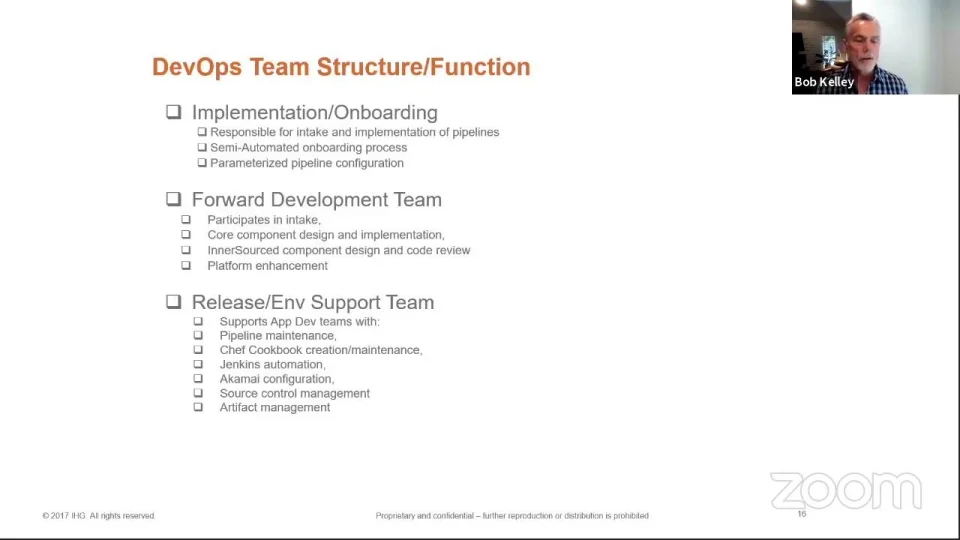
    It takes a lot of software to run a global operation of this size, especially one that’s growing so rapidly. IHG employs hundreds of engineers around the globe to build and deploy the business applications and systems that keep our company competitive and growing. As the director of delivery engineering at IHG, which is our DevOps program, I’m tasked with empowering these developers with the tools and processes they need to be productive and successful at their jobs, helping translate their work into business success for IHG.

    That’s a tall order for any engineering organization and ours is no exception. But we’ve forged ahead on our DevOps journey, starting by putting together a business case and setting some high-level goals and ambitions for our teams. Our list includes adding more automation and certification to our delivery flows, improving our processes and gaining more transparency and visibility into performance. Of course, we want to support innovation to keep our business ahead of the competition.

    After finalizing our goals, we “took them to market,” which in our case meant sharing them with the software development community here at IHG. What could go wrong, you might ask?

    Well, right out of the gate we discovered there were significant differences among the teams, their cultures and their tools and processes. The disparity left us struggling to bridge the gap between where we wanted the teams to go, and where they thought they were going. This was going to be a tougher journey than we expected. We had to fail fast and learn quickly.

    Rethinking standardization

    It became clear we needed to rethink our approach and how we engaged our development community. Recognizing that one size doesn’t fit all, we decided to take more of a consultative or service mindset, focusing more on people and engaging our developer community. After all, we have a lot of smart developers with great ideas that represent an incredible value opportunity.

    Our approach features a comprehensive communications plan designed to motivate developers to embrace DevOps. We’re looking at gamification strategies, for example, that would make it fun for people to engage with the program, share their accomplishments and track progress toward reaching their goals. We also want to help team members reduce the amount of time they need for build and deploy processes, so we’re introducing more automation, including developing a semiautomated onboarding process.

    Moreover, we’re involving developers in a transparent governance process – one that’s not simply a rulebook handed down and controlled by a third party or some other group in the organization, but one that’s shared and co-developed by our teams. Everybody’s represented in the governance process. Teams from application development, testing and quality, infrastructure and operations, security – and of course the DevOps group – all have a voice and work together to define quality gates and other requirements. It’s a true “voice of the customer” approach that puts developers’ needs first.

    Supporting developers

    To tame the complexity of our environment, we’ve taken steps to achieve some consistency around things like testing, merge processes and build and deploy routines. However, we never want to hamstring developers by over-defining process flows, so instead we provide teams with simplified workflow or pipeline templates that should work for just about any application.

    I’m proud to report that our teams have been making huge progress along our DevOps journey. We’ve helped build about 40 pipelines for dev teams and we’re working on even more. Performance is up: Teams are now able to move a new version of an application to production in less than 30 minutes, compared to taking a week previously. And it now takes less than two hours to deliver applications to eight datacenters worldwide, with no downtime.

    We’re also tapping the insights of our developer community by creating an InnerSourcing model where virtually anybody who has a good idea can add it to our code base to benefit the whole organization.

    This is just a small sampling of our recent successes. And it’s all happening without micromanaging our developer community. The way we look at it, we’re here to enable and guide our teams, not dictate their choice of tools and processes. By allowing for a diversity of approaches – by embracing not replacing – DevOps is empowering developers at IHG to unleash their creativity and help drive IHG’s next round of growth.

  • How to Do Agile Software Development the Right Way

    How to Do Agile Software Development the Right Way

    Agile development has been around for years, but not everybody is doing it the right way. Just ask Elisabeth Hendrickson, who until recently was vice president of quality assurance at Pivotal Labs, a leader in agile software development and now a division of VMware.

    Hendrickson’s career in the software industry spans a few decades and includes stints as a technical writer, developer, and test automation specialist. The variety of jobs has been a good thing, she says, giving her a holistic view of the industry and a deeper appreciation of each step of the development lifecycle.

    Hendrickson started on her journey to agile software development after spending several years working for companies that developed software the traditional way, where the roles of code writing and quality testing were rigidly separated. She noticed that despite extensive testing, quality problems persisted. “It looked like QA was doing an incredible job,” she says. “They were finding and fixing all these bugs, so you think you would get better quality.”

    Not so, Hendrickson says. “What’s happening is they’re finding the bugs so late in the cycle that it’s too late to fix them all.” Based on that experience, she wrote an award-winning paper debunking the notion that you can correct poor engineering simply by testing more.

    In her search of a better way to do quality assurance, Hendrickson crossed paths with Rob Mee, co-founder of Pivotal Labs. “I had been learning about agile software development and I was intrigued by everything he said,” Hendrickson says. It wasn’t long before the future VP of QA joined Mee’s company. The move completely changed her perspective. “This is what software development is supposed to feel like,” she recalls thinking. “I never looked back.”

    Agile Creativity

    At Pivotal, she came to realize that agile software development was all about getting ideas into the code base in a way that was quickly “shippable,” thus allowing for fast feedback. She saw how waterfall-type approaches, with their multiple stages and signoffs, were actually just a series bottlenecks that slowed innovation. By contrast, agile software development – when done correctly – smooths the path from innovation to delivery. Agile practices were there to support human creativity, not about “process for process’ sake.”

    Although organizations have now widely embraced the concept of agile software development, Hendrickson believes one of agile’s core tenets – early feedback – has been forgotten by many, with potentially dire consequences. “Agile done badly can be dangerous,” she says. “If you don’t have any form of feedback and you’re just focusing on being fast, you will end up shipping software that doesn’t work.”

    How do you know you’re doing agile right? Hendrickson boils it down to what she calls the “Agile Acid Test.” There are three parts to it:

    • Delivering a continuous stream of value. This doesn’t mean developing faster, but rather sooner. You put capabilities into the hands of customers more frequently, in smaller chunks, and get feedback faster.
    • At a sustainable pace. Delivering software more frequently doesn’t work if it’s not sustainable for the team. “Doing a death march every month doesn’t work,” Hendrickson says.
    • While adapting to the changing needs of the business. As the world shifts, your organization needs to shift with it. Agile software development makes sure you don’t build software products that nobody wants.

    Delivering software continuously at a sustainable pace enables you to get the feedback you need to “steer towards value,” Hendrickson says. That’s why she’s always focused on delivering sooner, not faster. And when you think about it more broadly, she says, that’s a strategy that could benefit the whole business.

    What else is on Elisabeth Hendrickson’s mind? Tune into DevOps Radio Episode #75 to learn about how she motivates development teams, thrives in a traditionally male industry, and avoids one of the worst mistakes you can make in agile software development.

  • Securing Open Source Libraries: Managing Vulnerabilities in Open Source Code Packages

    Securing Open Source Libraries: Managing Vulnerabilities in Open Source Code Packages

    This book will help both development and application security architects and practitioners address the risk of vulnerable open source libraries and discuss why such vulnerable dependencies are the most likely to be exploited by attackers. It will also guide you through best practices and tools for:

    • Finding vulnerabilities across your open source packages
    • Quickly remediate new vulnerabilities and make fixing easy
    • Understanding the benefits of testing at the source level as well as the built applications.

    To sign up to download the free book, click on the link below:

    https://info.snyk.io/oreilly-lp


  • Building Container Security Into Development Processes

    Building Container Security Into Development Processes

    This interactive video gives you the best insights on how to best utilize Snyk Containers and how they stay secured.


  • Snyk Open Source Security Overview

    Snyk Open Source Security Overview

    Snyk Open Source helps developers to easily find and fix vulnerabilities and license issues in open source dependencies throughout the SDLC. Watch the video to learn how you can:

    • Detect vulnerabilities and license issues as early as possible
    • Analyze easily and make data-driven security decisions
    • Fix quickly to reduce exposure with automated remediation
    • Monitor continuously to maintain your code security level

    To learn more, click the video link below:


  • A first look at emerging team challenges

    A first look at emerging team challenges

    We surveyed employees from a wide range of industries to understand how the abrupt transition to working from home has impacted the quality and pace of teamwork. Through this survey, it was found that there are many challenges emerging for these employees.

    For more information on this survey, download the eBook here:

    [su_button url=”https://devops.wpengine.com/wp-content/uploads/2020/07/The-state-of-WFH-eBook.pdf” target=”blank” background=”#ef2d3f”]Download Now[/su_button]


  • CloudBees Core for AWS – A Solution Brief

    CloudBees Core for AWS – A Solution Brief

    Accelerate software delivery through seamless collaboration. CloudBees® makes it easy for teams to focus on delivering features with the flexibility of choosing the right continuous delivery stack for their needs. Companies can scale their operations in a centralized manner without having to worry about infrastructure restricting the growth. CloudBees integrates with every DevOps tool so developers can use the best technologies while enterprises can standardize on repeatable, scalable and secure assembly lines for producing software.

    To learn more, download this solution brief here:

    [su_button url=”https://devops.wpengine.com/wp-content/uploads/2020/07/cloudbees-core-aws-f.pdf” target=”blank” background=”#ef2d3f”]Download Now[/su_button]

  • Digital Darwinism: Driving Digital Transformation with DevOps and Continuous Delivery

    Digital Darwinism: Driving Digital Transformation with DevOps and Continuous Delivery

    The need for innovation has never been greater. The success of Google, Facebook, Amazon, Microsoft and Apple — five of the eight largest and most successful companies in the world — is largely due to their ability to rapidly develop and deliver innovative software. Conversely, former market leaders like Borders, Blockbuster and Kodak buckled because of their failure to recognize disruptive technologies quickly enough. Competitors and new market leaders emerged by innovating rapidly, rendering these once dominant brands irrelevant.

    For more information on Digital Darwinism, download this White Paper:

    [su_button url=”https://devops.wpengine.com/wp-content/uploads/2020/07/digital-darwinism.pdf” target=”blank” background=”#ef2d3f”]Download Now[/su_button]

  • Continuous Everything: Why Software Delivery Management Matters

    Continuous Everything: Why Software Delivery Management Matters

    The widespread move towards an integrated DevOps approach to software engineering, building software fast, bringing it safely to market while combining it with maximum product adoption, is still fraught with bottlenecks and inefficiencies.

    • It’s not uncommon for a company to use more than 50 different development tools in an attempt to move faster and reduce errors, but each tool solves only one discrete step in the software development lifecycle while contributing to ever-increasing complexity.
    • There is no shared data, no way to manage handoffs between teams and no single pane of glass to provide visibility into the entire process.
    • In addition, the software organization often has no information about how the software fits into the overall business strategy or how it is used by customers.

    Fore more information on how this widespread move is being made, download this White Paper:

    [su_button url=”http://devops.wpengine.com/wp-content/uploads/2020/07/continuous-everything-why-software-delivery-management-matters.pdf” target=”blank” background=”#ef2d3f”]Download Now[/su_button]

  • Exploring DevOps: Charting a Course for the Enterprise

    Exploring DevOps: Charting a Course for the Enterprise

    If you are reading this eBook, we can assume that you are interested in the process required to roll out a DevOps initiative across an enterprise.

    If that is the case, we’ll also assume that you wish to successfully embed DevOps into the DNA of your enterprise and drive a transformation in software delivery. In our view, companies who have made a success of DevOps have recognized it involves cultural change across the organization and not merely the latest in a line of initiatives driven from Head Office.

    For the full eBook, download it here:

    [su_button url=”http://devops.wpengine.com/wp-content/uploads/2020/07/charting-a-course-for-the-enterprise.pdf” target=”blank” background=”#ef2d3f”]Download Now[/su_button]