Author: Bill Doerrfeld

  • State of API Report Highlights Productization and Generative AI

    State of API Report Highlights Productization and Generative AI

    In today’s software landscape, an API-first strategy is increasingly popular. It’s the bedrock of how applications are built and connected. APIs help promote internal tech reusability, helping developers do more with less. Due to this increasing API reliance, maintaining quality control is increasingly important for internal and partner integrations and ensuring the reliability and security of these connections remains a top priority.

    Due to the rising API ubiquity, nearly half of the total development energy is spent working with APIs. And to continually improve these interfaces, taking a product mindset is proving helpful. In fact, 60% of API developers now view their APIs as products. Generative AI has also shown incredible promise and is now being used in tandem with traditional tools to increase API code quality.

    Postman recently released its fifth annual State of the API Report. The 2023 edition, which surveyed thousands of developers and API professionals, found subtle changes in tooling preferences and styles. It also sheds light on the ongoing API productization movement and API developers’ use of generative AI. Below, I’ll focus on these two key areas and review the report for its other key takeaways.

    API Productization is Hot

    The majority of API developers now view their API as a product, and this figure rises to 68% in large companies. A full 65% of respondents said their API generates revenue, too. This news is significant, as it demonstrates the industry is maturing its view of APIs. They are no longer offshoot developer toys but fully functional services contributing to overall business growth.

    But how much growth? Well, of those monetizing APIs, 43% now say APIs generate a quarter of company revenue. For some companies, APIs generated more than 75% of total revenue! There also appears to be a parallel between API revenue generation and large companies.

    Do you view your APIs as products? Most developers say "yes."
    Do you view your APIs as products? Most developers say yes.

    Other industry reports unearthed similar API productization potential. Rapid’s 2022 State of APIs report found that 42.6% of organizations are now monetizing APIs. And investment into API-first products remains strong even amidst a broader contracted tech investment climate. These findings come as social media giants like Reddit and Twitter attempt to monetize their APIs.

    That said, for 28% of companies, API revenue still equates to less than 10% of total revenue. APIs still don’t get the lion’s share, perhaps because they’re packaged with an existing platform or because of the many other indirect ways APIs might benefit the business. Furthermore, consumers are becoming more cost-conscious, as 60% cite pricing as a factor before integrating with an API. Still, the numbers are significant firsts for the burgeoning economy.

    Most API Developers are Using Generative AI

    Generative AI interfaces like ChatGPT and Bard have certainly taken the tech industry by storm due to their ability to generate code snippets, debug code and more. And for the first time, the State of the API Report spotlighted generative AI and its use within the API economy.

    Today, 60% of API professionals are using generative AI on the job. API engineers commonly use generative AI to find mistakes in code, generate machine-readable code and increase learnability around their programs. Some even use generative AI to suggest potential security flaws in their APIs.

    Compared with other app development endeavors, developers are by far most excited about building generative AI-powered applications in the year ahead. Yet, the efficiency gains are modest—many engineers forecast productivity improvements of 10% to 25%.
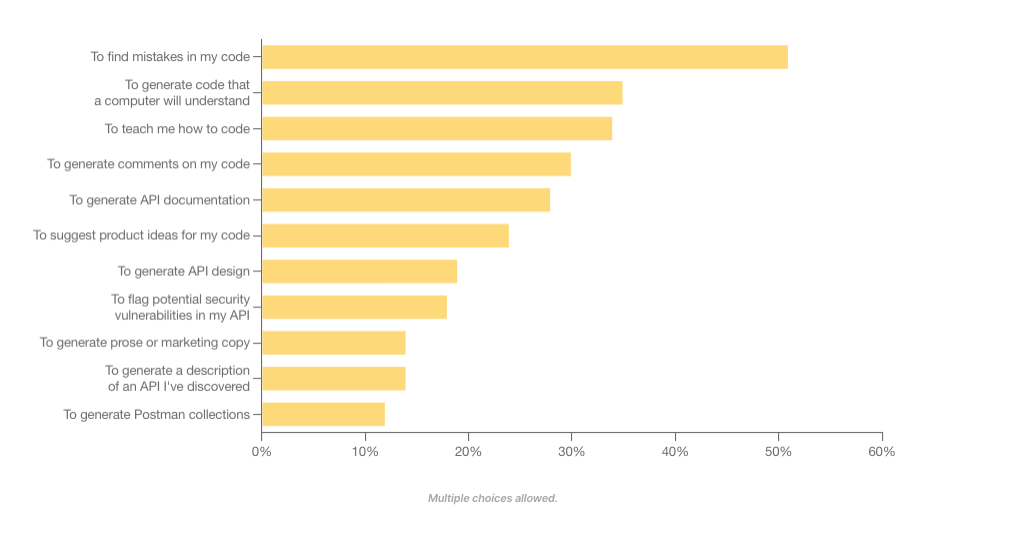
    How are API developers using generative AI in their work?
    How are API developers using generative AI in their work?

    Generative AI is set to accelerate many areas, including DevOps and API operations. Yet, contrary to some headlines, generative AI can’t automate all aspects of the software development life cycle. Rather, the technology is more likely to augment the API developer’s workflow than replace the need for seasoned professionals altogether.

    Other Key Takeaways

    Similar to last year’s report, integrating between internal applications, programs or systems remains a top concern for integrating an API or producing an API. The good news is that these integrations continue to increase in quality.

    The report found that deployment failures and times-to-recovery are improving on average. More than half (56%) of respondents said API security incidents occur less than once a year within their organization. This shouldn’t overshadow the significant impact API security breaches can have but signals that DevSecOps is beginning to respond to persistent API vulnerabilities.

    There are more API-first leaders than ever before. And API owners continue to evolve how their services are built and deployed. For example, REST is still by far the most common API style, used by 86% of developers. Webhooks made second place at 36%. However, GraphQL rose in usage, bumping SOAP into fourth position.

    SOAP slips on API architectural styles
    REST is still the dominant style, but GraphQL makes gains as SOAP slips.

    Other Quick API Factoids

    • More non-developers are becoming interested in APIs, as evidenced by 53% of survey takers being non-developers.
    • Most APIs are private—61% percent of businesses’ APIs are for internal use only.
    • After the technology group, business/IT services, financial services and health care are the most common sectors to adopt APIs.
    • Microservices is still the dominant architectural style of APIs, at 42%.
    • Performance, security and reliability are the top factors evaluated when integrating with a new API.
    • Improper authentication, authorization or access control is the most commonly cited API risk.
    • Common API tools include Postman, SwaggerHub, Datadog, SoapUI and Insomnia. Top gateway and API management platforms include AWS API Gateway, Azure API Management, Apigee and Kong.
    • JSON Schema is by far the most popular API specification.
    • The financial industry is a leader in API-first strategies—32% of respondents spend more than 20 hours a week working with APIs.
    • Most developers deploy APIs to production once a week to once a month.
    • When developers leave a company, their departure can cause outdated documentation, zombie APIs and a loss of institutional memory.

    API Obstacles Remain

    Looking to the future, investment in APIs is projected to climb. In fact, 92% of developers said their organization plans to invest the same or more time and resources into APIs in the coming year. Yet, some obstacles remain—a lack of documentation and poor service discoverability are still prominent roadblocks to API consumption. Furthermore, a lack of time and talent are major concerns that might stunt API development.

    The Postman State of API Report surveyed over 40,000 developers and API professionals, making it the largest study conducted on APIs to date. It should be noted that, given Postman’s specific focus in the market and its surveyed pool, figures may be skewed to represent increased API enthusiasm. For deeper insights, you can read the entire report here.


  • Key Insights From the Stack Overflow 2023 Developer Survey

    Key Insights From the Stack Overflow 2023 Developer Survey

    Stack Overflow has released its seminal yearly developer survey. The 2023 report, which surveyed over 90,000 developers, provides a comprehensive view of the current software developer experience.

    Below, I’ll highlight a few important findings, namely the significant programming language and tooling preferences, the use of AI in the development workflow and what these trends could mean for the DevOps field. I also gathered insights from Joy Liuzzo, vice president of product marketing at Stack Overflow, to dive deeper into some of the findings.

    Developer Technology Preferences in 2023

    Of note is that more and more developers are learning to code online. Learning to code using online resources increased from 70% in 2022 to 80% in 2023. Although many developers (47%) still have a Bachelor’s degree in computer science or the equivalent, these trends underscore the movement toward alternative knowledge solutions, especially for younger programmers. The topmost online resources include technical documentation, blogs, forums and how-to videos.

    JavaScript is still king—it’s now in its eleventh year as the most common programming language. But it’s worth highlighting that Python has overtaken SQL as the third top language. “SQL was solidly in the top three (JavaScript, HTML/CSS, SQL) since 2015, so it’s a big deal for it to have fallen below Python,” said Liuzzo. “We’ve seen Python’s popularity increase based on the number of questions asked on our public site, so we’ve been expecting some shifts.”

    TypeScript and Bash/Shell have also consistently grown in usage over the last few years. “These two languages are involved with the functions of other popular programming languages, explaining their prevalence among programmers,” Liuzzo said.

    PostgreSQL also overtook MySQL as the most common database type. In terms of web frameworks, Node.js and React.js are the most dominant. Other frameworks, like jQuery and ASP.NET, are showing signs of going out of style, likely because they are older web frameworks.

    Spotlight on AI

    The explosion of new AI innovations, such as large language models (LLMs) and chat-driven generative AI tools, had a major impact on this year’s technology findings. In fact, 83% of respondents have used ChatGPT over the past year. This is followed by Bing AI (20.6%), WolframAlpha (13.36%) and Google Bard AI (9.86%). GitHub Copilot was ranked as the top most-used AI developer tool.

    There was a significant spike in using AI tools amongst those learning to code—these folks often see benefits like speeding up learning, increasing productivity and greater efficiency. “Pair this with how they are currently using AI tools to debug and get help (68%) and learn about a codebase (50%), and we see that the commonality is that AI tools enable learning,” explained Liuzzo.

    That being said, there’s skepticism around AI’s accuracy, and only 13% see improved accuracy in coding as a benefit of using such tools. These pain points may resolve as LLMs evolve, but for now, there still needs to be human judgment to catch bugs and avoid hallucinations.

    “AI has a complexity cliff. Much like Helmsman’s complexity cliff found in project management, after a certain point, the ability for AI to handle all the nuances and interdependencies of a solution drops off,” said Liuzzo. “That’s when humans, their ability to apply judgment and have original thoughts, saves the day.”

    So what are some takeaways for those working in the DevOps field, namely DevOps tooling providers and platform engineers? Well, new tooling preferences and habits will continue to evolve in the DevOps field in new ways. Here are some potential examples:

    • More Markdown-based collaboration. Markdown is the most admired asynchronous tool and has increased in popularity this year. New programmers are adopting a blend of Markdown, GitHub Discussions and Notion for their asynchronous tooling. Flavors of Markdown are already being used for comments, merge requests, issues and more.
    • Continued Docker reliance. Docker remains the top-used tool, followed by npm and Pip. Despite the rise of managed container services, Docker is still a popular way to package and distribute software.
    • Challengers to the big three loom in the distance. Amazon Web Services (AWS) is still the most-used cloud platform at 48.62%. It’s followed by Microsoft Azure (26.03%) and Google Cloud (23.86%). Yet, newer developers want to work more with Hetzner and Vercel.
    • Online learning is paramount to knowledge sharing. Given the steady increase in new programmers and their reliance on online resources rather than traditional schooling, DevOps and open source communities should seek to enhance their online footprint by making knowledge like tooling documentation and tutorials easily consumable.

    Last but not least, generative AI is set to enhance programming in many areas and is already becoming embedded into many environments. Just as AI can be used for code generation and debugging, LLMs will likely assist the DevOps side of the equation, helping automate the CI/CD pipeline, optimize infrastructure, detect anomalies and provide more chat interfaces to initiate these capabilities.

    “AI tools are empowering and enabling learning,” said Liuzzo. “Generative AI will democratize coding and grow the developer community by several folds—and that growing number of developers will be the ones using the tools and also verifying and validating the outputs as they learn—bringing the power of the developer community and the technological power of AI together.”

  • How to Avoid Risk When Using Multiple Low-Code Platforms

    How to Avoid Risk When Using Multiple Low-Code Platforms

    Organizations are still increasing their use of low-code/no-code (LCNC). But this adoption isn’t always consolidated around one tool—frequently, multiple low-code/no-code platforms are used under the same roof. In fact, Gartner predicts that by 2024, 75% of large enterprises will be using at least four low-code development tools for both IT application development and citizen development initiatives.

    Utilizing multiple low-code/no-code platforms simultaneously introduces some security concerns. This is partially due to a lack of standard policies to govern different platforms in the same way. Low-code platforms are often incompatible with traditional IT security processes, like vulnerability scanning, manual code reviews and runtime security monitoring. Organizations going all-in on citizen development need safe ways to use low-code/no-code platforms. So, how can they safely enable this innovation without hindering productivity?

    I recently met with Michael Bargury, CTO and co-founder, Zenity, about securing LCNC systems. Bargury, who oversees the OWASP Low-Code Top Ten list, has significant insight into both the benefits and drawbacks of low-code/no-code platforms. Below, we’ll review the potential risks of using multiple low-code platforms and consider ways to mitigate these concerns.

    Why Companies Have Multiple Low-Code Platforms

    Interest in low-code has been rising, and low-code/no-code adoption continues to accelerate across enterprises. According to Bargury, large enterprises often don’t get a choice in the matter—low-code tools are arising organically, and it’s challenging to keep a lid on their proliferation.

    One way this occurs is that low-code becomes embedded into the SaaS platforms everyone already uses. Software platforms integral to business operations, like Salesforce, Microsoft Office and ServiceNow, have arguably mutated into low-code platforms, making them more like cloud providers than SaaS vendors, said Bargury.

    The other way low-code platforms emerge is through bottom-up transitions, says Bargury. This could be a specific knowledge worker working in a subset of the business to automate a domain-specific operation or integrate various tools. Then, there are the platforms, like OutSystems, Mendix or Mulesoft that specifically target professional developers.

    Organizations going all-in on citizen development may build a center of excellence and focus efforts on a single platform. And low-code platforms targeting developers will sometimes encourage more consolidation. Yet, “different platforms solve different use cases better,” explained Bargury. As a result, you will usually have a few converging in the same enterprises.

    Potential Security Concerns of Multiple Low-Code Platforms

    The emergence of low-code is similar to the bring your own device (BYOD) movement. IT and security leaders fought to avoid it at one point, but nowadays, everyone does it. So, what are the security implications if low-code becomes similarly ubiquitous? Well, no matter how it’s generated, low-code-bred programs are still applications susceptible to the same logical problems. And unfortunately, compared to your typical traditional code development life cycle, low-code development is fraught with discrepancies, says Bargury.

    Immature CI/CD Pipelines

    Some platforms do not offer the kind of mature CI/CD process one would expect from a software development platform. For example, there may be no way to create tests or separate your environments. Since there’s no coherent and consistent way to push code from development into production, you lack a way to apply secure development across platforms. “You don’t have a way to ensure every piece of software is up to your standards,” said Bargury.

    Opaque Underyling Codebases

    In traditional software development, you apply your own security reviews to ensure applications don’t contain risks. This includes shift-left scanning, security gates, manual reviews to catch mistakes early on and runtime scanning to catch unknown vulnerabilities in production. But there aren’t always parallels in low-code development. Low-code solutions typically have their own way of doing things with fewer standards, and they avoid exposing the underlying code and Git, said Bargury.

    Lack of Visibility

    As such, with low-code obfuscation, you lose a degree of visibility into how an application runs. Logs may be insufficient or wholly inaccessible. It’s also tricky—or at times impossible—to set up runtime monitoring, let alone scan various platforms. This means that low-code users can’t leverage powerful observability tools to identify errors and remediate security holes.

    Lack of Unified Policies

    Finally, establishing common authorization and permissions across multiple low-code development platforms is another hurdle. Since low-code vendors have their proprietary building blocks, you’re unable to leverage something like OPA or Kyverno to create and unify policies. Lacking shared policies across tools makes it challenging to verify that best practices have been implemented, says Bargury.

    How to Secure Multi-LCNC

    Low-code can grant much creative potential. But, knowing the above risks, what should IT be doing to reduce risks around low-code—especially when using multiple platforms? Well, Bargury shared several steps to help cybersecurity leaders start safely addressing the emergence of increasingly low-code capabilities.

    1. Take low-code development under the application security umbrella. First, low-code must be brought under the security umbrella, if it isn’t already. “It should be part of their mandate,” said Bargury. Shift the responsibility to professionals well-trained in resolving threats.
    2. Understand your surface area. As a basic security tenant, you can’t secure what you don’t know. Thus, Bargury recommends increasing your visibility into each low-code platform by collecting logs when possible and centralizing your analysis.
    3. Create automated guardrails. Next, it’s critical to identify your risks and set guardrails for your low-code users—especially when citizen development is involved. The OWASP framework provides a good overview of common risks and mitigation advice across robotic process automation (RPA), integration and low-code. In general, it’s important to design permissions with the rule of least privilege in mind. This can help reduce the chance of vulnerabilities like LCNC-SEC-03: Data Leakage and Unexpected Consequences and LCNC-SEC-01: Account Impersonation.
    4. Address gaps within the development life cycle (SDLC). Lastly, low-code platforms often provide the building blocks to secure applications, but it’s still up to you to ensure they are safely used. Cybersecurity teams should continually audit the low-code SDLC to ensure holes don’t persist.

    You’re Responsible for Securing Low-Code Development

    Low-code development platforms aren’t 100% safe from harm. It’s not out of the question for hackers to abuse low-code platforms and turn them against their owners. For example, Microsoft’s Detection and Response Team (DART) reported how a hacker group used entry to a low-code tool to remain hidden within an organization for six months, using credential stuffing to access an administrative account. By creating automations, they were able to use internal discovery tools and exfiltrate secrets and data that could have been used for privilege escalation.

    As you can see, there are legitimate concerns for low-code, especially at scale. However, security responsibility is not always that transparent. To date, there isn’t an equivalent of a shared cloud responsibility model in the realm of low-code development. As such, at the end of the day, you need to take the reins to own the applications that you build and ensure everything is secure.

  • Leaders in Resilience See ROI From Observability

    Leaders in Resilience See ROI From Observability

    Observability is maturing throughout the software industry. Observability is often defined as merging metrics, logs and traces to get a fuller picture of an application’s state. This can help pinpoint disruptions or security incidents and offer a clearer path to remediation. Observability is touted to advance the application monitoring practices of yesteryear, but are investments paying off?

    According to recent findings, many organizations are using observability tools and seeing a positive outcome. A full 73% of organizations reported using observability tools for over a year. And impressively, 86% of observability leaders said the ROI on their observability tools has exceeded their expectations. The practice appears to be paying dividends for organizations that have gone “all-in” with mature observability processes.

    The State of Observability 2023 report released by Splunk demonstrated how observability leaders are reaping a positive return from observability tools. According to the report, observability is helping to meet performance expectations, avoid downtime and enhance resilience in general. However, not all organizations are on the observability maturity bandwagon. Below, we’ll examine some of the key trends from the report and consider the benefits of refining your observability efforts.

    Now that observability is more commonplace, dedicated roles are emerging to support these initiatives. In fact, 87% of respondents now employ specialists who work exclusively on observability projects. Site reliability engineers likely make up a portion of these experts, as observability data can be used to advance efforts around meeting service-level objectives (SLOs).

    But although observability might be more common than a few years ago, not every observability practice is mature or standardized. Just 40% have a formal approach to resilience that has been institutionalized organization-wide. Because of this, only 43% are confident in their team’s ability to meet its application reliability and performance objectives. It should be noted that this number increases significantly for those with more mature observability adoption, which we’ll expand on below.

    Furthermore, not all applications are cloud-native. Organizations reported operating and maintaining, on average, 165 internally developed business applications, half of which are hosted in the public cloud and half of which are on-premises. Due to the persistence of legacy modalities, observability tools must continue to support a hybrid architecture if they are to be comprehensive and useful.

    And although we’ve previously covered how many organizations are drowning in a sea of observability data, observability leaders now say their ROI on observability tools far exceeded their expectations. Perhaps this indicates that, with more open standards, analysis centralization and fewer false positives, teams are finding ways to avoid observabiliy tooling sprawl.

    Lastly, the report unveiled desires to loop AI and ML into the observability pipeline. In fact, 66% of observability teams already use AI/ML, while 26% are in the process of deploying the technology. And 91% said AIOps is an important enabler of their observability goals. Certainly, AI is becoming a pervasive instrument to accelerate many areas, including observability.

    Benefits of Observability

    An impressive 64% reported that their investment into observability has exceeded their expectations. So, what are some of the top benefits of observability? Well, the report found the topmost benefits to be areas like decreasing problem detection and resolution times, identifying “true positive” incidents, and enhancing application security.

    Observability is being deployed as a tool to evolve traditional security efforts, as it uncovers a deeper understanding of application behaviors. This can help security teams correlate errors to specific diagnoses and spot potential threats in a quick manner. As such, 59% said observability helps them uncover security issues thanks to the intelligence capabilities of observability solutions. And 55% say they can uncover more security vulnerabilities thanks to the visibility afforded by observability.

    Observability can also be used to improve visibility into hybrid architectures. A full 86% said it’s important to have flexible observability solutions that cover hybrid architectures, though half identify this as an area for improvement. Although we like to think that cloud-native development is the status quo, many enterprises still oversee a mixture of on-premises, private cloud and multi-cloud environments. A unified, agnostic observability layer is thus essential to peek into all these disparate environments to grapple with disparate data outputs.

    The Leaders of the Observability Pack Win

    Service interruptions can have negative consequences for organizations, including lower customer satisfaction, loss of revenue and loss of customers. In fact, 76% of respondents reported downtime can cost up to $500,000 per hour.

    Thankfully, observability has emerged to help improve overall resilience and avoid these negative repercussions. But, to truly reap the benefits, you must have a mature practice in place. As defined by the report, “observability leaders” have a more formal approach to resilience and have standardized this across their organization. And 89% of those leaders are completely confident in their ability to meet their application availability and performance requirements. The catch-22 with observability is that you must invest more energy into formalization and knowing when the effort is worthwhile is a moving target.

    A solid observability practice is supported by standardized metrics, logs and traces across the organization. Furthermore, to make observability behave correctly, you will need flexible tooling that can leverage data from multiple sources, such as the network, infrastructure, servers and databases.

    The State of Observability 2023 report surveyed 1,750 observability practitioners from around the globe, making it the most extensive study on observability to date. For more insights, you can pick up a copy of the report behind an email gate here.

  • How Open Source Can Enhance Developer Experience

    How Open Source Can Enhance Developer Experience

    Developer experience (DX) is becoming more and more of a competitive advantage among developer-facing tools and platforms. A great developer experience that’s easy to follow and implement can truly help a software tool stand out from the crowd.

    Simultaneously, open source software is all the rage. In fact, a recent StackOverflow survey found open source software (OSS) to be, by far, the most revered and proven technology trend.

    With that in mind, what are the synergies between developer experience and open source? And how can building in an open source format aid the developer experience for your public-facing toolsets and internal development platforms?

    I recently met with Adam Frank, SVP of product and marketing at Armory, to explore the state of developer experience and open source adoption. According to Frank, open source can bring numerous DX benefits. Below, we’ll explore these areas and consider why organizations might benefit from adopting more open source within their developer-facing initiatives.

    The State of Developer Experience and Open Source

    So, what is the state of developer experience, and why is it important now? Well, DX is continually leveraged to help improve agility and competitiveness in the market. In addition to granting differentiation, DX also enables more flexibility, helping users switch from one tool to another if necessary.

    “Developer experience is at the forefront right now because technology and change are moving faster than ever before,” said Frank. “Companies need to focus on DX as a competitive advantage to survive and thrive.” At the same time, open source can help organizations move quickly and iterate more efficiently.

    Yet, historically, open source has not been associated with fantastic DX. Most of us have at least one horror story of an open source project simply going belly-up without warning. It’s common for an OSS tool to lack comprehensive documentationor suffer from a lack of funding for ongoing maintenance, zero customer support and deprecated modules. Some tools that developers directly download and contribute to may not possess a quality DX emphasis, says Frank.

    However, the status quo for OSS has undoubtedly evolved over the years, he adds. Nowadays, there are more established groups, like Linux Foundation’s Cloud Native Computing Foundation (CNCF), with specific Technical Oversight Committees (TOCs) to oversee individual projects. The maturity of OSS ownership now ensures core projects stay relevant and receive continual support—not to mention ongoing developer experience enhancements.

    On the other side, OSS is often absorbed by a platform team to enable their internal developers to move faster or ship more code, says Frank. From this perspective, open source communities give platform engineering the opportunity to contribute back to the project, helping them solve deeper-level problems that are more specific to their environments.

    How Open Source Can Enhance Developer Experience

    Not all IT leaders are sold on the idea of building in a transparent, open source model. Yet, this enhanced transparency can bring dividends in the long run, especially where developer experience is considered. Frank shared some of the benefits of adopting open source.

    Receiving Feedback From The Community

    “As a product manager, you want as much feedback from your users as you can gather,” said Frank. Receiving user feedback is a great way to fix DX issues, and OSS gives you that on a larger scale. By adopting open source, you benefit from collecting insights from your customer base and the developer community at large. This can translate into a broader range of use cases, which can significantly improve projects and overall experience.

    Increasing Ecosystem Transparency

    Building in a more transparent and open fashion so that everyone has the ability to submit pull requests can also help you work together with potential partners. This makes it easier to develop third-party integrations that ensure the broader ecosystem can work together. By decreasing the barrier to entry through OSS, you provide others with the ability to solve more problems around developer experience.

    Streamlining the Developer Toolchain

    “Developers want to innovate; they want to solve problems,” said Frank. Open source can also help expose inefficiencies in the developer toolchain and, notably, many open source CI/CD tools are often leveraged to automate deployment and increase efficiency. The end result is that developers can focus on innovating their own competitive advantage. “Making the deployment aspect of the developer lifecycle really seamless can significantly improve their experience,” he said. Therefore, any tools or extensions around CI/CD are an excellent area to consider open-sourcing.

    Increasing Flexibility

    Another benefit of the open source model is that you have far more flexibility than off-the-shelf proprietary software. As a customer, you don’t have to wait to submit enhancement requests. With OSS, you can fork a project or quickly collaborate with the maintainers. This equates to making fixes far quicker and providing the ability to customize developer experiences to the tasks at hand.

    Best Practices to Ensure Open Source Improves DX

    Open source provides many key benefits that can enhance software development and delivery. But, this should be taken with a grain of salt, as best practices still must be followed to ensure open source enhances, not hinders, developer experience.

    For example, Frank mentions that simplicity should be a guiding light. “Have simplicity for the user experience design in the forefront of everything you’re building and thinking about,” said Frank. Adopting simplicity should help ensure developer-facing materials are structured well and documented in an easy-to-comprehend manner.

    On that note, open source projects will require standards around areas like good documentation and well-written APIs that abide by contracts, said Frank. Anything less will hinder developers and confuse them with disparate data formats. On that note, he has witnessed OpenTelemetry emerge as a common way to unify data that systems produce with standard formatting, which increases the observability of these environments.

    Lastly, it’s critical to hire talent with experience in open source. Bringing in folks that have knowledge of how OSS communities operate will make onboarding easier and encourage safer open source security practices as well.

    What the Future of DX and OSS Holds

    Open source appears to aid developer experience in many ways, from driving more innovation, opening software up to feedback and developing a closer-nit developer community. But what does the future of developer experience and open source look like?

    According to Frank, we will likely see increased data standardization that makes it easy to work with various projects and data formats. OpenTelemetry, for example, makes aggregating logging easier. We’ve also seen standardization around OpenAPI Specification for describing web APIs. Another example is FinOps Foundation’s FOCUS specification to unify cost analysis.

    Open source tends to leverage open source. And as the industry continues to coalesce around open standards, we’ll likely see more robust, compatible layers of abstraction emerge throughout the market, Frank predicts.

  • Technical Debt is Inevitable. Here’s How to Manage It

    Technical Debt is Inevitable. Here’s How to Manage It

    Eventually, your organization will accumulate technical debt. It doesn’t matter what programming language, software stack, computing style, host, or slick hybrid mix you use. It doesn’t matter if you’re using a waterfall or agile methodology. Ultimately, most technology becomes technical debt one day.

    “Technical debt is inevitable,” said Insight’s North American chief technology officer, Juan Orlandini. “Technical debt is like credit card debt. If you’re not smart about how you use it, your balance keeps increasing.”

    Today’s technological trends will one day fall out of favor, especially as talent moves on and older maintainers retire. And while this all might sound grim, acceptance is the first step toward change. Realizing this pattern of technical debt and accepting its inevitability may be the key to building future-proofed, evolvable software ecosystems.

    I recently chatted with Orlandini to understand some of the significant contributors to technical debt and how software maintainers can plan for and address it. Below, we’ll outline some of the major causes of technical debt and suggest methods to tackle it and prevent it from accumulating.

    Major Contributors to Technical Debt

    Enterprises face growing technical debt. A study from Outsystems found that 40% of IT budgets are devoted to addressing technical debt in large enterprises. To mitigate technical debt, we must first understand the main contributors to it. The causes of technical debt are wide and varied but can be distilled into a few common areas, said Orlandini.

    Unsupported software stacks. One major cause of technical debt is outdated or unmaintained software. Too often, a consumer will purchase a proprietary system that eventually becomes sunsetted, said Orlandini. Or, the vendor may evaporate during an acquisition or merger. When this occurs, the package goes unmaintained and leaves a mess on your hands.

    Trends in programming languages. Another obvious area is the continual evolution of programming languages. Even today’s most popular languages aren’t that future-proofed—Python replaces Perl, Go replaces Python, Rust replaces Go and so on. The same is true for frameworks. Ruby on Rails used to be in, but now Vue.js is a more hip framework.

    Aging cloud infrastructure Just because you’re in the cloud doesn’t mean you don’t have technical debt, reminds Orlandini. When early cloud adoption began, many core services we take for granted today, like authentication and authorization, weren’t offered by the cloud service providers. Some of the first-ever cloud migrations were stitched together with homegrown tooling, which may not be aging well. Or, organizations may have “lifted and shifted” legacy services into the cloud. Operators overseeing these older cloud-based environments will likely feel the pressure to refactor into more modern, cloud-native styles.

    The proliferation of microservices and APIs. Furthermore, cloud services retire features all the time. Thus, it can be challenging to keep up with these minute changes to retain backward compatibility for things like API versioning shifts. In the DevOps world, web APIs are the glue that connects our tools. But in an increasingly complex landscape, it can become easy to produce shadow IT and lose track of dependencies.

    Legacy physical infrastructure: It’s not just the software that becomes debt; the systems and hardware it runs on might also become obsolete. For example, the network itself might be full of old edge switches and wireless access points, says Orlandini. Or, an enterprise may hold onto aging on-premises servers. (This is often due to the depreciation benefits of using a capital expense accounting model as opposed to an operational expense model.)

    Other factors that could contribute to technical debt are things like rushed decision-making, skills and resource gaps and failure to implement DevSecOps.

    Ways to Tackle Technical Debt

    Technical debt is a threat to innovation, so how can we mitigate it? Well, if you don’t already do so, it’s a good idea to build technical debt into your budgeting, planning and ongoing operations, said Orlandini. “You have to manage it, expect it and be responsible with your technical stacks in the same way you are responsible with your financial stacks,” he said. Here are a few other ways to manage the debt you have and avoid accumulating more.

    Consider using AI to refactor legacy code. Generative AI could be leveraged to reactor legacy code into more modern programming languages. This could help automatically convert PEARL code, for instance, into JavaScript. Today’s large language models (LLMs) could help solve many of today’s problems. However, since they are built on a pre-existing body of work, they will use less trendy languages and might cause some technical debt in the process, cautioned Orlandini.

    Don’t over-rely on new DevOps processes as a cure-all. DevOps can accelerate the time to release features, but it does not, by its nature, eliminate technology changes, said Orlandini. Just because DevOps helps deploy an aging framework doesn’t mean it will maintain or evolve the debt. As frameworks go out of style, IT teams must continually assess their software stack.

    Remain lean whenever possible. Preventing the accumulation of unnecessary technology should be top of mind. In the DevOps world, there is a proliferation of individual services, and it’s easy to loop in a tool because it’s “the next best thing.” While sleek tools can help quickly integrate new functionality, looping in too much unnecessary tech could introduce sprawl concerns, said Orlandini. In general, he recommends keeping things as optimized as possible and carefully vetting the introduction of new technology. This includes carefully vetting new partners to ensure their business model works and that they themselves are future-proofed.

    Continually maintain updates of dependencies. Today’s software infrastructure is largely composed, at its foundation, of open source software. And if these packages aren’t mature and well-supported, you may be sitting on an unstable house of cards. It’s a good idea to continually audit your OSS use and respond to updates in a timely manner.

    Managing the Inevitable: Tech Debt

    Tech debt is like credit card debt—easy to get into and tough to get out of. And just like its financial equivalent, you shouldn’t go too far into technical debt. Thankfully, we’ve covered some best practices to keep in mind that should help spot key problem areas and reduce bloat before things get out of hand.

    As a final note, consider asking: How much stuff are you using and why? It’s become a trope, but the principle of KISS (keep it simple, stupid) bears repeating in software architecture dialogues. Because if you reduce the surface area, it will make ongoing maintenance easier and reduce the potential of cyberattacks.

    The subject of technical debt is a multi-faceted issue with many factors to consider. For related insights, you can also watch the conversation between Techstrong Group Chief Content Officer Mike Vizard and Juan Orlandini on Techstrong.tv here:

  • FinOps Foundation’s FOCUS Aims to Standardize Cloud Billing

    FinOps Foundation’s FOCUS Aims to Standardize Cloud Billing

    Cloud spending is on the rise. As organizations shift more applications to the cloud, there is a growing need to optimize workloads and reduce spending when possible. But a lack of visibility into complex cloud bills often impedes these goals. This is compounded by a lack of data standardization across the multi-cloud landscape, with cloud vendors producing lengthy billing reports in various formats. With things so decentralized, FinOps practitioners often struggle to make sense of it all.

    FinOps Open Cost & Usage Specification (FOCUS) is set to change this status quo. FOCUS, an initiative sponsored by the FinOps Foundation, a Linux Foundation technical project, aims to create a standard, vendor-neutral specification for cloud cost, usage and billing data. A common schema for cloud billing should help unify cost data across cloud vendors and greatly aid FinOps objectives in areas like allocation, chargeback, budgeting and forecasting.

    I recently met with Udam Dewaraja, FOCUS lead at FinOps Foundation, to understand the context that led to creating the specification. Below, we’ll dive a little deeper into FOCUS, examining the details of the proposed specification and considering what benefits it will bring to cloud consumers and cloud service providers (CSPs).

    Why the Cloud Needs a Common Billing Schema

    The complexities of today’s cloud services can often create headaches around cloud billing. For instance, AWS alone has hundreds of services and potentially thousands of SKUs. Cloud service providers each have their own data formats and terminologies, which are reflected differently in detailed bills. And with the granularity of cloud metering, enterprises could be staring at hundreds of millions of rows of cost data. Now, extrapolate that across multiple cloud service providers, SaaS and APIs, and you can see the dilemma that the modern CFO faces.

    “There are many nuances that FinOps practitioners need to understand,” said Dewaraja. “And a lack of a common definition can be a scalability challenge as you add more things.”

    It’s relatively easy to spend money on more and more cloud-based consumption models. As Dewaraja said, “Everyone has the company credit card.” Of course, you can use tools like AWS Cost Explorer, Cloudability or Datadog to garner some insights to reduce spending. But to really get the fuller picture, you need to rationalize cost metrics across many areas. Plus, in 2023, The State of FinOps report found the widest variety of cloud cost management tools in use in the history of the report, indicating tooling sprawl.

    Overview of FinOps Foundation

    First, for those unfamiliar, the FinOps Foundation is a Linux Foundation-supported group that aims to help practitioners understand the discipline of FinOps. Representing a community of over ten thousand FinOps practitioners, the FinOps Foundation routinely shares best practices and oversees a FinOps framework. “FinOps is more of a cultural practice that should be adopted,” explained Dewaraja. As such, the initiative aims to oversee training, meetups and events and encourage executive buy-in around the FinOps concept.

    Understanding the FOCUS Specification

    So, what exactly does FOCUS entail? Well, FOCUS is an open source royalty-free specification for cloud billing data. It will provide standard dimensions, attributes, and terminologies for cloud billing data sets. To formalize the specification, the project contributors are actively considering the essential FinOps capabilities and what requirements these cloud bill data sets have in common.

    The specification itself has yet to be officially released and is still being formalized at the time of writing. Microsoft and Google have joined the initiative, as well as numerous cloud finance and cost analysis vendors. And while the group waits for additional CSPs to join, the community is building out open source validators and converters, said Dewaraja.

    Benefits of a Standard Cloud Billing Spec

    Cost management solutions are already available, but what’s not readily available is a method to make business decisions based on broader richer datasets, explained Dewaraja. This is where standardized cloud billing can greatly aid efforts by creating a more holistic picture.

    Specifically, this can aid objectives like allocation, chargeback, budgeting, and forecasting. Doing so is often an incremental process, explained Dewaraja—as you gather insights into data, you iteratively use this visibility to make improvements over time.

    Some other benefits of adopting FOCUS will likely be:

    Putting finance in engineering terms. In the cloud, finance is quite dynamic. And interestingly, the FinOps discipline is becoming engineering’s responsibility as part of the shift left approach, said Dewaraja. Engineers now need to understand this problem and how to architect their solutions cost-effectively. As such, bringing specifications into the mix will help put financial responsibility squarely on the shoulders of engineering terms.

    Bringing accountability to cloud consumption. A standard specification should empower essential FinOps capabilities that rely on usage segmentation like internal cost reporting, showback and chargeback. Because if invoices are just one big pie, there is no accountability for individual departments, and you can’t drive the behaviors you need, said Dewaraja.

    Win-win for practitioners and cloud vendors. With FOCUS, cloud providers will drive more trust in cost data, providing more visibility. And corporations using the cloud can make their adoption more efficient, likely influencing them to bring on more workloads. “Driving trust and understanding of this cloud data is mutually beneficial,” Dewaraja said.

    FOCUS Set to Improve FinOps

    Dewaraja, who previously spearheaded FinOps practices at Citigroup, knows all too well the strains of managing disparate cloud billing data. He oversaw a broad, dynamic cloud-native platform of distributed cloud and SaaS and sought to embrace platform engineering principles. In this environment, you need a holistic cost picture that associates various expenses to make the right calls, he said. “You really see success if you can plug this into the workflows of those developers and into business processes themselves,” he said.

    Theoretically, FOCUS could deliver on these goals. But although the project is gathering momentum, it’s still in an early stage. For the standard to gain a foothold, it will require greater awareness and more contribution from other CSPs. The specification is community-driven but is being led from the practitioner down, adopting corporate contribution licenses instead of individual developer contributions. Thus, cloud vendors and cost management vendors will likely lead the initial charge.

    FOCUS looks great in the long run but will require a little bit of work upfront to get folks on board. That said, it should be on the radar for 2024 roadmaps, said Dewaraja. To learn more about FOCUS and how to contribute, software providers should check out the FinOps Foundation materials.

  • What’s the Difference Between DevOps and Platform Engineering?

    What’s the Difference Between DevOps and Platform Engineering?

    The DevOps space is buzzing with a new trend—platform engineering. Platform engineering has been gaining steam over the last few years but has really peaked in interest lately. In fact, according to a study conducted by Puppet Labs, 51% of organizations have adopted platform engineering or plan to do so in the next year. But what exactly is platform engineering, and how is it different than DevOps?

    Below, we’ll explore the nuances between these two concepts. We’ll review what DevOps and platform engineering are and see how they’re similar and dissimilar. We’ll also outline the benefits of platform engineering and suggest some best practices to make the most of this emerging discipline.

    What is DevOps?

    DevOps is a broad topic, but it generally involves efforts to increase software release efficiency and frequency. Some of the hallmarks of the DevOps discipline include reducing siloes between teams and increasing collaboration. DevOps is often directly associated with various tools that automate the process of moving code from a local environment into production, also known as continuous integration and continuous delivery (CI/CD). Monitoring, incident management and configuration management tools also support the DevOps process.

    “DevOps reflects more of a philosophy and a way of working,” said David Sandilands, senior solutions architect for Puppet. DevOps enables more of a shift left mentality. Instead of having operations teams “guarding the gates,” developers work in partnership with Ops. In doing so, groups can decrease build time significantly, he said. This style helps engineers incrementally and rapidly release new features, replacing old waterfall development cycles.

    The ultimate goal of DevOps is to automate the software life cycle and shorten the feedback loop. Thus, DevOps takes a life cycle approach to shipping applications more efficiently, streamlining phases such as build, release, configure, monitor, plan, create and verify. Microservices architecture and containerization also often play a crucial role in enabling DevOps.

    What is Platform Engineering?

    Platform engineering is all about developing a self-service internal platform that serves the needs of developer consumers. Although DevOps opened things up and empowered individual developers with advanced automation, it left organizations with scattered tooling and processes, especially at large enterprises. For example, various infrastructure-as-code (IaC) configurations might exist for similar functions within the same organization but be unknown to engineers in different departments. Not to mention, overseeing a growing DevOps pipeline means added responsibilities around continual updates and security.

    Platform engineering places more control in the hands of a central platform team rather than individual developers. These teams typically treat the platform as a product. They do so by evaluating the needs of developers across an organization, building out internal self-service tools that suit the needs of most consumers and maintaining the platform.

    The 2023 State of DevOps Report found that this self-service approach typically handles areas like deployment, operation of infrastructure, monitoring production applications and security and compliance. Other capabilities, such as abstracting Kubernetes or overseeing secrets management, may also play a role in these efforts.

    Benefits of Platform Engineering

    • Improve developer experience: Platform engineering can enhance the experience a developer has with their software build and release systems. A better developer experience can do loads to improve morale and create a more productive engineering atmosphere.
    • Standardize DevOps practices: By bringing together common DevOps approaches into a shared platform, organizations can begin to standardize with reusable build processes and automated infrastructure. This can unite an organization on common runtimes, observability methods and deployment processes. This can streamline the introduction of DevOps practices to an organization.
    • Secure the DevOps pipeline: Various vulnerabilities exist within tooling that comprises modern CI/CD chains and cloud-native open source software. By outsourcing DevOps responsibility to a shared platform team, the organization can coalesce around more secure practices and avoid overlooking important updates or holes.
    • Supply additional guardrails: Platform teams might also assist in the acquisition of new tools as well as outlining and enforcing policies for software infrastructure. While this may come at the cost of customization, additional guardrails can help avoid shadow IT and governance around internal development. Letting platform teams handle it could make maintenance easier across an organization.

    Platform Engineering: Under the DevOps Umbrella

    I don’t see platform engineering as replacing DevOps. Instead, I view platform engineering as falling under the umbrella of DevOps since platform engineering takes DevOps processes and makes them more reusable and self-service. Both use a lot of automation and share many of the same end goals.

    However, there are nuances between the two approaches that reflect the recent trends in the IT market. With DevOps, the market was more interested in shifting responsibility left and empowering individual developers to oversee the entire software life cycle. Now, as sprawl and shadow IT emerge, the pendulum seems to be shifting back toward a bit more centralization and governance with platform engineering.

    Platform engineering is typically more of an in-house development initiative. So, what are some best practices IT divisions should remember to get the most out of platform engineering? Hope Lynch, senior director of platform at Cloudbees, shared some great strategies to consider that revolve around treating the platform as a product. Doing this involves accepting feedback from developers, not controlling everything and always maintaining a focus on developer experience.

    Hopefully, by following these tips, organizations should have a better grasp of the emerging discipline of platform engineering and have the confidence to begin introducing platform-based concepts within their own environments.

  • State of Developer Experience Report Finds Growing API Reliance

    State of Developer Experience Report Finds Growing API Reliance

    Web APIs continue to grow in interest among developer users. APIs can empower new customer experiences and help engineers avoid rebuilding common functions. The technology is also powering microservices and headless architectures that we’ve seen gain more traction in recent years as enterprises become more composable.

    On the provider side, a web API strategy can enable co-creation in partner ecosystems and even open new revenue opportunities for the business. Yet, like any software-as-a-service (SaaS), APIs require great developer experiences to create quick onboarding journeys and easy ongoing maintenance.

    Nylas recently released its inaugural State of Developer Experience Report, detailing the key trends, technologies and priorities that are molding the modern developer experience. The study found increasing reliance on APIs and hopes to increase investment in API-driven technologies. I also met with Isaac Nassimi, SVP of product, Nylas, to explore the reasons behind some of these findings and to get his perspective on the API economy at large.

    Rising Importance of APIs

    As I’ve covered before, the number of APIs in the market has ballooned as more development teams have come to rely upon APIs to power new application functions. The largest companies, those with 10,000 or more employees, have more than 250 internal APIs, according to Rapid’s 2022 State of APIs report.

    Similarly, the Nylas study underlined the growing reliance on APIs. A full 98% of developers said they view APIs as a key contributor to helping them and their team get their work done. And 86% of developers said they expected their use of APIs to increase in 2023.

    According to Nassimi, APIs are something that’s become more and more prevalent over time. For example, in 1998, setting up a web server was pretty cumbersome. But nowadays, a junior developer can accomplish the task (and much more) with a few lines of code, he said. APIs abstract complexity and help leverage external infrastructure so you aren’t constantly reinventing the wheel. “They add more functionality and help outsource labor, thought and cognitive load,” explained Nassimi.

    APIs Bring Developer Experience Benefits

    Another possible reason to shift toward APIs is to handle escalating tool usage. Almost half (48%) of developers said they are either always or often overwhelmed by the number of tools they use daily. Simultaneously, 98% of developers said APIs would lessen the number of workplace tools they use daily. The study indicates that investment in APIs can increase automation and reduce the manual headaches of crafting new features by hand.

    For example, Nassimi describes creating a video transcoding service from scratch in a previous company. The entire engineering team had to dedicate months and months to the process, using muscles they hadn’t ever exercised. After much effort, they ditched their work and ended up just using an API. “It was a really good feeling to delete 200 lines of code,” said Nassimi. “If you do that five times, you reduce all these esoteric things you have to learn how to do in your company by an order of magnitude.”

    In addition to reducing headaches, APIs can also enable speed. For example, it can take over a year for three senior engineers to build an email or calendar integration without the help of an API, the report found. With an API, this integration timeline can be minuscule, said Nassimi. As a result, 95% of all respondents said they would like to see their company invest more heavily in APIs within the next year.

    Developer Experience Improvements

    Developers find speed to be the number one benefit when working with APIs. And to grant this speed, API providers must create a streamlined developer experience (DX). The speed of implementation can make the difference between a good DX and one that is not so good, and a significant contributor to this speed is familiarity. One DX hangup is that the API you use must function like the code you use in your own environment, said Nassimi.

    Although solid documentation and naming conventions should exist in the background, Nassimi shared that forcing developers to learn terminology about the thing the technology is abstracting is a lousy developer experience. Instead, installing SDKs in the unique language of choice, like TypeScript bindings, and using autocompletes to understand the SDK can grant a much better experience.

    Workflow automation and AI can also enhance developer experience, as it frees up time for engineers to be more productive. In fact, two out of three developers would like their company to invest in AI for workflow automation and to curate better user and customer experiences. And 72% of developers said they or their organization are currently using AI for data analytics and making sense of their data.

    However, when it comes to generative AI like ChatGPT and Bard, developers are less enthused—only 14% of developers reported it as a useful area that their companies should invest in over the next year. Although the headlines proclaim that generative AI will disrupt most aspects of modern work, the technology is still new and can produce errors and introduce potential security repercussions.

    Looking Through the Micro Lens

    Developers integrating with APIs will have various backgrounds and priorities. And although speed is an important consideration, providers should also understand where their workloads lie and what particular features they should be driving, said Nassimi. “You want to show off all endpoints and features, but if you narrow down to show users what they need to get started, you will close more deals,” he said.

    For more details, you can download a copy of Nylas’ State of Developer Experience 2023 behind an email gate here.

  • How LinkedIn is Investing in Developer Productivity and Satisfaction

    How LinkedIn is Investing in Developer Productivity and Satisfaction

    More and more companies are beginning to examine the role developer experience has in improving engineering productivity and morale. And one company often referenced as a model for developer productivity engineering is LinkedIn—its engineering leadership has invested heavily into reducing time-consuming developer tasks and constructing an internal platform to gauge developer satisfaction on the tools they use.

    Engineers at LinkedIn recently shared how the company has invested in measuring developer productivity and happiness as well as their strategies for automatically cherry-picking commits. I also met with LinkedIn engineering leadership for a closer look at how the organization is working to improve the developer experience across its internal platform.

    Below, we’ll take an inside look at LinkedIn Engineering’s efforts to enhance developer happiness. We’ll explore their approach to improving their internal software development trends and consider the benefits LinkedIn has gained throughout the process.

    A Look at LinkedIn Internal Developer Solutions

    Productivity is challenging to measure, said Jared Green, VP of engineering, head of developer productivity and happiness at LinkedIn. So, the company opted to take a different approach by including happiness as a variable in the equation. Thus, they measure not only how fast a workflow is but continually monitor how enjoyable the process is to ensure developers have a delightful experience.

    “We don’t just strive for productivity, but for productivity and happiness,” said Green. And to his point, on-the-job satisfaction can have real-world results—on average, happy workers are 13% more productive, according to a University of Oxford study.

    LinkedIn now oversees a custom-built internal platform for evaluating the sentiment of developer tools. The platform, known as iHub, is a holistic listening channel to gauge developer satisfaction across various tools. It collects real-time qualitative feedback from users and correlates it with objective quantitative telemetry. It then surfaces this data in a UI dashboard for team leads and individual contributors to view.

    But there’s an art to engendering the trust required to collect accurate feedback, says Max Kanat-Alexander, principal staff software engineer at LinkedIn. For example, individual contributors need to be sure the data won’t be used for performance reviews. Once that trust is established, folks are more willing to give genuine feedback, he said.

    Benefits of Investing in Developer Enablement

    The benefit of centralizing developer experience metrics with a shared platform means that tech leads can make data-backed decisions on how to improve their DevOps processes. “It’s really about thinking about giving people insights versus giving them data,” said Green. The idea is that frontline engineers can rapidly investigate any metric to expose problems and see trends. “The optics have given leaders ways to improve various parts of developer experience,” he said.

    Through their investment into developer experience, LinkedIn Engineering has discovered and streamlined hangups in the Git flow, exposed inefficiencies in their code review processes, and fixed specific developer build times. LinkedIn Engineering reported it has reduced time spent on certain time-consuming developer tasks by 99.6%.

    To construct iHub, LinkedIn Engineering wrote its own front end. The hub pre-computes data dimensions and stores them in an offline data store, increasing speed, said Kanat-Alexander. The system uses a sophisticated survey technology to collect the data and hides the complexity of manual collection in a sleek dashboard.

    LinkedIn managers have already leveraged iHub data to identify macro trends and resolve specific points of friction. For example, Kanat-Alexander describes how one director noticed that developer build time was worsening in their organization. They were able to isolate it to a single developer who wasn’t using remote development, which was spiking the metric. Leaders then assisted in unblocking them.

    Takeaways For Your Organization

    Most companies could benefit from a UI like iHub, explained Kanat-Alexander. But, you really must have a large engineering organization to see the benefits of the work. Plus, up to 80% of the legwork is simply data integrations—this involves hooking into systems, cleaning up data and deciding how to measure certain metrics. “Whatever you can measure, you can improve,” said Green.

    LinkedIn Engineering has flirted with the idea of open sourcing iHub, but it’s a bit too custom to LinkedIn to be valuable to other enterprises. “There’s a lot of variance in build technologies nowadays, and large-scale engineering systems are bespoke,” said Green. Implementing such a dashboard also requires a deep understanding of developer personas and how people work, which can be entirely unique for each organization.

    Although other organizations can’t fork LinkedIn’s efforts, there are some takeaways that could help others invest in their internal DX. First, Green recommended starting with the fundamentals. “Having a core of understanding about what you’re trying to move the needle on is important, as is coming up with ways to talk about it consistently.” This forethought should help establish what you want to measure.

    Turning DX Metrics Into Action

    Studies indicate that more companies are seeking to implement platform engineering or similar developer productivity engineering initiatives. The end result of these efforts should be to empower people and ensure they are satisfied with their work and not just a cog in the system.

    On that note, it’s critical that there are mechanisms for action to happen on the data that is collected, said Kanat-Alexander. Someone needs to monitor the insights and make changes to improve the metrics over time. “Then you can win hearts and minds.”