Author: Alan Shimel

  • Docker acquires Orchard to extend platform leadership

    Experienced team brings talent and technology to strategic developer initiatives

    San Francisco, CA – July 23, 2014 – Docker, Inc., the commercial sponsor of the Docker open source project, today announced that it has acquired Orchard Laboratories, Ltd., for an undisclosed amount.  Orchard is an early Docker community member and creator of solutions on the Docker platform, including a hosted Docker service and Fig, an application composition and orchestration tool.  With the Orchard team and technologies extending Docker’s capabilities for developers, this acquisition accelerates Docker’s mission of delivering an open platform to build, ship, and run distributed applications.

    “Our goal is to provide the best tools and experiences for developers creating web-scale applications that move frictionlessly between bare metal, virtualized, and cloud environments,” said Ben Golub, CEO, Docker.  “Orchard really stood out to us with their vision of what developers need and their delivery of well-designed services and products.”

    Fig, Orchard’s orchestration tool, is noteworthy in the ease with which a developer can compose and manage a multi-container Docker application.  After defining the application’s containers and their dependencies in a simple configuration file, the developer can – with a single command – automatically start all the components of the application, including containers, network connections, and storage dependencies.  This eliminates the overhead and inevitable mistakes inherent in re-typing multiple complex terminal commands or creating rigid, unmaintainable custom scripts.

    “Docker and the potential of its community and platform interested us from the start,” said Ben Firshman, CEO and co-founder, Orchard.  “We’re excited to bring our products and experiences from Orchard, and join with the Docker team to build great tools that developers love to use.”

    Firshman and co-founder Aanand Prasad will lead developer environment initiatives at Docker while continuing to maintain Fig.  Orchard, the hosted Docker service, will not be a focus, and Orchard customers have already been informed and will be provided with a smooth transition program.  Firshman and Prasad will continue to reside in London where, in addition to their product leadership work, they will help expand Docker’s European footprint.

    Additional Information


    About Docker, Inc.

    Docker, Inc. is the commercial entity behind the open source Docker project, and is the chief sponsor of the Docker ecosystem. Docker is an open platform for developers and sysadmins to build, ship, and run distributed applications.  With Docker, IT organizations shrink application delivery from months to minutes, frictionlessly move workloads between data centers and the cloud, and slash infrastructure costs by 50 percent or more.  Inspired by an active community and by transparent, open source innovation, Docker has been downloaded 4+ million times and is used by thousands of the world’s most innovative organizations, including eBay, Baidu, Yelp, Spotify, Yandex, and Cambridge HealthCare.  Docker’s rapid adoption has catalyzed an active ecosystem, resulting in more than 20,000 “Dockerized” applications and integration partnerships with AWS, Red Hat,  Google, Canonical, IBM, OpenStack, Rackspace, and Cloud Foundry.


    Docker, Inc. is venture backed by Greylock Partners (Jerry Chen), Benchmark (Peter Fenton), Trinity Ventures (Dan Scholnick), AME Cloud Ventures (Yahoo! Founder Jerry Yang), Insight Venture Partners, Y Combinator, and SV Angel (Ron Conway).

  • Docker acquires Orchard, makers of Fig

    Docker acquires Orchard, makers of Fig

    First acquisition by Docker bring tools, talent and geography to hot container start up.

    Docker today announced that they are making their first acquisition. Docker is acquiring Orchard. In terms of scope of the acquired company they didn’t have to look to far. Orchard was an early member of the Docker community. They operated a hosted Docker service and developed an orchestration tool called Fig. In terms of geography though Docker reached across the pond for this one, as Orchard is London-based and will remain so. The acquisition brings both IP and talent, as well as reach to San Francisco based Docker.

    I spoke to Scott Johnston, SVP of products at Docker about the acquisition.  Scott told me that the hosted service from Orchard is not really strategic to Docker’s future plans. In fact they have already told Orchard’s hosting clients that the service will be phased out and other options will be made available to them.  There are several hosted Docker solutions available, so no customers should be left in the lurch with this move.

    More strategic to Docker is Fig, with which, according to the release, “a developer can compose and manage a multi-container Docker application.  After defining the application’s containers and their dependencies in a simple configuration file, the developer can – with a single command – automatically start all the components of the application, including containers, network connections, and storage dependencies.  This eliminates the overhead and inevitable mistakes inherent in re-typing multiple complex terminal commands or creating rigid, unmaintainable custom scripts.”

    More than the IP itself though Johnston emphasized that the Orchard team shared Docker’s values, views and goals. This made the company an easy choice to be Docker’s first acquisition. As important as Fig, Johnston and the Docker team are excited to be adding the two co-founders of Orchard to the company. Ben Firshman and Aanand Prasad, will be joining Docker and will head up Docker’s developer environment initiatives while continuing developing and maintaining Fig.

    Since both Firshman and Prasad are based in London, Johnston told me that this will serve as a anchor for Docker’s UK based activities, as well as the start for Docker to expand its presence throughout Europe. Docker is as popular in Europe as here in the US, so having a presence there was important.

    Like so many acquisitions by start up companies, this one is as important for the talent Docker is bringing in house as it is for the IP and technology it acquired.  My friend and DevOps advisory board member, Brad Feld always told me that he liked to see the start up companies he invests in acquire other companies as the fresh blood and ideas they bring are good to keep the energy flowing. It appears that Orchard fits the bill here for Docker. I am sure there several VC investors are very happy with the acquisition.

    As expected Scott declined to discuss any specifics around the size of the deal. Usually these type of early stage acquisitions are heavily leveraged with equity. In the case of Docker, owning some shares pre-later round financing may wind up being quite valuable to the Orchard team indeed.

    I don’t think this will be the last acquisition we see from the Docker team. As they continue to build out there business model they will make build versus buy decisions pretty often. When they do if the decision is to buy, they have the means to do so.

    Congratulations to both the Docker team and the Orchard team. Building a company that someone is willing to fork over good money for is an accomplishment to be proud of.  Good luck to all of the Docker team, both old and new.

    While on the subject of Docker, James Turnbull has authored a new book, called appropriately enough “The Docker Book“. It is “designed for SysAdmins, Operations staff, Developers and DevOps who are interested in deploying the open source container service Docker™.”

  • Web-scale IT drives Chef momentum

    Web-scale IT drives Chef momentum

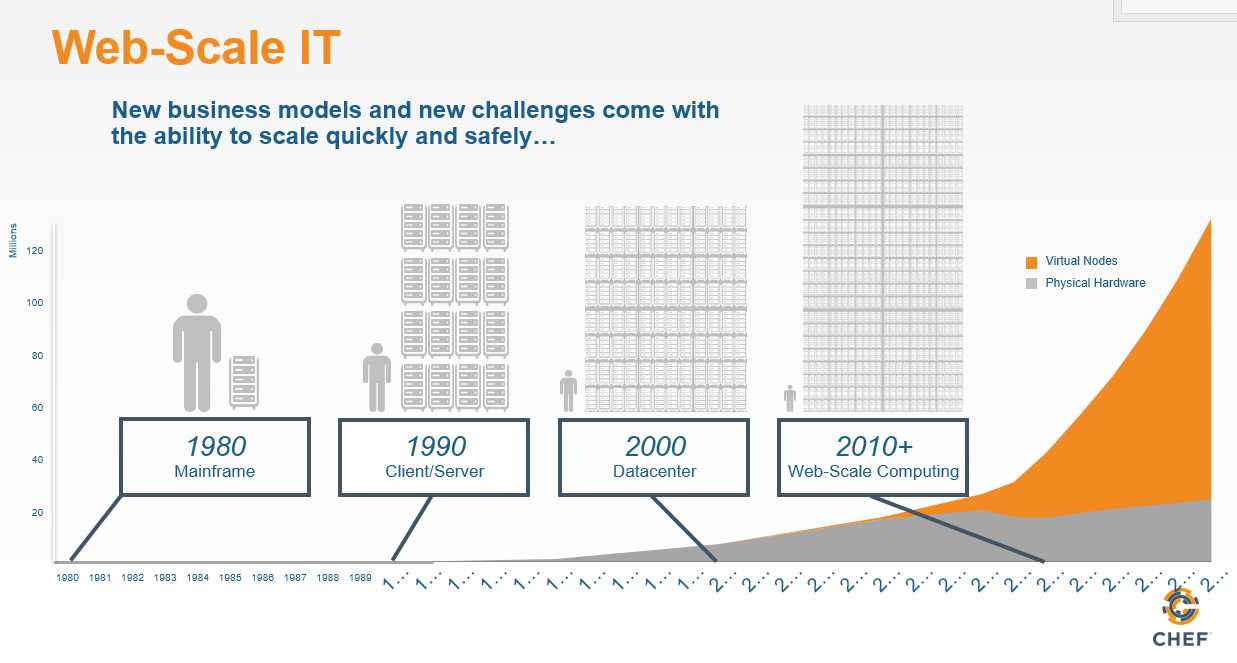
    Chef today announced a series of metrics and features showing their support of and success as a result of what they call the shift to Web-Scale IT. As the picture below shows the Web-scale IT era has given rise to an exponentially larger, more scalable IT infrastructure.

    webscale

    What is Web-sclae IT? According to Chef:

    Web-scale IT brings the practices of large, web innovators into every business

    • Web-oriented architecture
    • Cloud capable including hybrid
    • Commodity hardware
    • Open source software
    • DevOps practices

    But I don’t want to give the impression that Web-scale IT is a Chef invention. Actually it is Gartner that is providing a lot of the analysis on the key drivers here and forecasting its heightened importance in IT. From a recent press release from Gartner:

    By 2017, Web-scale IT will be an architectural approach found operating in 50 percent of global enterprises, up from less than 10 percent in 2013, according to Gartner, Inc. Web-scale IT is a pattern of global-class computing that delivers the capabilities of large cloud service providers within an enterprise IT setting by rethinking positions across several dimensions.

    Barry Crist, CEO of Chef said, “Today, every business is a software business. Customers everywhere expect delightful and immediate services. Meeting these expectations is only possible through the speed, scale, and consistency provided by employing web-scale IT. Chef’s IT automation platform packages the success patterns of web innovators and delivers them to the enterprise,”

    Here are some of the elements or patterns of Web-Scale IT:

    patterns of webscale


    Having been through so many IT adoption cycles (I remember the big move to client/server), I am always weary of any new “paradigm changing” scenarios. If they were all true I would have retired an Internet millionaire back in the first dotcom bubble. However, what Chef is calling out here is certainly supported by the facts. IT today because of the Cloud, Big Data, virtualization, mobility and more has fundamentally changed. Automation, agile and lean principles are enabling the leveraging of these technologies more every day.

    Companies like Chef are capitalizing on these trends by providing solutions that both leverage and enable Web-scale IT. It is hard to argue with the numbers from Chef:

    • 182% Incremental Revenue Growth YoY
    • 100% New Enterprise Customer Growth YoY
    • Over 700 paying customers
    • 70% of total Sales to F1000
    • 600,000 Chef downloads per month
    • 55,000 Registered Chef Community members
    • Millions of Managed Instances

    As part of the announcement around their momentum Chef also announced some new product features. From their press release:

    –        New Analytics Platform, Acquisition of Tower 3: Chef’s new analytics platform provides full visibility into all activity on the Chef server and lays the foundation for audit and compliance capabilities. Chef recently acquired big data and analytics startup Tower3, adding significant engineering resources and expertise to its ongoing analytics development efforts. Now available to Chef subscribers is the new Chef action log, which publishes notifications on who is changing what on the Chef server and allows administrators to track cookbook usage, roles, environments, and changes to infrastructure, all through an easy-to-use dashboard.

    –        Test-Driven Infrastructure: Test-driven infrastructure ensures maximum IT safety and consistency with programmatic and automated testing of the entire stack. Chef is the first company to offer its customers commercial support for test-driven infrastructure. Chef has also created a single installation package – Chef DK – for the open source tools covering the entire test and development workflow, from the workstation all the way to production. Rally Software is among a range of enterprise customers using Chef for a test-driven approach to infrastructure and applications (see separate release).

    –        End-to-End Container Workflow Automation: Chef is the first automation platform to deliver end-to-end management of container workflows. Chef Container is a build of the Chef Client that integrates with all Linux containers (LXC), including Docker, to enable seamless management of container resources. In conjunction with Chef Container, Chef is also releasing a Knife Plugin-in for Docker integration with Chef Container, enabling users to launch, configure and manage Docker containers. Together, Chef’s new suite of container tools and content fully automate the creation, management, monitoring and testing of containers, making them versionable, testable, and repeatable within a production workflow.

    If you are interested in learning more about Web-scale IT, Chef have also released a white paper: “Automation and Web-Scale IT”

    All very impressive from Chef. But I don’t want to convey the idea that Chef is the only success in Web-scale IT or DevOps. Other companies like Puppet Labs, Saltstack, StackDriver, Ansibile, etc. are all experiencing rapid growth by riding the Web-scale IT express. Behind them are a host (no pun intended) of new startups that are offering solutions in this area.  Maybe this time we really are seeing a paradigm shift.

    In the meantime congratulations to Chef on some phenomenal growth numbers. For those of you who have made it to the bottom here, how is Web-scale IT changing your life?

  • DevOps Days Tel Aviv Strikes Again

    DevOps Days Tel Aviv Strikes Again

    It’s no secret that the technology scene in Israel is at the forefront of innovation, and so it’s certainly no surprise that the DevOps community in Israel is simply booming.  And well, it’s that time of year again, and me and my awesome co-organizers have rolled up our sleeves and started working on DevOps Days Tel Aviv.

    This is my third DevOps event that I’m helping to organize in Israel, on top of our regular DevOps Israel meetup group that too has been growing and has had the pleasure of hosting some exceptional speakers (including the brilliant Kohsuke Kawaguchi at our next event).

    So it is with great excitement that we have opened the call for papers for the next DevOps Days, and have already started receiving really awesome submissions.

    The constant growth in interest and enthusiasm around these events has stunned even us.  With the awesome speakers that came out at our previous events – John Willis, Stephen Nelson-Smith, Ben Kepes, and the caliber of speakers who have already submitted for this event – Yossef Mendelssohn, Julia Ferraoili, Michael Ducy, and many more in the works.

    The event this year will be taking place September 28-29th, and we expect it to be even better than the last two.

    Registration is officially OPEN.  There are only a few early bird tickets available – so get ‘em quick.

    You are more than welcome to submit your proposals for talks, ignite talks, and workshops here.

    And as with all DevOps Days events – these are completely voluntary, and highly dependent on sponsorship – so if you’re interested, below you can find all the information you need, and you are more than welcome to reach out to the organizers of the event.


    Sponsorship Packages

    Included in Package Silver
    1000 USD
    Gold
    3000 USD
    Platinum
    4500 USD
    Two Available
    2 Tickets      
    Logo on event website      
    Logo on all email communication      
    Mention via Social Media      
    5 minute pitch to full audience (including streaming audience)      
    2 additional tickets (4 in total)      
    4 additional tickets (6 in total)      
    Shared table for swag      
    Booth/table space      
    Lunch or After Party Sponsorship (1 Each)      

    We’d love to see you at the event.  Reach out to us if you have any time @DevOpsDaysTLV

  • DevOps Rock Star dinner

    DevOps Rock Star dinner

    I have been so busy running from conference to conference lately. Next on the agenda is the Velocity conference in Santa Clara, Ca. While I am sure the conference is going to be great, I am super psyched about attending a dinner on the 24th that promises to be a blockbuster.  It is a “State of DevOps” event with an all-star cast including:

    Sounds like DevOps Rock Star panel doesn’t it?

    Part of the agenda is:

    • The Why andWhatofDevOps?
      • Who is DevOps for? Startup, Enterprise, Unicorn
      • Business drivers?
    • What will theimpactofDevOps be 10 years from now?
      • ROI and business value
      • How will DevOps cross the chasm?
      • What job functions go away? What methodologies / tools go away?
      • DevOps as a title?
      • Investment landscape?
    • How do we get there?

    Sound interesting? I am really looking forward to this one

    I will be following up with a report from the dinner later next week.

  • How	 Ansible makes automation easy

    How Ansible makes automation easy

    Continuing our series of videos from the recent Gluecon 2014 conference, here is our next one again courtesy of CloudSoft. In this video Peter Sankauskas talks about using Ansible to make automation easy especially with AWS.  Hope you enjoy it.

  • Log Data as a Valuable Tool in the DevOps Lifecycle (and Beyond)

    Log Data as a Valuable Tool in the DevOps Lifecycle (and Beyond)

    As many of us embrace DevOps, developers have to think beyond delivering code that is taken by “operations” to be deployed, run and monitored in production environments. DevOps instead focuses on breaking down silos within organizations and sharing the responsibility of development and operations such that developers are now more conscious of how their code will run in a production environment. They also play a critical role in the process of deploying, monitoring and operating the applications they write.

    Thus the responsibilities of developers can now span from development and testing, to deployment and monitoring, to gathering business metrics from production environments – i.e. they now follow a DevOps lifecycle rather than a development lifecycle. The focus of these responsibilities can change slightly depending on which stage an application is at in its maturity model. In this post, we first outline three high-level stages of an application’s maturity and then look at how logs can serve as a valuable tool at each of the different stages and in particular for teams following a DevOps methodology.

    The Stages of Application Maturity:

    1. Stage 1 – Initial system development and prototyping: When organizations embark on new projects, they usually have a small team iteratively develop an initial prototype before throwing the weight of a large development team behind it..This prototype is used to test any hypothesis and initial functionality; it limits risk and allows for an iterative feedback loop from early users. More and more often, prototypes are being quickly developed on cloud infrastructures where the initial development team plays the role of developing the system, selecting and managing the infrastructure, deploying the application, as well as putting in place initial monitoring for the running system. Only after an initial user group has used the system, provided feedback and helped prove a hypothesis will the system will move into a “go-live” state in the real world.
    1. Stage 2 – System going live: When an application moves from being a prototype to “going live,” an organization has made the decision that the project is worth pursuing and there is potential value in extending the system to a wider audience. This can involve investing in a larger development team, a larger infrastructure to handle real-user load, as well as marketing budgets to get the word out on this new offering. At this stage, focus can shift from initial concepts to building out more advanced and robust capabilities – ensuring service uptime, performance and reliability.
    2. Stage 3 – System generating value: If a system moves into a stage of creating value for the business, a number of new stakeholders can arrive on the scene with new requirements. Typically product managers and marketing teams will have requirements on how a new application’s features are being used, how an application’s marketing campaigns are tracking and how cohorts of users are flowing through the sales funnel. These new stakeholders are largely concerned with different business metrics and how they can be obtained from the running system.

    So where and why log data?

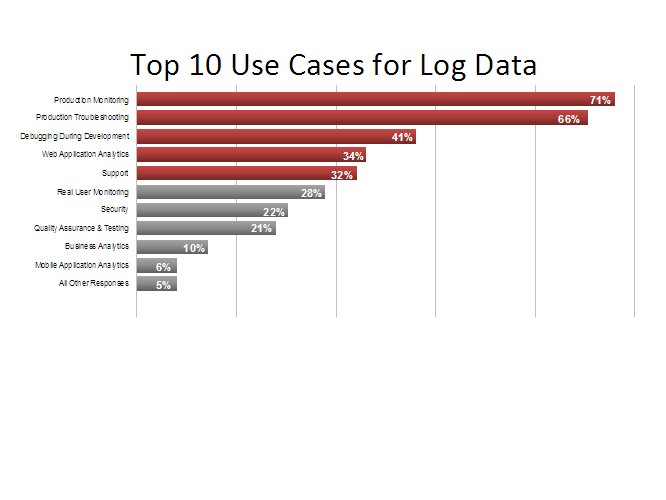
    While log data has traditionally been used by developers for debugging purposes (i.e. investigating exceptions stack traces), more recently log data is being applied for a much wider set of use cases.  A recent survey carried out across a sample of 25,000 log management users shows a breakdown of the following use cases:
    logos

    Results from a recent survey from a sample set across 25k users who were asked: “What are the top use cases for your logs?”

    As applications move across the different stages of maturity above, logs act as a valuable tool to assist with the insights required by the different stages of the DevOps lifecycle – e.g., during development activities, testing, production monitoring, and web and business analytics. In fact, logs provide a single data stream that can act as a common language across these different tasks.

    Because of this shift, it is important to look at how logs can be applied to assist with DevOps-related responsibilities during the different stages of application maturity:

    How logs are applied during application maturity stage 1

    The ability to apply agile development and testing are key during this phase such that early prototypes are iterated upon and hypothesis proved out:

    Logs as a debugging tool: Logs have always been a valuable debugging tool and continue to be so. They can capture events at different severity levels from every layer of the software stack (operating systems, web servers, databases, your software) and from across all devices (mobile devices, servers, routers, firewalls). During development, verbose logging can be enabled to give incredibly detailed information on the system as it executes. Today’s log management technologies are particularly useful as they allow you to utilize the benefits of verbose logging to easily cut through the noise and identify key events when exceptions occur. They also all allow for fast searching of key events in an extremely large volume of log data.

    Logs for system load and performance testing: Before a system goes live, system load and performance testing is often performed to give a level of confidence that real-world loads can be handled by the application. Load testing tools will often measure system response times to make sure that the system is performing well even under heavy loads. However, log data should also be analyzed during such tests to make sure high levels of exceptions are not being thrown and that the system is behaving “under the hood” as expected.

    How logs are applied during application maturity stage 2

    Production monitoring and troubleshooting can be a key focus during this stage of a system’s maturity given that any downtime can be particularly costly from a monetary and reputational perspective once a system goes live.

    Log for production monitoring: Production monitoring is fast becoming a leading use case for log data. Real-time processing capabilities of log management solutions now mean that log events can be parsed in real time, and important metrics can be extracted and visualized in high-level monitoring dashboards. Furthermore, real-time alerting can be applied to give notifications when important system events occur or particular thresholds are breached.

    Logs for production troubleshooting: Logs no longer simply contain exceptions and stack traces but are instead a blend of information from a range of different sources that can be correlated to allow for quick troubleshooting. This is especially important when there are issues in production. For example, logs will regularly now contain: server resource usage information, application performance metrics, feature usage information, exceptions and errors. This blend of information, which was traditionally only available by utilizing a number of other tools, is now available in a single location via a standard log management solution.

    How logs are applied during application maturity stage 3

    When an application begins to create value, product and marketing stakeholders will want to focus on usage and business metrics. While this information may go beyond the typical DevOps lifecycle, it is becoming more and more common for developers following a DevOps methodology to be tasked with gathering such information.

    Logs for web analytics: Analyzing website trends is not something typically associated with someone in a DevOps role and is usually the mainstay of marketing folks. However, developers are often engaged to collect this data for different parts of the organization. Logs provide a lightweight way to understand who is accessing an application, how often and from where. For starters, a lot of this information is already contained in web server logs without any additional instrumentation required. Furthermore, logs can give not only an aggregate view of web trends, but also allow the drill down to a per-user view to analyze behaviors at an individual user or account level.

    Logs for business metrics: Today’s log management technologies allow you to extract field-level values and can aggregate them and roll them up into high-level metrics dashboards. Thus,,logs can be used to not only understand a systems performance and usage trends, but also to aggregate business metrics such as signups per day, number of transactions, the value of those transactions, etc. However, the real benefit of using logs for metrics dashboards, in my opinion, is that they maintain the evidence. In other words, they allow you to easily validate any trends or changes in your system or business’ behavior. This has traditionally been a painful task, as it often involves engineering cycles/checking database tables, etc. Now, logs allow you to immediately drill down from a high-level view to the log-level to quickly view and understand the individual events that may have led to a spike in a key performance indicator.

    After spending many years talking to thousands of log management users, I am continuing to see logs become more and more critical to the different stages of an application’s maturity. The DevOps movement has greatly assisted with this because the same team or individual responsible for initial prototype development may also be responsible for production monitoring or gathering business metrics for that matter.  The value of logs is now being recognized early in the DevOps lifecycle, and the power of log data is quickly expanding across a range of different functions.

    This article is by Trevor Parsons, PhD, Co-founder and Chief Scientist, Logentries

  • Sold out Dockercon highlights Dockers coming of age

    Sold out Dockercon highlights Dockers coming of age

    Docker grows up with release of version 1.0

    There is little doubt that Docker is one of the hottest names in tech.  Anything written about them seems to be a magnet for readers. When Solomon Hykes, CTO and co-founder keynoted the recent Gluecon 2014 conference it was standing room only. It’s pretty much the same story at this week’s initial Dockercon conference in San Francisco.

    I spoke with Scott Johnston, SVP of product at Docker last week in anticipation of this week’s conference. Due to a prior commitment I couldn’t make it out for the conference. It seems I am the only one not there. Scott told me the only thing holding them back from letting more people in is the fire marshal. They have a waiting list of something like 300, while others are scalping passes to the show!

    The big news from the show is the official release of version 1.0 of Docker. Of course the previous release .11 was a preview release of 1.0. It is not that version 1.0 has any new important features that no one has seen before. It is more a case that Docker is now official. In an era where Google kept products in beta forever it seemed, Docker is out there.

    Speaking of Google, one of the presentations at Dockercon today is about how Google is now supporting and using Docker in Google Cloud. Red Hat is also a big proponent/partner of Docker and the fact that IBM is a platinum sponsor should give you a hint as to what Big Blue thinks of Docker.

    In fact in both my conversations with Johnston and with Scott Rich, IBM Distinguished Engineer, DevOps at IBM Innovate last week, they mentioned some interesting IBM/Docker work. I think we may have to wait a bit longer to get more facts on that.

    Besides the 1.0 release, Docker has a few other important announcements this week dealing with some of the new services and products that Docker is rolling out around the open source version. The best way to explain these to you is to frame it the way Scott Johnston did for me.

    The open source Docker project is now called Docker engine. That is the platform. On top of this Docker and others will roll out services and products. They can be rolled out via the Docker Hub. Think of Docker Hub as the beginning of a Docker app store or marketplace. I think that you will see both Docker and 3rd parties with offerings in the Docker Hub very soon.

    From the Docker Hub announcement major features include:

    • An integrated Console  for managing users, teams, containers, repositories, and workflows;
    • The Docker Hub Registry, offering more than 14,000 “Dockerized” applications, available to all users as building blocks for their own applications;
    • Collaboration tools, enabling  users to manage and share their applications through both public and private repositories, and to invite collaborators to participate in any stage of the application development lifecycle;
    • The Automated Build Service, which keeps applications up-to-date by automatically rebuilding and updating an application’s public or private repository whenever the source code is updated on GitHub or Atlassian Bitbucket. Over 25% of the more than 14,000 Dockerized applications in the Docker Hub Registry are now created using Automated Builds, providing both automation and end-user assurance of container origin;
    • The Webhooks service, which enables users to automate repetitive workflows for build pipelines or continuous deployment, Interoperable with any RESTful API,  webhooks enables organizations to take advantage of the web APIs published by any service or software package, like GitHub, AWS, or Jenkins; and
    • The Docker Hub API, which includes a user authentication service, so that third party applications and services can gain authenticated access to applications in a user’s public and private repositories. Third-party services that have already integrated with the Docker Hub API include AWS Elastic BeanStalk, Deis, Drone.io, Google Compute Engine, Orchard, Rackspace, Red Hat, Tutum, and many others.

    In addition to Docker Hub, Docker also announced enterprise support services in conjunction with the release of the 1.0 version. This will allow large enterprises to rest easy knowing they can get expert help and support with SLAs wrapped around using Docker.

    Not that lack of support is slowing down the hype around Docker. Another subject Scott and I spoke about is how Docker can possibly live up to the hype surrounding it?  All too often we have seen companies and technologies crushed under the over-hyped expectations which make it impossible to live up to. Scott and the whole Docker team are keenly aware of this. They are really trying to under promise and over deliver. They are intentionally not fanning the fire with much speculation.

    Every technology goes through the Gartner hype cycle I guess. Overblown expectations lead to the trough of disillusionment. But for leadership at Docker including Scott this is not their first rodeo. They are doing everything they can to balance the hype and promise with the reality of a project/product that is still taking baby steps.

    The Docker team is also hard at work on the next round of Docker Hub offerings, as well as improvements to the Docker engine itself.  Scott assures me the team is committed to open source and the Docker engine will remain open source. The project itself is getting more support and code contribution than ever, so it remains vibrant.

    If you are lucky enough to be a ticket holder to Dockercon, hold on to your stub. It may be worth something someday. You could say you were there at the very first one. In the meantime the Docker team is hard at work making sure that they fulfill the promise that this 1.0 release holds. Congrats and good luck to Ben, Scott, James Turnbull, Julien Barber and the rest of team over at Docker.

  • SecDevOps: the new black of IT

    SecDevOps: the new black of IT

    Much has been written about the role of Security in a DevOps culture. Almost universally the thought is that DevOps can help improve security.

    Why?

    How?

    Really?

    An old friend of mine from the security world Andrew Storms and I will discuss this and other issues around DevOps and security on June 11th at 1pm eastern time, 10am pacific time on a webinar entitled “SecDevOps: the new black of IT“.

    Andrew is the Sr. Director of DevOps at CloudPassage. Prior to that Andrew headed up the security research team at nCircle. He is oft cited in the security press and highly respected.  Andrew and I ill discuss how just when DevOps is catching on, adding to security to the mix can make it even more powerful. How can security help DevOps to succeed? How can DevOps help us with better security?

    We will discuss what this means in terms of different kinds of security tools and services, the cloud and more.

    If you are interested in security and DevOps register now and  tune in to the webinar next Tuesday

  • Using Docker & Ansible by John Minnihan @Gluecon 2014

    Using Docker & Ansible by John Minnihan @Gluecon 2014

    Continuing our series of videos from the DevOps track at Gluecon this past year, our next video is “Why Docker + Ansible Make Chef and Puppet 100% Unnecessary by John Minnihan, ModernRepo”  Again many thanks to CloudSoft for recording and making these videos available to us to post. Also the picture above is from the Ansible website originally.

    This presentation sounds pretty controversial if you just look at the title. Actually John is not advocating throwing away your Puppet or Chef scripts.  If you already have Chef or Puppet set up and you like the way it is working, there is no reason to change.  However, John believes that Docker with Ansible can negate the need to use either of these tools going forward. John is primarily talking about a greenfield situation here I believe.  Anyway, the video like the previous ones in this series are about 30 minutes. Enjoy!